Kit Close-Up: Checking Out the ASUS AI SuperBuild
What you’ll learn:
- How to use the ASUS NUC 16 Pro for local AI operation.
- How does the NUC fare with AI chores?
I looked at the ASUS NUC 16 Pro earlier. It’s a very nice mini-PC with AI acceleration. To test that out, I loaded up ASUS’s AI SuperBuild software from Intel. It targets users and developers who want to experiment with agentic AI and local AI models with minimal hassle.
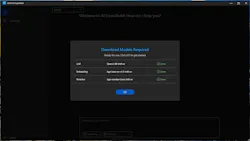
It provides an easy way to download free large language models (LLMs) like Qwen3, which are known to run on the platform (Fig. 1). It provides a chat interface that uses the models but runs everything locally, taking advantage of the NUC 16 Pro’s Intel Core Ultra X9 series 3 processor.
The processor is a 16-core CPU with four performance cores, eight efficient cores, and four low-power cores, along with an Arc B390 GPU and Intel’s neural processing unit (NPU). The GPU delivers 122 INT8 TOPS while the NPU offers 50 INT8 TOPS. The latter is more efficient and can run in the background.
The AI SuperBuild software is designed to handle agentic AI locally via the Model Context Protocol (MCP) agent interface (Fig. 2). These are essentially device drivers that LLMs can use to access other data and services.
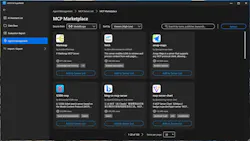
Certain MCPs can manipulate local data and never go to the cloud. Other utilize cloud data and potentially cloud processing. The AI SuperBuild software helps configure the system to take advantage of the agents in the MCP marketplace.
Other Alternative AI Platforms for Non-Programmers
The SuperBuild is primarily for those looking to test out AI at a lower level. Systems like OpenClaw are designed for non-programmers and may be more useful to many. If you’re looking for minimal runtime and targeting even smaller platforms, then ZeroClaw might be of interest. OpenClaw also has an MCP marketplace focused on agentic AI tasks.
Most of the other free or open-source alternatives have gone the way of subscriptions. There are the major platforms like Claude, Perplexity, and ChatGPT, but getting these set up for local operation can be a bit more challenging.
A Word of Caution
Running AI LLMs and agents locally has many advantages, including keeping data and processing local. The challenge also revolves around running things locally. While the Core Ultra X9 is a powerful chip, it doesn’t compare in performance to what’s in the cloud, with multiple GPGPUs and AI accelerators capable of handling extremely large LLMs. Nonetheless, many applications will work locally. The AI SuperBuild software provides a way to test what might be doable.
The other area of caution is security and accessibility. Running software locally means that local data may be made available to the models, and this information may be used with MCPs. If those run on the cloud, then you need to be careful of what’s made available and how it will be used.
In general, I was able to get applications and agents to run locally to do search and other chores. Not having to go to, or depend on, the cloud meant that these actions would work if the internet was down or if I wanted an isolated system.
About the Author
 William G. Wong
Senior Content Director - Electronic Design and Microwaves & RF
I am Editor of Electronic Design focusing on embedded, software, and systems. As Senior Content Director, I also manage Microwaves & RF and I work with a great team of editors to provide engineers, programmers, developers and technical managers with interesting and useful articles and videos on a regular basis. Check out our free newsletters to see the latest content.
You can send press releases for new products for possible coverage on the website. I am also interested in receiving contributed articles for publishing on our website. Use our template and send to me along with a signed release form.
Check out my blog, AltEmbedded on Electronic Design, as well as his latest articles on this site that are listed below.
You can visit my social media via these links:
- AltEmbedded on Electronic Design
- Bill Wong on Facebook
- @AltEmbedded on Twitter
- Bill Wong on LinkedIn
I earned a Bachelor of Electrical Engineering at the Georgia Institute of Technology and a Masters in Computer Science from Rutgers University. I still do a bit of programming using everything from C and C++ to Rust and Ada/SPARK. I do a bit of PHP programming for Drupal websites. I have posted a few Drupal modules.
I still get a hand on software and electronic hardware. Some of this can be found on our Kit Close-Up video series. You can also see me on many of our TechXchange Talk videos. I am interested in a range of projects from robotics to artificial intelligence.