GaN Power ICs Move Multi-Axis Motor Drives
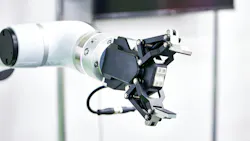
A new family of 100-V integrated GaN power-stage IC from Efficient Power Conversion (EPC) are designed to power high-performance, multi-axis motor drives in humanoid robots, drones, and industrial motor drives.
Intended for high-performance motion-control as well as synchronous rectification and high-density DC-DC converters, the monolithic ePower Stage ICs — including the EPC23108, EPC23109, EPC23110, and EPC23111 — integrate high-side and low-side GaN FETs, gate drivers, and level-shifting circuitry into a compact, thermally enhanced QFN package. When it comes to its power capabilities, the devices support up to 100-V operation with current ratings of 35 A and 20 A.
The new family features advanced protection such as fast fault shutdown, safe gate control under power-loss conditions, and continuous duty-cycle operation at 100%. There are also single-input PWM options for simpler multi-axis motor control designs. To assist engineers, EPC also released a technical deep dive on the new family, titled “From Device to Platform: EPC23108/109/110/11 100 V Integrated GaN Power Stages Simplify Multi-Axis Motor Drive Design."
To accelerate system development and evaluation, EPC also offers the EPC91128, EPC91129, EPC91130, and EPC91131 three-phase BLDC motor-drive evaluation boards. These compact, GaN-based inverter platforms integrate gate drivers, current and voltage sensing, housekeeping power supplies, temperature monitoring, and protection features.
The EPC23108 and EPC23109 are priced at $3.70 each, while the EPC23110 and EPC23111 devices are priced at $2.47 each, both in orders of 3,000 units.
About the Author
 Lee Goldberg
Contributing Editor
Lee is the author of the popular PowerBites series.
Lee Goldberg is a self-identified “Recovering Engineer,” Maker/Hacker, Green-Tech Maven, Aviator, Gadfly, and Geek Dad. He spent the first 18 years of his career helping design microprocessors, embedded systems, renewable energy applications, and the occasional interplanetary spacecraft. After trading his ‘scope and soldering iron for a keyboard and a second career as a tech journalist, he’s spent the next two decades at several print and online engineering publications.
Lee’s current focus is power electronics, especially the technologies involved with energy efficiency, energy management, and renewable energy. This dovetails with his coverage of sustainable technologies and various environmental and social issues within the engineering community that he began in 1996. Lee also covers 3D printers, open-source hardware, and other Maker/Hacker technologies.
Lee holds a BSEE in Electrical Engineering from Thomas Edison College, and participated in a colloquium on technology, society, and the environment at Goddard College’s Institute for Social Ecology. His book, “Green Electronics/Green Bottom Line - A Commonsense Guide To Environmentally Responsible Engineering and Management,” was published by Newnes Press.
Lee, his wife Catherine, and his daughter Anwyn currently reside in the outskirts of Princeton N.J., where they masquerade as a typical suburban family.