Transform Real-World Signals into Real-Time Intelligence
Members can download this article in PDF format.
Edge AI is redefining embedded systems. By converting real-world signals into real-time intelligence with high accuracy, low latency, and consistent reliability across a wide range of operating conditions, AI processing is shifting from the cloud directly onto local physical devices.
Sponsored Resources:
- Simplify development with TinyEngine™ NPU
- Real-Time AI Raw Sensor Fusion with mmWave Radar
- Watch Edge AI Camera and Robot Demos
Edge AI supports:
- Fast decisions: Integrated neural processing units (NPUs) process data locally in milliseconds without cloud lag. Response time is trimmed by 10X to 90X.
- Fault detection: Systems spot mechanical or load imbalances with high accuracy.
- Reduced energy use compared to standard CPUs.
- Local sensing: Wearables and smart cameras can filter noise and identify objects directly on the device.
The singular question, then, is whether Texas Instruments can provide the foundation to make edge AI possible. To answer that question, TI offers a portfolio of AI-enabled microcontrollers (MCUs), processors, wireless connectivity, and radar sensors backed by comprehensive software and tools. They leverage edge AI to deliver the response times, power consumption, performance, memory footprint, and cost needed to transform data into real-time decisions
Sensor Fusion with mmWave Radar
Let’s look at one example: TI millimeter-wave (mmWave) radar, which brings unique advantages to sensor-fusion systems that are difficult to achieve with other sensing technologies (see figure). For starters, the ability to directly measure range and velocity enables precise motion understanding that enhances tracking and prediction.
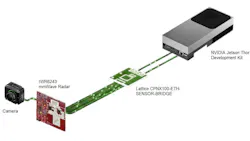
The robustness of mmWave sensing further allows perception systems to operate reliably in environments where optical sensors degrade, including low light, glare, fog, and dust. The ability to directly measure range and velocity makes possible precise motion understanding that improves tracking and prediction.
The IWR6243 mmWave radar sensor delivers much higher fidelity than a radar-only or vision-only approach. This is particularly valuable in scenarios involving fast-moving objects, partial occlusion, or visually degraded conditions where camera-only perception can fail.
Simplify Development with the TinyEngine NPU
TI MCUs with an integrated TinyEngine NPU enable edge AI in more electronics, from resource-constrained devices such as portable, battery-powered products to complex industrial applications. The TinyEngine NPU is a proprietary hardware neural processing accelerator integrated by TI into select C2000 and Arm Cortex-based MCUs to run edge AI efficiently.
The NPU executes machine-learning algorithms in parallel to the primary CPU, allowing for real-time processing of neural-network models. It unlocks edge AI acceleration in more embedded systems operations to reduce latency and power consumption when processing at the edge, eliminating the round-trip latency of cloud-based inferencing for increased system responsiveness.
The device helps expand edge AI capabilities into devices that were previously unable to support meaningful AI workloads. This includes battery-powered electronics, medical wearables with real-time insights, personal electronics, and industrial equipment.
The TinyEngine NPU addresses key design constraints that have traditionally prevented widespread adoption of embedded AI by delivering: 120 times less energy per inference and 90 times lower latency compared to software-based AI.
Edge AI Camera and Robot Demos
Whether building intelligent sensors, predictive-maintenance systems, or autonomous vehicles, TI solves the constraints that matter: response times, power consumption, performance, development complexity, memory footprint, and cost to transform data into real-time decisions. TI Edge AI and robotics software demos, created with AM6xA processors, show how to add embedded intelligence to your designs.
The demo application shows radar-camera fusion by combining pointcloud with imagery to determine the distance to detected objects. This demo has various applications in safety at the factory floor and close proximity collaboration between robots and human.
Streamlining Development
Embedded-system designers can get started faster on AI-enabled designs with access to TI’s free CCStudio Edge AI Studio with 60+ code examples. Edge AI studio is a suite of tools designed to streamline the development of edge AI applications on TI's embedded devices. Edge AI Studio is part of the CCStudio development tool ecosystem.
The ecosystem is a unified suite of free, high-quality development tools with integrated generative AI to accelerate your embedded development. Using simple language and industry-standard agents and models fed with TI's expansive resource library, you can develop applications faster — regardless of expertise level — while maintaining reliability and performance standards.
It supports both AI-accelerated devices such as processors featuring a C7 NPU or microcontrollers featuring a TinyEngine, as well as AI-supported devices without a dedicated accelerator.
Conclusion
Whether building intelligent sensors, predictive-maintenance systems, or autonomous vehicles, current technology, e.g., vision sensors alone, often degrades in performance when exposed to fog, glare, dust, rain, or low-light environments. What’s more, single-modality (processing data from one specific input channel) depth sensors frequently struggle to deliver stable measurements in cluttered or dynamic scenes.
All of these incremental updates signify a page turned in the book of AI advancement. Engineers can deploy edge AI across applications with TI’s portfolio of AI-enabled MCUs, processors, wireless connectivity, and radar sensors backed by comprehensive software.