Processes Combine to Deliver 16-Channel Beamforming Ultrasound Pulser IC
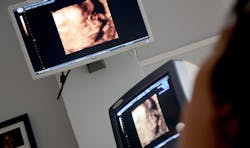
Ultrasound testing is a non-invasive, safe, and deep-peering industrial and medical application that’s gaining additional traction. This is largely due to the self-reinforcing circle of increased user interest leading to improved components, which in turn leads to even-larger market opportunities—a cycle that repeats to mutual benefit. The latest entry is the STHV1600 from STMicroelectronics, which uses its existing BCD8s-SOI technology to support bipolar analog, CMOS digital, and DMOS power functions on a single die (Fig. 1).
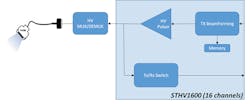
1. The STMicroelectronics STHV1600 16-channel ultrasound-pulser IC supports high-voltage, high-current operation, along with high-speed, user-programmable beamforming.
The IC supports up to 16 channels of high-speed ultrasound pulsing with an integrated transmit beamformer—critical for useful imaging—and pulser output range for the piezoelectric transducers up to ±100 V and ±2/4 A; operating frequency is up to 30 MHz. In continuous-wave (CW) mode of operation, commonly used for inspection and medical tests, power consumption is just 150 mW/channel, while rms jitter is 270 fs (100 Hz to 20 kHz) and phase noise measures −147 dBc/Hz at 1 kHz. The integrated transmit/receive (T/R) switch has 9-Ω on-resistance and 28-pF parasitic capacitance.
In transmitting mode, the beamforming functions offer user-programmable single-channel delay for beamsteering and beam focusing, at a clock frequency up to 200 MHz and with per-channel delay of 0 to 327 µs with 5 ns of minimum resolution. The integral, programmable power-management functions optimize the performance when the circuitry is housed in a probe. The IC includes thermal protection for the logic and for each channel, undervoltage protection, and self-biased high-voltage MOSFET gate drivers with internal checks. On the digital side, the IC includes 65 kb of embedded memory for program-code excitation, which allows users to implement high-voltage stages and store the patterns in memory
In addition to the IC itself, ST offers the STEVAL-IME014V1B evaluation kit for evaluating the IC’s characteristics and functionality (Fig. 2), with evaluation and graphical user interface (GUI) software. The kit includes four preset programs to test the pulser in typical conditions, while output waveforms can be displayed on an oscilloscope by connecting the scope probe to the corresponding connectors. The typical load (100 Ω/300 pF), which is connected on high-voltage outputs (100 Ω/300 pF), can be easily removed if desired.
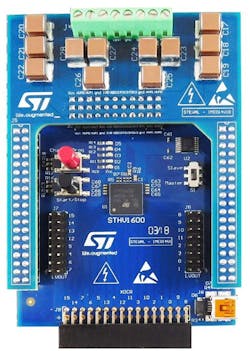
2. The STEVAL-IME014V1B evaluation kit for the ST Microelectronics STHV1600 simplifies setup, test, and evaluation. In addition, there’s software that supports pattern-creation functions; a matched power supply is available, too.
The USB-connected GUI assists in quickly changing waveforms and configurations. The kit includes a button interface to control waveform generation, along with status LEDs. An accompanying power-supply module (STEVAL-IME014V1D) provides four high-voltage rails and one low-voltage supply rail, while all other necessary low-voltage supplies are generated on-board.
The STHV1600 operates from 1.55 to 3.5 V for its LVDS/CMOS digital I/O, and up to ±100 V at 4 A at maximum saturation current. Available now, the device comes in a 144-lead BGA measuring just 10 × 10 × 1.0 mm.

About the Author

Bill Schweber
Contributing Editor
Bill Schweber is an electronics engineer who has written three textbooks on electronic communications systems, as well as hundreds of technical articles, opinion columns, and product features. In past roles, he worked as a technical website manager for multiple topic-specific sites for EE Times, as well as both the Executive Editor and Analog Editor at EDN.
At Analog Devices Inc., Bill was in marketing communications (public relations). As a result, he has been on both sides of the technical PR function, presenting company products, stories, and messages to the media and also as the recipient of these.
Prior to the MarCom role at Analog, Bill was associate editor of their respected technical journal and worked in their product marketing and applications engineering groups. Before those roles, he was at Instron Corp., doing hands-on analog- and power-circuit design and systems integration for materials-testing machine controls.
Bill has an MSEE (Univ. of Mass) and BSEE (Columbia Univ.), is a Registered Professional Engineer, and holds an Advanced Class amateur radio license. He has also planned, written, and presented online courses on a variety of engineering topics, including MOSFET basics, ADC selection, and driving LEDs.
