Incoherent NoC Enables Quantum Computing
What you’ll learn:
- Why quantum computers need monitoring to work.
- Why network-on-chip (NoC) chiplet architecture?
- How diamond-based quantum computers eliminate the need for cryogenic qubits.

Artificial intelligence (AI) continues to garner the world’s attention when it’s not distracted by wars, attacks by government agencies or how we can fill up with more expensive gas instead of using electric vehicles. But don’t be fooled, quantum computers are where technology is moving.
While AI is going to help, advances in chiplet architecture will ultimately allow AI to monitor and stabilize quantum computers that can operate faster and more efficiently than conventional computers.
Diamond Quantum Computing
IBM’s Q System One is a 20-qubit transmon quantum processor (Fig. 1). The cooled superconducting system works; however, like many of its peers, it’s large and requires a significant infrastructure. That’s less of an issue in a data center, but a bit impractical to deliver quantum computing to the masses.
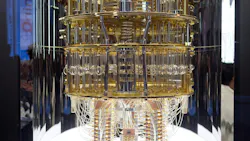
Breakthroughs like diamond-based qubits significantly reduce the size and supporting infrastructure. Engineers at QuTech have demonstrated diamond-based quantum gates with error probabilities below 0.1%. The issue of error probabilities is significant.
Stabilizing Quantum Computers
“Quantum error correction (QEC) is used to protect quantum information from errors caused by decoherence and other sources of quantum noise.” Quantum computer qubits can change from stable to unstable states quickly, which isn’t desirable. Before diamond qubits, keeping things cool was critical. Universities like MIT have been working on this problem for a while.
QEC support can benefit from AI acceleration. For instance, the Acme Post Quantum Computer Company (NYSB:APQCC) is developing a chiplet-based QEC system to support diamond-based quantum computers that could lead to smartphones and other mobile devices with a quantum computer inside (Fig. 2).

QEC and Incoherent NoCs
Coherent network-on-chips (NoCs) are just one way to connect devices on a die, as is die-to-die communication between chiplets. A coherent NoC allows multiple compute engines, including CPUs, GPUs, and NPUs, to share memory on a massive scale.
Incoherent NoCs (INoCs) complement QEC’s addressing instability by providing unstable communication, making QEC better at handling unstable qubits. An array of chiplets can handle QEC for an array of diamond qubits, which can also be implemented as a chiplet, allowing for conventional 3D packaging. INoCs make compact quantum computing practical.
On April 1st, APQCC announced its first incoherent NoC-based chiplet solution to support is a 4,096-qubit chip. It’s still a bit pricey for a smartphone but, given the interest and demand, the technology is likely to shrink — much like the AI chips from NVIDIA found in the increasingly massive data centers that have been scaled down to fit in smartphones.
It may take some time before diamond-based qubit quantum computers with APQCC’s incoherent NoC technology makes it into your pocket, but it’s definitely a technology worth a little jocularity.
More April 1st Humor
If you liked this article then check out the rest of our April 1st offerings from this and past years. We hope you enjoy them.
 Wizard April 1st
About the Author
 William G. Wong
William G. Wong
Senior Content Director - Electronic Design and Microwaves & RF
I am Editor of Electronic Design focusing on embedded, software, and systems. As Senior Content Director, I also manage Microwaves & RF and I work with a great team of editors to provide engineers, programmers, developers and technical managers with interesting and useful articles and videos on a regular basis. Check out our free newsletters to see the latest content.
You can send press releases for new products for possible coverage on the website. I am also interested in receiving contributed articles for publishing on our website. Use our template and send to me along with a signed release form.
Check out my blog, AltEmbedded on Electronic Design, as well as his latest articles on this site that are listed below.
You can visit my social media via these links:
- AltEmbedded on Electronic Design
- Bill Wong on Facebook
- @AltEmbedded on Twitter
- Bill Wong on LinkedIn
I earned a Bachelor of Electrical Engineering at the Georgia Institute of Technology and a Masters in Computer Science from Rutgers University. I still do a bit of programming using everything from C and C++ to Rust and Ada/SPARK. I do a bit of PHP programming for Drupal websites. I have posted a few Drupal modules.
I still get a hand on software and electronic hardware. Some of this can be found on our Kit Close-Up video series. You can also see me on many of our TechXchange Talk videos. I am interested in a range of projects from robotics to artificial intelligence.
Comment About the Article
To join the conversation, and become an exclusive member of Electronic Design, create an account today!
 Leaders Logo
Leaders relevant to this article: