EVs, HEVs to Offer Passenger-Powered Battery-Charging Subsystem
What you'll learn:
- The inspiration for the pedal-power concept.
- Why EVs and HEVs are a natural fit for the idea.
- How a standard foot-powered exerciser serves as a local generator.
- The benefits to the vehicle’s range and health of the occupants.
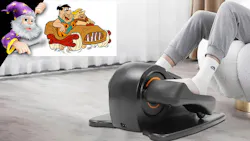
Some of you may remember the classic TV show The Flintstones, which ran from 1960 to 1966 and is still shown in reruns on “classic comedy/cartoon” channels and YouTube. Among its very clever features was the family car variously known as the Flintmobile, cavemobile, or footmobile (Fig. 1). This stone-and-wood vehicle, featuring a canopy roof and no floor, was propelled by the characters' feet, and appeared throughout the duration of the classic Hanna-Barbera animated series.
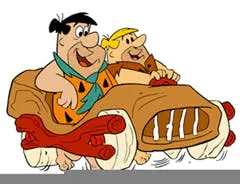
While such a vehicle is neither practical nor desirable in our modern age, there’s one aspect of it that inspired a startup car company. They realized that the powertrain’s batteries in the electric vehicle (EV) or hybrid EV (HEV) were a good fit for recharging—while in motion and on the road—by the passengers.
An Elliptical Alternative
Instead of having the feet of the occupants propel the car via direct contact with the roadway, they installed modified elliptical foot exercise machines at each seat of the car (Fig. 2).
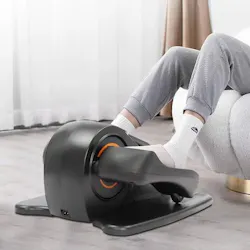
They then linked the 24-V DC electrical output of the elliptical unit to the car’s battery-recharge subsystem bus. In this way, the pedaling can recharge the internal batteries, thus extending driving range (or even getting the car to a recharging station if the batteries are low).
The basic design will have one pedal-power generator installed in the passenger seat. Units for the back-seat occupants will be optional. Looking ahead to autonomous vehicles, there will even be a model option that allows someone sitting in the vacant driver’s position to also provide power. When not in use or needed, each elliptical machine is easily unplugged via a connector in the front and can be stored in the vehicle’s trunk.
Dual Benefits: Power Generation and Exercise
How much power can such a system generate? There are many factors, of course, but a good estimate is that a typical adult in reasonable condition can continuously develop about 75 to 100 W, corresponding to about 3 to 4 A at 24 V. After generator, power-transmission, and power-conversion losses, the net power should be 50% to 75% of the source power, or about 35 to 50 W.
Not only does this system increase range, but occupants get valuable exercise and avoid leg fatigue and cramps — and they can “work off “their road snacks. A spokesperson for the as-yet unnamed company said they hope to have a prototype on the road by early 2027.
They’re in stealth startup mode while they work out a “rights” agreement with Hanna-Barbera to license some images and naming. In addition, regulatory issues and certifications need to be worked on to make the vehicle roadworthy.
More April 1st Humor
If you liked this article then check out the rest of our April 1st offerings from this and past years. We hope you enjoy them.
 Wizard April 1st
About the Author
 Bill Schweber
Bill Schweber
Contributing Editor
Bill Schweber is an electronics engineer who has written three textbooks on electronic communications systems, as well as hundreds of technical articles, opinion columns, and product features. In past roles, he worked as a technical website manager for multiple topic-specific sites for EE Times, as well as both the Executive Editor and Analog Editor at EDN.
At Analog Devices Inc., Bill was in marketing communications (public relations). As a result, he has been on both sides of the technical PR function, presenting company products, stories, and messages to the media and also as the recipient of these.
Prior to the MarCom role at Analog, Bill was associate editor of their respected technical journal and worked in their product marketing and applications engineering groups. Before those roles, he was at Instron Corp., doing hands-on analog- and power-circuit design and systems integration for materials-testing machine controls.
Bill has an MSEE (Univ. of Mass) and BSEE (Columbia Univ.), is a Registered Professional Engineer, and holds an Advanced Class amateur radio license. He has also planned, written, and presented online courses on a variety of engineering topics, including MOSFET basics, ADC selection, and driving LEDs.
Comment About the Article
To join the conversation, and become an exclusive member of Electronic Design, create an account today!
 Leaders Logo
Leaders relevant to this article: