Curved Video Screen to Replace Conventional Auto Windshield — and More
What you'll learn:
- The technology advances that make this idea viable, and the rationale for it.
- The benefits to users of having a large video screen instead of a plain glass windshield.
- How the video screen meets multiple automotive-safety regulatory mandates.
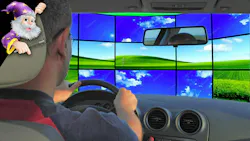
The classic basic, clear-glass automobile windshield (“windscreen” in the UK) may be on the way out, if a proposal from an industry “Automotive User Interface” working group gets traction. Instead of the standard, totally passive see-through glass, the windshield would be replaced by a large, curved video screen that electronically presents various “tiles” to the driver and passengers. The center tile would be the largest and show what’s ahead of the vehicle, as today’s glass window shows (Fig. 1).
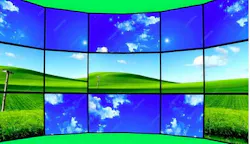
Why the change? According to a group spokesperson, “We can do so much more now with large-format screen; it makes sense to leverage their capabilities. At the same time, the price of larger curved screens is dropping rapidly, due to their use in high-end home theaters.”
For example, in addition to the broad forward-facing view, skinny tiles running down the right and left sides could show the equivalent of the two outside rear-view mirrors (now unneeded) (Fig. 2). The driver would no longer need to turn his/her head to see these rear-view mirrors or take eyes off the road. A touchscreen version would also enhance usability.
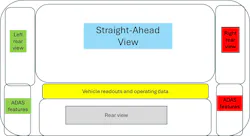
A small section at the bottom would always show the rear view, thus eliminating an inside mirror, and dynamically expand when the car was in reverse. Further, one section of the screen can be used as a head-up display, providing data to the driver that’s presently presented on the console (often called the dashboard).
By eliminating the need for side mirrors, console screen, and other console indicators and readouts, the overall bill-of-materials (BOM) cost between solutions will be comparable, although the large-screen windshield can do so much more.
Curve Appeal
Note that today’s windshields aren’t just a simple, single-layer piece of sheet glass, similar to a storefront window but curved. They’re actually made of laminated safety glass, which consists of two sheets of glass (usually soda-lime glass) bonded together by a tough, thin inner layer of plastic, typically polyvinyl butyral (PVB). It’s subject to intense heat and pressure in an autoclave to create a permanent bond.
When this windshield breaks, whether due to an accident or other impact, the PVB layer holds the fragments together. It thus prevents injury by protecting passengers from flying shards and provides structural support, keeping the windshield in the frame. The proposed video screen would use similar glass-layer technology for safety.
Safety considerations are always a major consideration, of course. The glass-equivalent video mode would always be enabled for normal view, unless the car was stopped and turned off. The driver could also override this mode when the car was off. If the screen’s electronics failed at any time, the screen would revert to a transparent mode so that the driver could see ahead.
For absolutely safety, if the transparent mode fails to actuate, the driver has two choices: use a small mallet installed under the driver’s set to smash the video screen, or push a button that initiates a modest “explosion” to blow the screen glass off the car’s frame utilizing a technology similar to airbags. With these two add-ons, the proponents are confident that the new front “windshield” can pass regulatory safety requirements.
How is a Video Windshield Beneficial for AVs?
The video screen as windshield also provides potential benefits for autonomous vehicles. It could be blanked and make the car’s interior into a “private zone” for the passengers while the outside cameras, LiDAR, and other sensors provide data that the vehicle needs to self-drive. The screen would return to normal viewing modes as passengers exited the vehicle. Alternatively, it could be used for a gaming display or internet browser screen while also displaying needed vehicle parameters along the bottom.
One drawback is the power consumed by the screen, compared to the zero-power needs of a glass windshield. However, with the move to 48-V rails, there’s more power available, and the dynamic screen offers less-obvious savings where other discrete functions of the console are eliminated.
Will this admittedly somewhat “wild and crazy” idea just be another technology-driven proposal that goes nowhere due to factors such as user acceptance as well as technical and cost issues (after all, why do we still have steering wheels when a joystick could be used)? Or will it eventually make sense in terms of costs, features, benefits, and acceptability to become a high-end option, then migrate down to being standard in most vehicles?
Stay tuned. One thing we know for sure is that the future rarely unfolds the way we presume it will.
More April 1st Humor
If you liked this article then check out the rest of our April 1st offerings from this and past years. We hope you enjoy them.
 Wizard April 1st
About the Author
 Bill Schweber
Bill Schweber
Contributing Editor
Bill Schweber is an electronics engineer who has written three textbooks on electronic communications systems, as well as hundreds of technical articles, opinion columns, and product features. In past roles, he worked as a technical website manager for multiple topic-specific sites for EE Times, as well as both the Executive Editor and Analog Editor at EDN.
At Analog Devices Inc., Bill was in marketing communications (public relations). As a result, he has been on both sides of the technical PR function, presenting company products, stories, and messages to the media and also as the recipient of these.
Prior to the MarCom role at Analog, Bill was associate editor of their respected technical journal and worked in their product marketing and applications engineering groups. Before those roles, he was at Instron Corp., doing hands-on analog- and power-circuit design and systems integration for materials-testing machine controls.
Bill has an MSEE (Univ. of Mass) and BSEE (Columbia Univ.), is a Registered Professional Engineer, and holds an Advanced Class amateur radio license. He has also planned, written, and presented online courses on a variety of engineering topics, including MOSFET basics, ADC selection, and driving LEDs.
Comment About the Article
To join the conversation, and become an exclusive member of Electronic Design, create an account today!
 Leaders Logo
Leaders relevant to this article: