A New Kind of Geosynchronous Orbit
What you'll learn:
- What is an OEO satellite?
- Why OEO satellites eliminate latency issues.
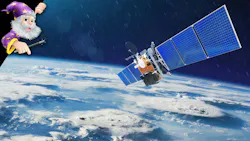
Thousands of satellites have been deployed during recent years in efforts to create space-based internet connectivity, with plans to even put data centers into space. Many of us are familiar with the more common terms of GEO, MEO, and LEO for geosynchronous orbits, medium-earth orbits, and low-Earth orbits. However, some satellite advocates are trying an altogether new approach to this issue by proposing a technology they call “OEO.”
This technology has several distinct advantages over the more conventional orbital approaches:
- Satellites are guaranteed to be geosynchronous around the equator, where today’s geosynchronous satellites are constrained, as well as at other latitudes.
- Latency issues that plagued GEO satellites, and which were lessened with MEO and LEO satellites, are virtually eliminated due to the satellite’s proximity to the user.
- Deployment costs are a tiny fraction of those of GEO, MEO, and LEO.
- For space-based data centers, the costs of hardware updates and energy consumption are vanishingly small compared to their GEO, MEO, and LEO counterparts.
OEO promises to solve all of these problems and more by using technology that’s readily available to anyone anywhere on earth (Fig. 1).
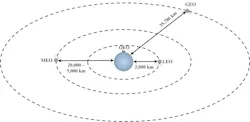
Gone are the issues with GEO satellites, which had to be launched to an altitude of 35,786 kilometers, or 22,236 miles above the earth’s surface. They also needed to be positioned very precisely over the equator, traveling at 11,052 km/h or 6,867 mph to be useful.
OEO satellites travel at a rate that keep them in synch with the communities they serve, at a much slower 1,670 km/h or 1,040 mph at the equator. They slow considerably more the farther north the orbit is placed, though.
There are similar, but less daunting, orbital issues with MEO and LEO satellites. However, the tradeoff is that these satellites must use more sophisticated communications systems involving handoffs, as I will explain later.
GEO: Great Except for the Latency
For certain tasks, like spreading around an endless stream of mindless TV shows, GEO is the ideal solution. As long as there’s little or no interplay between the sender and the receiver, the ~300-ms delay of an upload/download cycle won’t be noticed. On the other hand, those who suffered through the satellite intercontinental phone calls of the 1960s and 1970s were exposed to the difficulties of communicating when there’s a sizable lag involved. Computers are even less tolerant of this.
By their extraordinarily low altitude, the OEO satellite virtually eliminates these problems, and it allows internet communications to travel at the speed of… well… the internet!
Eliminating Handoffs
LEO and MEO satellites take great advantage of a technology called Handoff, which was developed for cell phones back in the 1980s. When you drive around in your car talking on your cell phone, your signal is handed off from one cell (tower) to the next, depending on which receives a stronger signal.
When a client takes advantage of a LEO or MEO satellite orbiting above, it’s a reversal of that process, but using the same technology. Consider it to be something like the cell phone standing still while the cell towers go racing past. The technology is the same, but it’s put to a different use.
However, with OEO, as with geosynchronous satellites, there’s no need to hand the signal off from one data center to the next, which eliminates any likelihood of the data center equivalent of a dropped call. It also abandons the notion that a workload might need to be passed from one orbital data center to the next keep the workload within communication range of the user. Moreover, the system’s hardware is much less complex when handoffs are avoided.
This is true of GEO satellites as well, but with OEO, there’s not the latency mentioned above.
OEO actually maintains its low-altitude geosynchronous orbit by using the earth’s friction. Its orbit is low enough to be sufficiently influenced by friction to make the satellite automatically keep pace with the earth’s surface.
Cost of Deployment
Two issues are of the utmost importance when deploying satellites: the weight of the satellite and the altitude that it must reach.
GEO has the highest orbital altitude of the common orbit types, at 35,786 kilometers, while MEO satellites orbit the earth 5,000 to 20,000 km above the surface. LEO, previously the lowest type of orbit, hovers at about 2,000 km. The cost to put a 1-kg satellite into GEO ranges from about $17,000 to $35,000; MEO might cost $10,000 to $20,000, while LEO would cost the least at about $3,000/kg.
OEO, the new on-earth orbit type, has the lowest orbit of all at 0 km. Thus, it’s very feasible to ignore the issue of weight when considering the cost of space-based data center deployment.
The extremely low altitude of these satellites allows them to be deployed at a considerably lower cost, with the bulk of the expenses being consumed by lateral, rather than vertical, movement of the payload. This is extraordinarily important for space-based data centers, whose hardware must be updated at least every two years to prevent obsolescence. Lateral motion requires very little work to offset the force of gravity, a key factor in the high cost of moving a kilogram of electronics into space.
This becomes an even greater consideration when reliability and service-level agreements (SLAs) are considered. How does a space-based data center remain competitive when technology changes from year to year? With OEOs’ low deployment cost, the “Rip and Replace” methodology already in use in today’s earthbound data centers becomes an attractive means of keeping hardware up-to-date.
But what about reliability? How do you service a space-based data center? It’s not feasible to keep astronauts in space-based data centers to ride through aisles in a golf cart looking for blinking lights to tell them to replace an SSD or server or something.
OEO removes those concerns since the data center orbits within the earth’s atmosphere. Repair personnel don’t need to go through astronaut training; they’re often satisfied to take upon themselves the cost of travel to the data center.
Issues Energy, Cooling, and Radiation
One very significant cost of deploying higher-orbit satellites involves providing the energy required for them to perform useful work. Add to this the issue of cooling electronics in an environment with no water or air to carry away the heat. The problem becomes enormous, and it can only be solved by adding solar panels and sophisticated cooling mechanisms that easily double or triple a satellite’s weight.
And, as we saw above, weight is a particularly thorny issue when putting a satellite into orbit.
OEO satellites solve this issue by operating within the earth’s ecosystem, availing themselves of local power, whether hydroelectric, nuclear, wind-driven, solar, or other, and by using the earth’s atmosphere to carry away generated heat.
Another advantage of OEOs is that they can use SSDs for storage, instead of being required to use only HDDs — a much more energy-hungry and weighty storage medium.
Finally, OEOs eliminate issues of data upsets caused by the very high radiation levels outside of the earth’s atmosphere. Data integrity is considerably higher, allowing for higher reliability while also eliminating the power costs caused by constantly needing to reiterate on data found to have become corrupt.
Different Countries Have Other Ideas
The On-Earth Orbit satellite isn’t the only new endeavor being undertaken to provide low latency, geosynchronicity, and a better cost structure.
As an alternative to OEO, Chinese researchers devised an orbital plan that takes advantage of one of the country’s particular strengths. The Rare-Earth Orbit satellite (REO) harnesses special chemical properties to allow its satellites to carry an advantage over satellites serving other regions.
In England, a study is ongoing for Middle-Earth Orbits, which are actually subterranean, but still geosynchronous. They can be found in tunnels under the roots of trees. Since the name MEO has already been taken, researchers are searching for words they can form into the acronym HOBBIT to make it fit the application. Stay tuned.
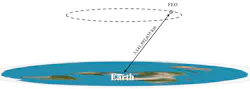
Finally, a cult in the U.S. has taken on the idea of creating an FEO — Flat-Earth Orbit — to be aligned with their notion of orbital mechanics, which space disallows me from explaining here (Fig. 2).
More April 1st Humor
If you liked this article then check out the rest of our April 1st offerings from this and past years. We hope you enjoy them.
 Wizard April 1st
About the Author
 Jim Handy
Jim Handy
General Director, Objective Analysis
Comment About the Article
To join the conversation, and become an exclusive member of Electronic Design, create an account today!
 Leaders Logo
Leaders relevant to this article: