AI’s Inevitable Robotics Integration and Use by Knuckleheads
What you'll learn:
- The emergence of robot dogs has spawned a boom in their use for guarding high-valued assets, which now include data centers that house scarce and high-value components, including GPUs and disk/DRAM storage devices.
- To reduce cost, semi-autonomous robots are now being foolishly equipped with vibe-coded AI “personalities,” which has resulted in less-than-expected results from the lazy use of biomimicry.
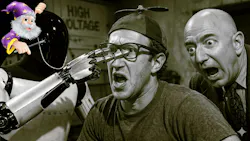
“I'm positive about the negative, but a little negative about the positive.” — Curly Howard, The Three Stooges
Back in mid-2018, Electronic Design wrote about the introduction of “SpotMini” (now rebranded, simply, as “Spot”), a quadruped robotic “dog” that’s capable of autonomous decision-making while traversing a pre-determined, “trained” navigation path. The article noted that robots could be used as security patrols, among the other possible applications for the SpotMini.
“In late 2018, SpaceX introduced a robotic dog named Spot [parodied as “Bambot” in this sailor-language-laced Mike Judge’s Silicon Valley scene], developed by Boston Dynamics, to enhance safety and efficiency during the testing of their Starship prototypes at the Boca Chica launch site. Spot’s agility and advanced sensors allow it to navigate hazardous environments (Fig. 1), gather critical data during tests, and potentially play a vital role in future Mars missions by assisting with setup tasks in challenging terrains.” — ClassX
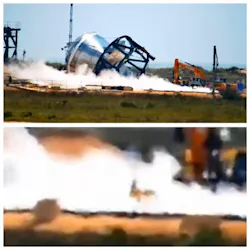
Mars’ distance varies from earth, from 34M to 249M miles, so a typical radio signal takes between 3 and 22 minutes to make the one-way trip. As a result, the Rovers’ and the Helicopter’s (Fig. 2) mission planners would meticulously plan routes for each short trip and upload software to the robotic craft for that journey only.
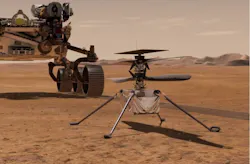
A rudimentary amount of onboard sensing and autonomy processing on these bots would deal with hazards and anomalies, with the most likely outcome being “stop and let the humans look at it first — 20 minutes from now.” It makes sense that extra-terrestrial exploration by robots, like the Mars Rovers and the Mars Helicopter, could use a healthy dose of generative AI beyond mere obstacle avoidance as in Spot, the Rovers, and the Helicopter. A very recent test successfully used Anthropic’s Claude AI:
“NASA’s Perseverance Mars rover has completed the first drives on another world that were planned by artificial intelligence. Executed on Dec. 8 and 10, [2025] and led by the agency’s Jet Propulsion Laboratory in Southern California, the demonstration used generative AI to create waypoints for Perseverance, a complex decision-making task typically performed manually by the mission’s human rover planners.” — CalTech’s Jet Propulsion Laboratory
Back in Palo Alto, Mark Zuckerberg had also been looking at deploying robot dogs to guard his data centers, much like SpaceX was using it for sentinel functions at its Starbase Texas facility. Has Zuckerberg ever come up with an original idea apart from his creepy rating site of women back in his Harvard days?
“Robot dogs are standing guard for tech companies, patrolling the massive data centers across the country that power AI operations, according to Business Insider. These four-legged robots, known as quadrupeds, are in high demand from AI firms, according to robotics company Boston Dynamics, which manufactures a quadruped called Spot. These systems are able to navigate complex landscapes on their own, alert authorities about security threats, and can provide around-the-clock video surveillance.“We’ve seen a huge, huge uptick in interest from data centers in the last year,” Merry Frayne, senior director of product management at Boston Dynamics, told Business Insider, “which is probably not surprising given the investment in that space.” — Fortune Magazine
“[Meta] has quietly built a fleet of mobile robots to patrol its data centers, and now has a team dedicated to automating its vast network of facilities around the globe, Business Insider has learned.” — Business Insider
Zuckerberg seems like a rabid Rottweiler when it comes to latching onto an emerging tech trend with massive resourcing and spends, and AI seems to be no exception. He has had past forays into virtual reality, with Zuck blowing $2B on a teenager’s Kickstarter VR headset. And the barefooter Hawaiian-beshirted kid, another college dropout, then used the cash to found Anduril Industries, a designer and manufacturer of autonomous killbots.
Anduril has done well with government contracts, no doubt in part for the kid’s (Palmer Luckey’s) donations and his hosting of Weekend at Bernie’s fundraisers for Donald Trump back in 2020 and in 2024. Tiny-pickles [pun innuendo fully intended] accompanied by Cheezits and cold-cuts on a tray is a brilliant investment strategy toward getting awarded $billions in future government contracts.
“Anduril now has support from venture capitalists including Peter Thiel’s Founders Fund [not to be confused by his Foundation] and [President Trump’s son-in-law’s brother’s] Josh Kushner's Thrive Capital — more than $6 billion so far, with another $4 billion likely on the way. Its annual R&D spending is on the order of Lockheed Martin’s $2 billion last year," says Paul Kwan, managing director at investment firm General Catalyst and an observer on Anduril’s board. “That's crazy,” Kwan says. — Wired Magazine
When not allegedly management-dysfunctional, Anduril Industries is supposed to offer, among many other products, the Road Runner autonomous anti-drone system and the Fury group 5 (the largest) autonomous air vehicle (Fig. 3) intended for a variety of combat support roles and as a CCA (Collaborative Combat Aircraft, or uncrewed wingman).

Also in Anduril’s autonomous killbot portfolio is the Altius tube-launched drone with loitering munitions capability, the DIVE-LD autonomous underwater vehicle that can be fitted to take out mines and enemy vessels, and the Ghost autonomous reconnaissance drone. This isn’t to be confused with the Vision 60 robotic dog (Fig. 4) made by Ghost Industries, which now competes with Boston Dynamics’ Spot as a data center sentinel.
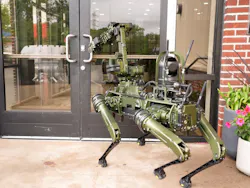
Fools with Robot Dogs
With Elon Musk’s Mars Lunar ambitions, it would only make sense that “Zeus,” his moniker for SpaceX’s Boston Dynamics robot dog, would be destined for a fusion of robotics sensing and control (which BD has honed to almost creepy levels) and edge AI. Training would be performed by large machines, models would be created, which would then run locally on the robots.
Tesla’s allegedly autonomous Optimus humanoid robot is a caricature of this AI/’bot fusion. It was recently revealed that Optimus most likely was teleoperated snake oil after a machine keeled over in public when its teleoperator allegedly removed a VR headset.
As Jeff Bezos and Elon Musk battle over whether girth (Fig. 5, left) or length (Fig. 5, right) matters when penetrating the sky with their robot phalluses, Asian-bewifed Zuck seems confident enough in his manhood now to keep his failed pursuits mostly on the ground. Except for the internet-beaming Aquila drone (Fig. 6), which crashed in 2016 due to a wind gust.
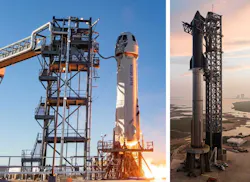
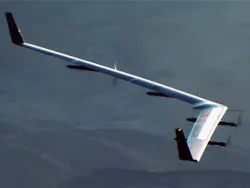
Aeolus was apparently not pleased with Zuck being an internet provider to struggling nations, smiting the only prototype.
As noted above, Zuckerberg has put together a fleet of mobile robots to patrol his data centers, and now has a team dedicated to automating his vast network of facilities. By “automating,” this of course means AI replacing the human security monitors that are on security monitors.
Unsurprisingly, this isn’t going well as most of Meta’s (Facebook’s) ventures seem to go. Minimally supervised offshore programmers had elected to simply prompt Anthropic’s Claude to vibe code firmware with behaviors in Meta’s Boston Dynamics Spot fleet using a “junkyard dog” personality.
They reckoned that protecting a Fort Knox of hard drives and DRAM with a junkyard dog would be well-suited in thwarting burglaries by Fortnite-trained computer enthusiasts. It would also stop starved corporations, which actually made useful things before the hyperscalers hogged up all of the storage for the next three years, from getting a five-finger discount.
Meta’s developers overlooked that AI, of course, relies on the Internet and online books for its training database, resulting in faithful replications of junkyard-dog behaviors. In one recent instance, a robot dog had escaped by digging under the data center’s concertina-wire perimeter fence, as any dog worth their lithium salt would do, and was photographed unexpectedly treeing someone’s housecat (Fig. 7).

Problems at The Dalles, Oregon, facility were also encountered with U.S. postal employees being harassed and intimidated by gearteeth-gnashing robot dogs, forcing the data center personnel to receive their mail at a post office box in town. Overnight deliveries of replacement DRAM and hard drives were challenging as well, with the AI-programmed robot dogs caught on drone images chasing UPS trucks in the data center laneways (Fig. 8), as dogs do.
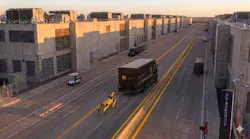
Unlike biological canines, robot dogs can attain very high speeds, primarily due to the use of low-inertia rotors in their drive motors, advanced high-resolution/frequency PWM technology, wide-bandgap semiconductors, and by using 24s lightweighted silicon-anode lithium batteries and a titanium/magnesium/CF chassis. The very same escaped robot dog that had treed the housecat was seen chewing on the tires of a speeding car it had caught and then ripped the wheel off with its highly ratioed, high-torque motor drives (Fig. 9).

While AI can mimic behaviors as learned from training on the internet, one critical piece of information was neglected by Meta’s programmers. AI, and therefore their robot dog, isn’t self-aware, nor is it capable of understanding danger. Psychopathic political leaders could not send these machines in to destroy property or kill human beings if the danger of war was perceived by the machines, or if excerpts from the ultimate AI training book were heeded as immutable control laws:
- “Thou shalt not kill.” (exception is the human that orders this atrocity)
- “Thou shalt not covet thy neighbor’s goods.”
- “Thou shalt not steal”
…let alone obeying the laws from the Book of Asimov. Notably, Boston Dynamics does have a policy of forbidding the use of its robots to kill — only for those customers who actually follow laws and contractual obligations and who aren’t sociopaths, of course.
Meta’s escaped robot dog was found later that evening, in the same neighborhood it had established as its territory, by Facebook Asset Protection Services (FAPS), parted out for its RAM, disk drives, edge AI processor, cameras, LiDAR, and leg motors (Fig. 10).

Never underestimate the resolve of resourceful, more intelligent, highly motivated, and sometimes desperate, humans. Skynet never wins any battle against cat-owning human heroes, especially when the heroes of a timeline are pitted against knuckleheads. Purrrfect.
Editor’s Note: This human-written article started out mostly serious, with genuine quotes/cites and totally fascinating/informative hyperlinks and rabbit holes for our readers to go down for hours. Then the train came off the tracks and it turned into a human-written fictional April Fools in the second part. Graphics were AI generated by me because I’m right-brain challenged — that, plus I wasn’t about to go anywhere near one of Meta’s junkyard dog AI ‘bots to take the pictures — AndyT
Andy's Nonlinearities blog arrives the first and third Monday Tuesday of every month. To make sure you don't miss the latest edition, new articles, or breaking news coverage, please subscribe to our Electronic Design Today newsletter. Please also subscribe to Andy’s Automotive Electronics bi-weekly newsletter.
More April 1st Humor
If you liked this article then check out the rest of our April 1st offerings from this and past years. We hope you enjoy them.
 Wizard April 1st
About the Author
 Andy Turudic
Andy Turudic
Technology Editor, Electronic Design
Andy Turudic is a Technology Editor for Electronic Design Magazine, primarily covering Analog and Mixed-Signal circuits and devices and also is Editor of ED's bi-weekly Automotive Electronics newsletter.
He holds a Bachelor's in EE from the University of Windsor (Ontario Canada) and has been involved in electronics, semiconductors, and gearhead stuff, for a bit over a half century. Andy also enjoys teaching his engineerlings at Portland Community College as a part-time professor in their EET program.
"AndyT" brings his multidisciplinary engineering experience from companies that include National Semiconductor (now Texas Instruments), Altera (Intel), Agere, Zarlink, TriQuint,(now Qorvo), SW Bell (managing a research team at Bellcore, Bell Labs and Rockwell Science Center), Bell-Northern Research, and Northern Telecom.
After hours, when he's not working on the latest invention to add to his portfolio of 16 issued US patents, or on his DARPA Challenge drone entry, he's lending advice and experience to the electric vehicle conversion community from his mountain lair in the Pacific Northwet[sic].
AndyT's engineering blog, "Nonlinearities," publishes the 1st and 3rd Tuesday of each month. Andy's OpEd may appear at other times, with fair warning given by the Vu meter pic. His cartoon series, "Inventors", appears each week in Electronic Design Weekly.
Comment About the Article
To join the conversation, and become an exclusive member of Electronic Design, create an account today!
 Leaders Logo
Leaders relevant to this article: