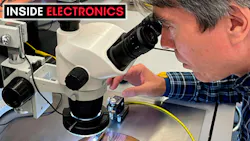
How Nanusens is leveraging CMOS processes to develop nanoscale MEMS sensors.
Nanusens
6a28239e268290f1ded996ab Nanusensnew Promo
Our world has been changed by microelectromechanical-systems (MEMS) devices such as sensors — they’re smaller, more efficient, and usually more accurate than their legacy predecessors. MEMS technology is based on an extended form of traditional IC manufacturing, where complex nanoscale microstructures are built by repeating processes from film deposition to etching.
Recently, Nanusens has begun making nanoscale structures within the layers of a CMOS chip using standard processes in CMOS fabs. The resulting MEMS sensors and required control circuitry form single-chip solutions that are significantly smaller than their current, multi-component counterparts. Many different sensors can be built into the same tiny chip to enhance the user experience and differentiate products without taking up more space.
We sat down with Nanusens CEO Dr. Josep Montanyà Silvestre to talk about the industry, the company, and its technology. The company manufactures single-chip solutions with a packaged size of only 0.5 mm3. Nanusens uses 0.18-micron CMOS technology, which is a well-established, high-volume technology that makes it possible to use any fab.
An Army veteran, Alix Paultre was a signals intelligence soldier on the East/West German border in the early ‘80s, and eventually wound up helping launch and run a publication on consumer electronics for the US military stationed in Europe. Alix first began in this industry in 1998 at Electronic Products magazine, and since then has worked for a variety of publications in the embedded electronic engineering space. Alix currently lives in Wiesbaden, Germany.
Also check out his YouTube watch-collecting channel, Talking Timepieces.
Dr. Josep Montanyà Silvestre is CEO and co-founder of Nanusens, leading the company with +18 years of experience in MEMS, patents, and the semiconductor industry. He founded Baolab Microsystems prior to Nanusens.