History, Harvard, and Hegseth
What you'll learn:
- Why Sec. Hegseth cutting ties with Harvard is bad.
- What is the Harvard Architecture?
- What do butterflies have to do with the announcement?

The New York Times article, “Hegseth Says Defense Department Will Cut Ties With Harvard,” spurred me to write this article. It has taken me over 50 years to figure out that I’m in the business of writing about history. I was actually surprised it took me so long, but I never did well with history in school. I also focused on engineering very early on, working with vacuum-tube electronics and programming a FORTRAN development system I wrote in BASIC.
I didn’t like history in school much, but it’s probably more from the way it was presented and what I had to learn. Many of the more interesting items for me were left out. I didn’t pick those up until much later, when I got interested in history and did more of my own research. It turns out that many consider history to be something that’s just very old. However, once you read this, the fact that you read it is now history, too.
Those who cannot remember the past are condemned to repeat it.
- George Santayana | (1905) Reason in Common Sense, p. 284, volume 1 of The Life of Reason.’’
Like many, I’ve repeated George Santayana’s quotes, but didn’t really appreciate them enough. It’s just as true now as it was then.
But back to Harvard.
Defense Secretary Pete Hegseth said on Friday that the Defense Department would sever its academic ties with Harvard University, the latest broadside by the Trump administration in its pressure campaign to force the university to cut a deal with the government.
I think most of you already know about Harvard University. It’s a well-known Ivy League research university whose graduates and research has had a major impact on technology and the world. This is why the Defense Department encouraged and supported, among other things, graduate-level professional military education, fellowships, and certificate programs. However, that’s history now with the renamed Department of War cutting ties.
I’ll leave the justification and discussion of this change to other publications while I delve into aspects of history, and why it’s important to look at more than surface comments and historical tidbits.
Harvard, Names, and Computer Architectures
Most programmers and engineers are familiar with John von Neumann and the Von Neumann architecture (Fig. 1). It’s what all of the major computer systems were built on. These days, though, there are more tweaks and turns on actual implementations; a typical system-on-chip (SoC) might employ any number of different processor architectures.
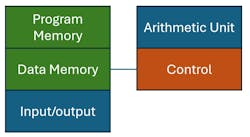
The Von Neumann architecture isn’t the only one. Another that most embedded developers will be familiar with is the Harvard Architecture (Fig. 2). Of course, you might think that this architecture originated at Harvard University. It did, sort of.
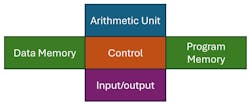
The term is often stated as having originated from IBM’s Harvard Mark I computer conceived by Howard Aiken. Aiken did earn a doctorate at Harvard University; the computer and its successors were built at Harvard.
The Wikipedia entry notes that “The Mark I had 60 sets of 24 switches for manual data entry and could store 72 numbers, each 23 decimal digits long. It could do 3 additions or subtractions in a second. A multiplication took 6 seconds, a division took 15.3 seconds, and a logarithm or a trigonometric function took over one minute.”
Of course, delving a bit more into history, I ran across “The Myth of the Harvard Architecture” (IEEE Annals of the History of Computing, Volume 44, Issue 3, pp. 59-69) by Richard Pawson. That notes the term "Harvard architecture" was coined decades later, in the context of microcontroller design. It was retrospectively applied to the Harvard machines and subsequently applied to RISC microprocessors with separated caches. It was also applicable to the Harvard Mark III and IV computers.
Another Harvard tidbit is that the Harvard Mark II was the first computer to have a real bug associated with it. The bug was a moth. Also, the term “bug” originated with Thomas Edison.
By the way, Pete Hegseth, U.S. Secretary of War, is a graduate of Harvard University. His concern for “woke ideology” for our military didn’t seem to affect him too much, but that’s history.
Tying Together the Strands
The underlying computer architecture and software implications are more important than what the architecture is called, but often that’s what people remember without delving into the details. One of the challenges with history is that there’s so much of it. “Historians” often focus on a very tiny subset so that they can become experts, which is useful because no one can know it all. And, by definition, what’s known will be a subset of actually experiencing it.
As an example, I’m going to talk about an interest and pet peeve of mine: computer programming languages, their design and use. I use a lot now, and used a bunch in the past, and studied more along the way. I put together the “Do You Recognize These? Programming Language Challenge” based on this long-time endeavor.
Programming history can be useful in the challenge, but my pet peeve is how so many programming language designers ignore or don’t know the history of programming languages. Thus, they repeat the mistakes of the past and miss the solutions that others have developed — history isn’t just recording what happened, but learning from the past.
I’m always surprised when talking with programming language and compiler developers who mostly have a limited view of programming languages, being unfamiliar with competing or complementary solutions. The challenge is that these developers need to consider lots of issues from compiler performance and efficiency of the output to security, ease of use, and so on.
Back to history tidibits: Grace Hopper was one of the first programmers on the Harvard Mark I that used a language called Autocode. Grace Hopper created FLOW-MATIC and was instrumental in the development of COBOL. COBOL got started with a meeting initiated by Mary Hawes, a computer scientist at Burroughs Corporation where I was a co-op engineer many years ago; Grace Hopper was just one of many. I won’t go down the rabbit hole tying Harvard into this, other than highlighting the importance of all the different technologies developed at universities like Harvard.
What’s with the Lead Image?
If you went to Harvard, you probably noticed the image at the top isn’t from Harvard. If you happen to be a graduate of the Georgia Institute of Technology, then you will recognize Tech Tower. Tech happens to be my undergraduate alma mater.
Here’s a history tidbit: I recall some of the ROTC students practicing their rappelling technique down the side of our dorm. It’s just one university out of many that have a relationship with the Defense Department.
Here’s hoping that Harvard’s woes aren’t repeated with the likes of Georgia Tech, MIT, IIT, Cal Tech, and so on. Think about the Butterfly Effect and Murphy’s Law when considering tiny changes such as not sending officers to Harvard.
About the Author
 William G. Wong
William G. Wong
Senior Content Director - Electronic Design and Microwaves & RF
I am Editor of Electronic Design focusing on embedded, software, and systems. As Senior Content Director, I also manage Microwaves & RF and I work with a great team of editors to provide engineers, programmers, developers and technical managers with interesting and useful articles and videos on a regular basis. Check out our free newsletters to see the latest content.
You can send press releases for new products for possible coverage on the website. I am also interested in receiving contributed articles for publishing on our website. Use our template and send to me along with a signed release form.
Check out my blog, AltEmbedded on Electronic Design, as well as his latest articles on this site that are listed below.
You can visit my social media via these links:
- AltEmbedded on Electronic Design
- Bill Wong on Facebook
- @AltEmbedded on Twitter
- Bill Wong on LinkedIn
I earned a Bachelor of Electrical Engineering at the Georgia Institute of Technology and a Masters in Computer Science from Rutgers University. I still do a bit of programming using everything from C and C++ to Rust and Ada/SPARK. I do a bit of PHP programming for Drupal websites. I have posted a few Drupal modules.
I still get a hand on software and electronic hardware. Some of this can be found on our Kit Close-Up video series. You can also see me on many of our TechXchange Talk videos. I am interested in a range of projects from robotics to artificial intelligence.

Comment About the Article
To join the conversation, and become an exclusive member of Electronic Design, create an account today!
 Leaders Logo
Leaders relevant to this article: