Shrinking AI PCs
What you’ll learn:
- What can you do with a NUC?
- Getting AI acceleration in a small package.
- How AI PCs deliver AI performance using less power.
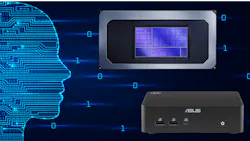
Artificial intelligence (AI) can be useful in many applications, but the amount of performance needed varies significantly. In many cases a neural processing unit (NPU) is worth the investment. In larger PCs, a GPU or NPU card can deliver high-performance AI compute. However, a more compact solution might be to add an NPU via an M.2 slot if one is available.
Turning to an AI PC allows a system to employ AI acceleration that’s part of the processor package. This is the typical approach when using the compact, Next Unit of Computing (NUC) form factor. NUCs tend to have limited expansion options, often limited to M.2 or DRAM sockets, but this is often sufficient for regular PC users as well as many embedded applications.
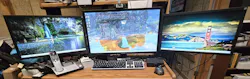
I recently upgraded my 10-year-old SuperMicro PC to an ASUSTeK ASUS NUC 16 Pro (Fig. 1). Able to handle up to four displays directly, it’s built around an Intel Core Ultra X9 Series 3 AI PC, which was launched earlier this year at CES 2026.
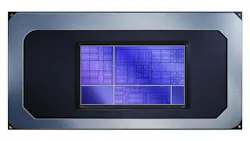
The Intel Core Ultra Series 3 (Fig. 2) includes Intel’s ARC GPU as well as its latest NPU. I had used an NVIDIA RTX 2080 Ti in the SuperMicro system until it died, and its performance far outweighs the Intel AI PC. Of course, this PCIe board is twice the size of the NUC and has a lot more power. The RTX 2080 Ti was also getting old, with NVIDIA’s latest boards far outdistancing it in terms of AI performance.
Still, the latest AI PC CPUs from AMD, Intel, and a host of Arm-based systems that incorporate a CPU, GPU, and NPU deliver AI acceleration that’s sufficient for many applications and users — and there’s no need for large cases, power supplies, and cooling systems. These days, a typical AI PC will deliver about 50 TOPS of performance from its NPU. It’s a reasonable tradeoff given the more limited power budget that ranges from 15 to 120 W. The architectures need to be balanced with GPU performance as well, since the combined system needs to fit within the power envelope.
AI PCs are still relatively new and the number of software packages that take advantage of the NPU is small but growing. Part of the challenge is how applications can take advantage of AI acceleration. OpenClaw’s support for autonomous agents is one example, though it’s not necessarily ideal for the uninitiated. Multimedia editing and creation are other areas where an AI PC can deliver more than their non-AI accelerated counterparts.
The advantage of local processing versus going to the cloud shows as lower latency as well as a higher level of security, since data isn’t moving through the cloud. Unfortunately, AI PCs can run large language models (LLMs) but not as large as those that work on higher-end PCs or cloud servers.
Although Microsoft will typically highlight any Windows 11 PC as an AI PC because of its CoPilot support, the more interesting aspects are the API support for on-board AI acceleration provided by the likes of Intel’s Ultra and AMD’s Ryzen AI PCs.
I’m looking at M.2 AI accelerators that can augment AI PCs like the NUC Pro 16. However, these tend to have dedicated software support via drivers rather than Windows API support. This may change in the future, making scalable user PCs practical.
About the Author
 William G. Wong
William G. Wong
Senior Content Director - Electronic Design and Microwaves & RF
I am Editor of Electronic Design focusing on embedded, software, and systems. As Senior Content Director, I also manage Microwaves & RF and I work with a great team of editors to provide engineers, programmers, developers and technical managers with interesting and useful articles and videos on a regular basis. Check out our free newsletters to see the latest content.
You can send press releases for new products for possible coverage on the website. I am also interested in receiving contributed articles for publishing on our website. Use our template and send to me along with a signed release form.
Check out my blog, AltEmbedded on Electronic Design, as well as his latest articles on this site that are listed below.
You can visit my social media via these links:
- AltEmbedded on Electronic Design
- Bill Wong on Facebook
- @AltEmbedded on Twitter
- Bill Wong on LinkedIn
I earned a Bachelor of Electrical Engineering at the Georgia Institute of Technology and a Masters in Computer Science from Rutgers University. I still do a bit of programming using everything from C and C++ to Rust and Ada/SPARK. I do a bit of PHP programming for Drupal websites. I have posted a few Drupal modules.
I still get a hand on software and electronic hardware. Some of this can be found on our Kit Close-Up video series. You can also see me on many of our TechXchange Talk videos. I am interested in a range of projects from robotics to artificial intelligence.
Comment About the Article
To join the conversation, and become an exclusive member of Electronic Design, create an account today!
 Leaders Logo
Leaders relevant to this article: