Why Boards and Modules Still Matter
What you’ll learn:
- Tradeoffs between custom boards and modules.
- Why custom versions aren’t always the best option.
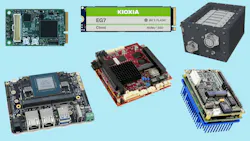
Building a system using boards and modules allows engineers to quickly create systems compared to a custom board design. There are reasons to go custom, such as minimizing the size or to incorporate features like embedded antennas. Cost might be an issue, especially where high volumes can generate savings.
Using boards and modules provide significant benefits to developers, thus putting the design and support onus on the supplier. It also lets companies easily provide customizable solutions at the board or module level, which can reduce cost or enhance performance by switching to a different board or module. The interest in embedded artificial intelligence (AI) also comes into play with this approach, as substituting an AI-enabled board or module allows features to be added without changing the overall system design.
Utilizing something like a 6U OpenVPX board and backplane results in a rather large system, However, quite a few smaller form factors are in the mix, too, from VITA 90 VNX+ to M.2 , which we'll take a closer look at.
We will not hit all of the available options, but I did split the list into single board computers (SBC), processor modules and peripheral modules. Modules are interesting as they need a carrier board. Mezzanine modules can also be used with SBCs and backplane-based boards.
Using Compact Single-Board Computers
Single-board computers (SBCs) tend to pack in all of the main components for an application, including the compute side that often incorporates a CPU, GPU and an AI neural processing unit (NPU). They typically have storage, peripheral interfaces, and connectors, allowing them to be used standalone.
The RMS Consortium (formally the PC104 Consortium), named after Rugged, Modular, Stackable (RMS), hosts stackable standards like Versalogic PC/104 boards (Fig. 1) as well as the new UxV/35 designed for UAVs, UGVs, and USVs.
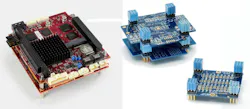
Since the original PC/104 was bus-oriented, all stacked modules are tied to the same parallel bus. PCI Express (PCIe) changed things with a point-to-point, high-speed serial interface requiring a different approach to stacking. In this case, there are connectors on the top and bottom of the board, with some PCIe lanes being used by the board and the remaining lanes being shifted for the next board in the stack. PCI/104-Express and PCIe/104 are two PCIe-based standards.
Backplane-based systems are common for larger systems like 3U, 4U, and 6U form factors. VITA 100 added 4U to the mix to provide a compact form factor like 3U, but it’s larger to accommodate the latest high-performance CPUs and GPUs as well as AI accelerators.
The VITA 90 VNX+ is a smaller form factor about the size of a deck of cards. The Pixus Technologies MIL Rugged Air Transport Rack (ATR) Chassis is designed to hold a few of these board (Fig. 2).
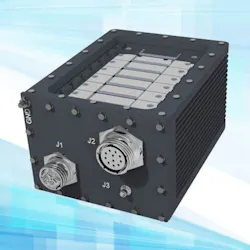
Form factors like VITA 90 are designed for compact, rugged applications like robots and drones. Unlike many other board standards like PC-based PCIe cards, the VITA 90 modules are enclosed and designed for conduction- and convection-cooled environments.
Building a System Using Processor Modules
Going with a processor module instead of an SBC can greatly simplify system design while allowing developers to customize their system without resorting to more complex printed circuit boards (PCBs), which are more common with today’s high-speed processors and serial interfaces. Even the power subsystem may be a challenging design for high-end processors.
Modules allow the carrier board to provide connections and interface buffers, often using a PCB with fewer layers and design constraints. Of course, it also makes it possible to select from a variety of modules that can plug into the same socket, simplifying system configuration.
A carrier board is required. Sometimes these boards can have multiple module sockets, such as a processor module socket along with one or more peripheral sockets like M.2 or Mini-PCIe.
PICMG’s COM Express is one example of a computer-on-module (COM) standard. WinSystems’ SBC-ZETA-3950 is an example of a COM Express Mini Type 10 form factor (84 × 55 mm/ 3.3 × 2.2 in.) SBC. Most COM modules are larger like the higher-end COM-HPC standard.
WinSystems’ modules sport an Intel Atom Apollo Lake E3950 processor and even have a single Mini-PCIe socket. Memory includes 8 GB of soldered-down LPDDR4 (2,400 MT/s) and 128 GB of eMMC along with a microSD socket. Dual Gb Ethernet and other GPIO, serial, and USB interfaces are exposed on the connectors.
The Standardization Group for Embedded Technologies’ (SGeT) Smart Mobility ARChitecture (SMARC) is another processor module form factor that uses an edge connector. Tria Technologies’ SM2S-G3E is based on Renesas’ RZ/G3E processor. It also includes 8 GB of LPDDR4 and 256-GB eMMC flash memory
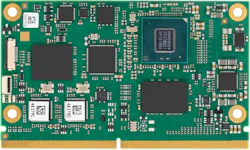
The RZ/G3E includes a quad-core Arm Cortex-A55 and a Cortex-M33 core for real-time processing. It also has an Arm Ethos-U55 NPU to handle AI chores. The SMARC 2.2 module features a plethora of interfaces, including dual 1-Gb Ethernet, USB 2.0 and 3.2 ports, camera, and displays such as LVDS and HDMI.
NVIDIA’s Jetson Orin NX module has become a popular AI platform for applications like robotics. It’s compact while sporting a 1,024-core Ampere GPU architecture with 32 Tensor cores. It can deliver up to 157 TOPS and fits nicely into Diamond Systems’ Jackson carrier board (Fig. 5).
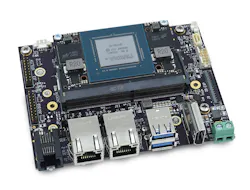
The carrier board exposes most of the module’s interfaces and adds others such as dual 1-Gb Ethernet, CAM, and USB 2.0 and 3.0. The back of the carrier board has an M.2 2242/2280 socket, a short M.2 E Key 2230 socket, plus a Mini-PCIe socket. “Jackson contains a unique camera adapter connector that makes it possible to interface any camera, including standard, custom, CSI, and GMSL cameras.”
Picking Peripheral Modules
There’s a wide variety of peripheral-module form factors, from vendor-specific solutions to standards-based form factors such as Mini-PCIe and M.2. Likewise, the interfaces can utilize a range of interfaces from I2C and SPI to PCI Express and NVMe. The latter has dominated the server and PC market; however, embedded systems are another matter as SATA SSDs still have a long life ahead of them.
Mini-PCIe has been used for both storage and peripherals like Acces I/O Products’ Mini-PCIe mPCIe-AIO16-16FDS. This module connects a multifunction data-acquisition system with a dual, 1-MHz, 16-bit differential ADC incorporating 16 single-end or eight differential inputs and four 16-bit DAC outputs. It also has latching IO connectors. A similar module is available in the M.2 form factor.
Quite a few vendors provide Mini-PCIe modules that handle everything from motor control to wireless communication. Storage modules are available as well, although M.2 is the choice for storage these days, e.g., the KIOXIA EG7 M.2 BiCS Flash NVMe SSD (Fig. 7).
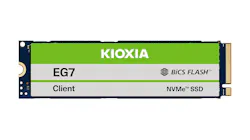
The EG7 M.2 SSD provides up to 2 TB of QLC flash with a PCIe 4.0 NVMe 3.0 interface. It maintains a sequential read performance of 7 GB/s and 1 G IOPS. Self-encrypting drives (SEDs) with TCG Opal 2.02 support are available. They come in M.2 Type 2230, 2242, and 2280, depending on capacity.
M.2 has also been the choice for peripherals, as noted earlier. This includes wireless and wired communication options as well as interface and data-acquisition support.
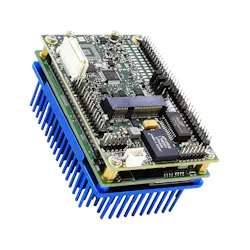
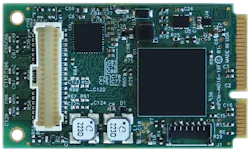
Among the challenges with M.2 and Mini-PCIe are limited space for electronics, extreme rugged support, and standard cooling specifications. This is where the VITA 93 QMC standard comes into play with modules such as Acromag’s QMC 730 multifunction I/O (Fig. 8).
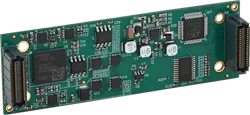
The QMC 730 module is a single wide QMC module with a 16-bit ADC, four 16-bit DACs, timers, and 16 digital IO. Its pair of headers make it more akin to the COM Express processor modules that have connectors on the bottom of the module. The VITA 93 standard also specifies how conduction and convection cooling can be done — the modules tend to be used in very rugged applications like avionics, where space and cooling are critical design criteria.
VITA 93 specifies x1, x2, x3, and x4 size modules that offer more cooling, power, interface pins, and a larger footprint, allowing for larger chips to be supported by the standard that exceeds what can be handled by M.2 or Mini-PCIe. The x1 QMC (26 × 78.25 mm) is about the same size as an M.2 2280 (22 × 80 mm).
The number of small-form-factor boards and modules presented here is just the tip of the iceberg. Many vendors have their own form factor that’s often supported by other vendors like NVIDIA’s Jetson. Additional options, both larger and smaller, may prove more useful for your application, so check out the options before locking down your design.
Electronic Design Word of the Week
Try out this Electronic Design Weekly word for the week of August 25th. It’s related to this editorial.
About the Author
 William G. Wong
William G. Wong
Senior Content Director - Electronic Design and Microwaves & RF
I am Editor of Electronic Design focusing on embedded, software, and systems. As Senior Content Director, I also manage Microwaves & RF and I work with a great team of editors to provide engineers, programmers, developers and technical managers with interesting and useful articles and videos on a regular basis. Check out our free newsletters to see the latest content.
You can send press releases for new products for possible coverage on the website. I am also interested in receiving contributed articles for publishing on our website. Use our template and send to me along with a signed release form.
Check out my blog, AltEmbedded on Electronic Design, as well as his latest articles on this site that are listed below.
You can visit my social media via these links:
- AltEmbedded on Electronic Design
- Bill Wong on Facebook
- @AltEmbedded on Twitter
- Bill Wong on LinkedIn
I earned a Bachelor of Electrical Engineering at the Georgia Institute of Technology and a Masters in Computer Science from Rutgers University. I still do a bit of programming using everything from C and C++ to Rust and Ada/SPARK. I do a bit of PHP programming for Drupal websites. I have posted a few Drupal modules.
I still get a hand on software and electronic hardware. Some of this can be found on our Kit Close-Up video series. You can also see me on many of our TechXchange Talk videos. I am interested in a range of projects from robotics to artificial intelligence.
Related
Comment About the Article
To join the conversation, and become an exclusive member of Electronic Design, create an account today!
 Leaders Logo
Leaders relevant to this article: