Engineer at the Movies: "Project Hail Mary" Review

Wow, did we engineers not get a lot of mileage out of “I’m going to have to science the $**t out of this” from The Martian back in 2015?
The author of The Martian is back. The latest movie based on Andy Weir’s library — Project Hail Mary — is opening this week worldwide. Does it bring that delicious science-reality to science fiction? Is science once again the hero?
Simply put, yes! Science reality is back in an epic near-future action film. At a whopping 2 hours and 36 minutes, you’ll be left thinking it was too short. You’ll walk away with pride as a fellow person of science., and you’ll have fun. You’ll want to see this movie. I give it a 3.14159 out of π stars.
That said, let’s talk a bit more about it.
Spoilers after this point, beware. Even if you read the book, beware.
The book, as some know, is action-packed, with scientific hypotheses and theories put into practice throughout the story. A lot of this gets rounded out of the equation to make room for the bigger swings of the plot. I do think this could have been two films, with more of the story fleshed out. But, it seems filmmakers can’t pull off a Matrix: Reloaded and Matrix: Revolutions with only a two-month gap these days. So, I completely understand what was left out.

The Performances Were Spot On
I think Ryan Gosling did a lovable performance as Ryland Grace. I was worried that the stoic-cool performance he had in Blade Runner 2049, Drive, or even Barbie would be here. But, no, he actually seems like a genuinely nerdy and awkward scientist throughout. It felt real. The desperation felt real. The triumphs felt real.
I found the following video clip moments before posting this video. It kind of encapsulates how I saw Gosling's performance.
His co-star for much of the film was an alien. Not much of a spoiler, especially since the trailers reveal the alien “Rocky.” As the name suggests, Rocky is a rock-based creature. Makes me wonder if Andy Weir had a pet rock as a kid; his age tracks.
I’m happy to know he was portrayed with practical effects. However, he did give off a little bit of a Muppet vibe at times. But Rocky wasn’t just a creature. He, too, was a scientist/mechanic on the way to solve the exact same problem being experienced by our hero Grace. For much of the film, Rocky had almost an equal level of scientific input and output.
Also, Rocky not being so technologically advanced whereby he appears magical was also a breath of fresh air. In fact, seeing how Rocky interacts with the environment around him was fascinating.
Big spoiler here: Rocky used a sort of sonar way of seeing. This was established in a trial-and-error sort of interaction between the two characters. The exact way I would have done it, to be honest. Eventually, the two were able to speak with each other with the help of an interpretation program made by Grace. I would have liked to know more about how this worked a bit better. The book elaborated greatly on the program, while the movie kind of glossed over it.
Andy Weir, in an interview I had with him, said that Rocky’s species, “Eridians,” have eidetic memories. So, he could easily remember what human words meant what in his language. The movie didn’t really say anything to make this clear. I suppose a creature using echolocation for movement might be more inclined to remember sounds quite well. But I don’t think dwelling on the communication mechanics was all that important to the plot.
Near Future Tech I Can See Becoming Real
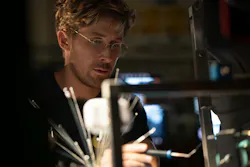
Rocky, being more of a mechanic by nature, used “hand tools” like a 3D printer. He could make anything. It was almost like a pair of those 3D-printer pens you can get right now. But imagine being able to actually make functional things with it. This is one of those sci-fi techs that I know will be a reality someday.
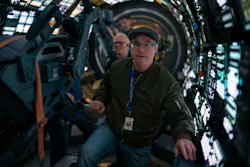
Another guaranteed future real tech was in this sort of 360-degree imaging room, where our heroes were able to experience Earth like they were there. But you could see that they were looking at screens at the same time. Think The Las Vegas Sphere, but smaller. I can see this being something in every home. It’s doable. It’s not like the “holodeck” (Star Trek), but more advanced than the nature room in Aliens (1986). It’s on the way to every home, I’m sure.
The Visuals are Worth that iMax Ticket Price
Despite the story mostly taking place on the small human spaceship, it didn’t feel claustrophobic. Cinematography made it cozy and spacious., even as Rocky builds something akin to hamster tubes all over the place. Exterior shots of both of our characters’ ships felt real. You could almost feel the realistic portrayal of physics in motion. You could feel the mass.
Spoiler again: it was a pivotal action scene that left me absorbing every second with grit hitting my face. When our heroes were flying in the boundary area of a planet’s atmosphere, literally meters/feet of burning up, it left me riding along like I was on some dangerous carnival swing ride. At any moment, something bad is going to happen; I could feel it. This whole scene and its outcome were probably the most impactful for me.
It wasn’t a used future, like Star Wars, or sterile monocolor like 2001. Project Hail Mary was vibrant and fun to look at. As I said, the world depictions were dazzling.
The Choice: A Scientific One?
At a certain point, Grace was confronted with the choice to save billions of human or Eridian lives. I was watching science make the best choice. It’s a practical race against time and space, literally. I appreciated how this worked out.
I won’t leak the big plot twists and turns. No need, critically speaking. They were unexpected and steeped in science and human limitations.
Go see it.
About the Author
 Cabe Atwell
Cabe Atwell
Technology Editor, Electronic Design
Cabe is a Technology Editor for Electronic Design.
Engineer, Machinist, Cartoonist, Maker, Writer. A graduate Electrical Engineer actively plying his expertise in the industry and at his company, Gunhead. When not designing/building, he creates a steady torrent of projects and content in the media world. Many of his projects and articles are online at element14 & SolidSmack, industry-focused work at EETimes & EDN, and offbeat articles at Make Magazine. Currently, you can find him hosting webinars and contributing to Electronic Design and Machine Design.
Cabe is an electrical engineer, design consultant and author with 25 years’ experience. His most recent book is “Essential 555 IC: Design, Configure, and Create Clever Circuits”
Cabe writes the Engineering Life & Engineering on Friday blog on Electronic Design.
See Cabe's cartoons & comic strips here.
Comment About the Article
To join the conversation, and become an exclusive member of Electronic Design, create an account today!
 Leaders Logo
Leaders relevant to this article: