New Tech Tuesdays: In-Cabin Infrared Sensing Expands Automotive Monitoring
New Tech Tuesdays
Join Mouser's Technical Content team for a weekly look at all things interesting, new, and noteworthy for design engineers.
Automotive safety technology is no longer focused solely on what happens outside the vehicle. Automakers are increasingly leveraging cameras, sensors, and artificial intelligence (AI) to better understand occupant behavior and cabin conditions. Driver monitoring systems (DMS), occupant monitoring systems (OMS), and child-presence detection features are becoming more important as safety regulations evolve and vehicle automation advances.
The challenge for engineers is that these systems must operate reliably under constantly changing lighting conditions. A camera that performs well during the day may struggle at night or when bright sunlight creates shadows and glare. To solve this issue, infrared (IR) illumination provides a consistent light source that is invisible to occupants yet highly visible to specialized camera sensors. As a result, in-cabin IR sensing is becoming a foundational technology for driver attention monitoring, biometric authentication, occupant classification, and child-presence detection.
This week’s New Tech Tuesdays explores international safety standards, the evolution of in-cabin IR sensing, and engineering considerations for next-generation automotive monitoring systems.
Road Rules
Regulatory activity in the US and the European Union is increasing demand for technologies that can detect driver distraction or impairment. In the US, the National Highway Traffic Safety Administration (NHTSA) has initiated rulemaking to evaluate performance requirements for advanced impaired-driving prevention technology, including driver monitoring as one possible approach.[1] In the European Union (EU), advanced driver distraction warning systems became mandatory for all new passenger cars and vans on July 7, 2026.[2]
As Level 2 partial driving automation becomes increasingly common, more drivers are encountering situations in which the vehicle controls steering, acceleration, and braking while the driver remains responsible for supervising the driving environment and intervening when needed.[3] Because the driver is expected to remain attentive and take control when necessary, the vehicle needs a monitoring system that continually assesses whether the driver appears attentive and available to intervene. Traditional systems use touch or pressure sensors in the steering wheel to detect the driver’s hands, but advanced driver monitoring systems directly monitor the driver’s state with cameras. By analyzing gaze direction, head movement, and blink frequency and duration, the DMS can identify indicators associated with driver distraction or drowsiness.[4] Camera-based sensing also supports OMS, enabling vehicles to classify rear-seat objects and help distinguish occupants, including children, from luggage.
In-Cabin Sensing
Modern automotive image sensors offer greater sensitivity to near-infrared wavelengths, enabling reliable facial and body tracking in nearly complete darkness. However, image sensors are only one part of the equation. Successful in-cabin sensing depends heavily on the quality of the illumination source. Engineers need IR emitters capable of delivering uniform coverage throughout the cabin while minimizing visible red glow, excess heat, and optical hot spots.
Higher-resolution cameras require greater illumination uniformity across larger fields of view. Engineers must provide sufficient illumination to ensure reliable sensing while minimizing visual and thermal distraction to drivers and occupants. Wavelengths should be carefully managed to ensure that visible red light is filtered out. Even if occupants cannot see the infrared light, they might be able to feel its heat if it is not carefully controlled.
The Newest Products for Your Newest Designs®
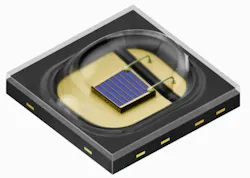
The ams OSRAM OSLON® Black SFH 4722CS A01 IR light-emitting diode (LED) is a high-power, AEC-Q102-qualified 940nm emitter designed specifically for automotive in-cabin sensing applications (Figure 1). These include driver monitoring, occupant monitoring, interior monitoring, gesture sensing, eye tracking, face tracking, and child-presence detection.
Figure 1: The ams OSRAM OSLON IR Black Automotive Series LEDs’ diverse lenses for different angles offer maximum design freedom. (Source: Mouser)
The SFH 4722CS A01 combines a double-stack emitter architecture with improved thermal dissipation and high-current pulse capability to deliver strong infrared output for camera-based sensing systems. Its reduced-red-glow output and 60° beam angle support uniform illumination for IR-sensitive image sensors while helping designers manage visible distraction and occupant comfort.
Tuesday’s Takeaway
As vehicle technology evolves, sensing systems are making passenger monitoring almost as important as road monitoring. Infrared sensing sits at the center of this transformation, providing the illumination needed for cameras and AI systems to operate reliably regardless of ambient conditions. For engineers designing next-generation automotive platforms, success will depend not only on sensors and algorithms but also on the optical infrastructure that enables them. With advances in infrared emitters and optics, the connected cabin is quickly becoming a safer, smarter, and more responsive environment.
This blog was generated with assistance from Copilot for Microsoft 365.
Sources
[1] https://www.federalregister.gov/documents/2024/01/05/2023-27665/advanced-impaired-driving-prevention-technology
[2] https://commission.europa.eu/news-and-media/news/safer-cars-safer-roads-new-rules-take-effect-2026-07-08_en
[3] https://www.autosinnovate.org/initiatives/innovation/autonomous-vehicles/levels-of-automation
[4] https://industrial.panasonic.com/ww/ds/ss/technical/ap2
Mouser Electronics, founded in 1964, is a globally authorized distributor of semiconductors and electronic components for over 1,200 industry-leading manufacturer brands. We specialize in the rapid introduction of the newest products and technologies targeting the design engineer and buyer communities. Mouser has 28 offices located around the globe. We conduct business in 23 different languages and 34 currencies. Our global distribution center is equipped with state-of-the-art wireless warehouse management systems that enable us to process orders 24/7, and deliver nearly perfect pick-and-ship operations.