LED Drivers Hit Automotive Triple Play: Small, Efficient, Low EMI

LEDs and autos may be a match made in heaven, but it’s one that still needs a “matchmaker” in the form of a suitable driver having the appropriate attributes with respect to size, efficiency, and EMI performance. The MAX25610A and MAX25610B LED-driver dc-dc converters from Maxim Integrated—nearly identical except for their 400-kHz and 2.2-MHz switching frequencies, respectively—address these objectives by integrating two power MOSFETs in 5- × 5-mm, thermally enhanced, 16-pin TSSOP-EP and 16-pin TQFN packages (see figure).
The converters support buck-, inverting buck-boost-, and boost-conversion configurations, and can deliver up to 3 A depending on mode (that’s up to eight high-brightness LEDs, typically). They operate from an input range of 5 to 36 V, while also withstanding 40-V load dumps associated with automotive environments. (The 2.2-MHz operation allows for the use of smaller inductors and thus smaller footprint, but with some tradeoffs.)
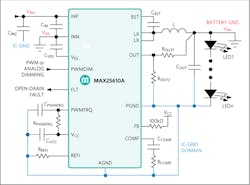
The MAX25610A (400-kHz) and MAX25610B (2.2 MHz) switching dc-dc converters from Maxim Integrated are highly integrated, efficient, low-EMI drivers for automotive LEDs, offering analog and PWM-dimming capability.
Efficiency of these devices reaches 90% in buck-boost mode. The LED drivers have an internal current-sense option and integrated 60-mΩ high- and low-side switching MOSFETs to reduce total solution space and cost. Dimming—a key consideration for automotive designs—uses both analog and PWM control to minimize the need for additional components or oversight, while offering a wide dimming range and high contrast ratio. To meet the auto industry’s stringent EMI requirements, the MAX25610A/B pair supports spread-spectrum operation and passes the stringent CISPR 25 EMI specification.
The dc-dc converters incorporate current-mode control that provides ±3% (MAX25610A) and ±6% (MAX25610B) LED-current accuracy, fast transient response, and ease of loop stabilization. Both devices also offer cycle-by-cycle current limiting, output overvoltage protection (OVP), open-string protection, output short-circuit protection (SCP), and thermal shutdown. They’re qualified to the AEC-Q100 standards including (but not limited to) its −40 to +125°C operating-temperature-range requirement.
The MAX25610A/B also incorporate two 5-V regulators. One is between VCC and analog ground and handles IC bias, analog dimming-control input (REFI), and PWM-frequency programming. The other is used between VEE and the ground side of the input supply (INN) for analog/PWM dimming and fault-indication output pullup.
The comprehensive datasheet provides full details on compensation, dimming setup, capacitor and inductor sizing, and PCB layout guidelines among other application insights, as well as graphs characterizing efficiency, dimming, regulation, and transient-response operating characteristics. Both the MAX25610A and the MAX25610B are priced at $2.10 each (1000-unit lots).

About the Author
 Bill Schweber
Bill Schweber
Contributing Editor
Bill Schweber is an electronics engineer who has written three textbooks on electronic communications systems, as well as hundreds of technical articles, opinion columns, and product features. In past roles, he worked as a technical website manager for multiple topic-specific sites for EE Times, as well as both the Executive Editor and Analog Editor at EDN.
At Analog Devices Inc., Bill was in marketing communications (public relations). As a result, he has been on both sides of the technical PR function, presenting company products, stories, and messages to the media and also as the recipient of these.
Prior to the MarCom role at Analog, Bill was associate editor of their respected technical journal and worked in their product marketing and applications engineering groups. Before those roles, he was at Instron Corp., doing hands-on analog- and power-circuit design and systems integration for materials-testing machine controls.
Bill has an MSEE (Univ. of Mass) and BSEE (Columbia Univ.), is a Registered Professional Engineer, and holds an Advanced Class amateur radio license. He has also planned, written, and presented online courses on a variety of engineering topics, including MOSFET basics, ADC selection, and driving LEDs.
Comment About the Article
To join the conversation, and become an exclusive member of Electronic Design, create an account today!
 Leaders Logo
Leaders relevant to this article: