Hydrogen Fuel-Cell Trucks to Support Port Newark Drayage Operations
What you'll learn:
- A $13 million grant will fund testing of six hydrogen fuel-cell-powered trucks at Port Newark starting in early 2026.
- Hyundai’s trucks will transport shipping containers from the port to warehouses and rail yards for 12 months of testing.
- The project aims to demonstrate how hydrogen can be used in real-world transportation operations.
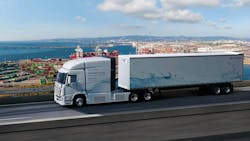
The Rutgers University Center for Advanced Infrastructure and Transportation (CAIT) in the School of Engineering is preparing to deploy and demonstrate hydrogen fuel-cell technology at Port Newark—a major container ship facility for goods entering and leaving the Northeastern United States. It’s part of an innovative pilot project funded ($13 million) by the New Jersey Economic Development Authority (NJEDA).
Hydrogen is a high-density energy carrier that allows fuel-cell electric vehicles (FCEVs) to provide a sustained power output suitable for long-haul driving and carrying heavy loads. Hydrogen fuel cells generate electricity using hydrogen and oxygen, producing only water and heat as byproducts.
In the trucking industry, this technology can support long driving ranges and quick refueling. And because hydrogen can be made from domestic resources, it offers potential benefits for energy security and economic development.
Specifics of the Rutgers-Hyundai Project
Rutgers CAIT, based in the School of Engineering, will manage project execution, performance tracking, and workforce development. The center will partner with Public Service Enterprise Group (PSEG), the Center for Transportation and the Environment (CTE), Hyundai Motor Company, and the Port Authority of New York and New Jersey.
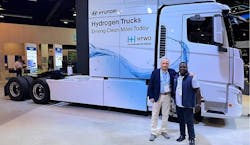
Hyundai’s XCIENT Fuel Cell Trucks will be used for this demonstration. The project will introduce six XCIENT heavy-duty trucks to support drayage operations — short-distance freight movement — at one of the East Coast’s busiest shipping terminals. These trucks will transport containers from the port to local warehouses and rail yards, replacing traditional diesel-powered drayage vehicles.
Jaehoon Chang, Vice Chair of Hyundai Motor Group, said, “With the rapid increase in power demand driven by the spread of AI, expanding renewable energy is essential. Hydrogen offers the most powerful solution to store and utilize renewable energy, complementing its intermittency and enhancing overall efficiency. By converting surplus electricity into hydrogen, we can ease the burden on power grids and make energy systems more flexible. Hydrogen is the ultimate game-changer for the future energy transition.”
Rutgers University will manage the project and lead the research, workforce development, and performance validation efforts. Partner PSEG will manage the fueling operations of the six hydrogen-powered trucks.
CAIT will work with project partner CTE to collect service data on existing drayage operations to establish key performance indicators (KPIs) and benchmarks for the zero-emission hydrogen trucks. After deployment, the trucks will operate under real-world conditions for 12 months, with KPIs tracked to assess the benefits and limitations of green hydrogen technology.
Project Data Findings to be Published
At the end of the pilot, the team will develop a comprehensive dataset and snapshot of the benefits and challenges associated with green hydrogen-powered drayage trucks. This includes shifts in fuel consumption rates, maintenance costs, and port utilization.
The team will also publish data on fuel efficiency, maintenance costs, and logistical effectiveness. The findings will help inform future public and private investments in hydrogen-powered transportation infrastructure.
The pilot project is expected to provide key insights into obstacles that the transportation industry may have to overcome to effectively implement, maintain, and operate green hydrogen-powered vehicles.
The demonstration project will proceed in phases, beginning with vehicle procurement, hydrogen fuel supply planning, and fueling station design.
Other Hydrogen and Decarbonization Efforts
Last year through the NorCAL ZERO Project, Hyundai Motor deployed 30 XCIENT Fuel Cell trucks at the Port of Oakland and Port of Richmond to haul freight containers and vehicles. This was the single largest commercial deployment of Class 8 heavy-duty hydrogen fuel-cell electric trucks in North America.
In Georgia, the company is dedicated to the Clean Logistics Project at its Hyundai Motor Group Metaplant America (HMGMA) to decarbonize the company’s production facility.
Hyundai Motor is actively working to decarbonize its captive logistics through its Clean Logistics Project. This year, the company will take a significant step by deploying XCIENT Fuel Cell trucks to its facility in Georgia. This deployment will begin efforts to reduce emissions from its internal logistics operations.
Hyundai Motor Group has a pilot project in Chungju, South Korea, which converts organic waste into hydrogen. The core processes involve:
- Extracting biogas from food waste through a process called anaerobic digestion.
- Converting the biogas into high-purity hydrogen.
- Supplying the hydrogen to an on-site refueling station for powering hydrogen vehicles.
The overall goal is to establish a resource-cycling energy system and build a complete hydrogen value chain.
The company also is collaborating with autonomous driving company Plus to enhance road safety and freight efficiencies. The two companies are testing Level 4 autonomous driving technology on XCIENT Fuel Cell trucks in the U.S., a first for a Class 8 fuel-cell electric truck in the country.
About the Author
Murray Slovick
Contributing Editor
Comment About the Article
To join the conversation, and become an exclusive member of Electronic Design, create an account today!
 Leaders Logo
Leaders relevant to this article: