Chery to Test Exeed EV with Solid-State Battery in 2026
What you'll learn:
- Chery Automobile first self-developed all-solid-state battery module that’s almost twice the energy density of today's lithium-ion batteries.
- Anticipated driving range distances.
- Worldwide solid-state battery shipments are projected to reach 614 GWh by 2030.

Introducing a game-changing technology is a bit like a baseball pitcher tossing a perfect game. Both events happen relatively infrequently, yet everyone knows there’s another one coming, but not exactly when or by whom.
Solid-state electric-vehicle (EV) batteries promise to be this kind of event, offering higher energy density, faster charging, improved safety, and longer lifespan compared to traditional lithium-ion batteries.
Solid-state batteries replace the liquid or gel electrolytes found in conventional lithium-ion batteries with solid electrolytes, typically made from ceramic or polymer materials. This structural change allows for the use of a metallic lithium anode, which significantly increases energy-storage capacity and reduces the risk of flammability associated with liquid electrolytes.
What’s more, solid-state batteries tend to degrade less over time, enabling more charge/discharge cycles compared to their liquid counterparts.
SSB Challenges Ahead
At the moment, however, all-solid-state batteries still face a series of challenges, including short-term difficulty in mass production and high costs.
Right now, an all-solid-state battery is estimated to cost 2.8X more than a standard liquid-electrolyte battery. This high price is due to expensive raw materials and low production yields, meaning it’s very difficult to build them efficiently at scale.
According to analysts at the China-based research institution EVTank, worldwide solid-state battery shipments are projected to reach 614 GWh by 2030. That would be more than 10% of the total battery market, worth over $34 billion
Doubling the Energy Density
Chery Automobile recently unveiled its first self-developed all-solid-state battery module. The prototype said to achieve a gravimetric energy density of up to 604 Wh/kg and a volumetric energy density of 1,027 Wh/L, almost twice the energy density of today's lithium-ion batteries.
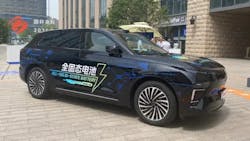
The Chery Solid-State Battery Research Institute developed the module, adopting an in-situ polymerized solid-electrolyte system paired with a lithium-rich manganese cathode material.
According to Chery, the cell maintained power delivery even after abuse tests, such as nail penetration and power-drill damage, without catching fire. In theory, vehicles equipped with this technology could exceed 1,500 km on a single charge, with real-world driving ranges expected to reach 1,300 km.
The company has stated its plans for a pilot operation in 2026 and a broader rollout in 2027.
The first vehicle scheduled to employ the solid-state battery is the Exeed ES8. Exeed Automobile Co. Ltd. is an automotive division of premium sport utility vehicles introduced by Chinese automobile manufacturer Chery in September 2017.

The ES8 includes features such as Huawei's HarmonyOS — a distributed operating system developed by Huawei for smartphones, personal computers, and other smart devices — a Qualcomm Snapdragon 8295 chip, four-wheel steering, a 15.6-in. central touchscreen, and LiDAR. There’s also preparation for an autonomous-driving system that can be over-the-air (OTA) upgraded to L3 and L4 autonomous driving functions in the future.
Other SSB Developments
Elsewhere in China, a team led by Professor Zhang Qiang from the Department of Chemical Engineering at Tsinghua University has proposed a strategy for designing a novel fluorinated polyether polymer electrolyte. It would create a fluorine-rich anionic structure that stabilizes high-energy lithium-rich manganese-oxide (LRMO) cathodes, enabling stable, high-capacity anode-free batteries.
The researchers who developed this new type of fluorinated polyether electrolyte recently published their findings in the journal Nature. The fluoropolyether-based electrolyte pouch cells are said to exhibit an energy density of 604 Wh kg−1 (1,027 Wh l−1) during 120°C high-temperature tests, and safety under a nail penetration at a fully charged condition.
Developments like these could redefine expectations for long-range EVs by doubling today’s typical driving range and advancing China’s position in next-generation battery technology.
About the Author
Murray Slovick
Contributing Editor
Comment About the Article
To join the conversation, and become an exclusive member of Electronic Design, create an account today!
 Leaders Logo
Leaders relevant to this article: