The 2025 Space Race: What Happened, What Didn’t, and What’s Coming Next
What you'll learn:
- How commercial launch providers reshaped space activity in 2025 while government exploration programs faced schedule pressure.
- Which major lunar and deep-space milestones didn’t happen in 2025, and why those delays matter.
- What missions, vehicles, and infrastructure developments are expected to drive the space race in 2026.

The space race in 2025 wasn’t defined by a single historic landing or a dramatic first, but rather momentum. Launch windows increased, commercial space cemented its role as the industry’s growth engine, and long-promised exploration programs continued moving forward, although more slowly than originally planned. Instead of a breakthrough year, 2025 became a transition point, setting up several critical milestones that now spill into 2026.
Commercial launch providers dominated activity in orbit throughout the year. SpaceX continued operating at a pace unmatched by any other launch provider, expanding its Starlink constellation via Falcon 9 rockets while refining reusability and operational efficiency.
Redefining Low Earth Orbit
The volume of launches underscored how space access has shifted from rare events to routine deployment. Low Earth orbit is no longer just a destination for science missions. It’s become a working environment supporting communications, defense, and Earth observation on a global scale.
At the same time, competition in heavy-lift launch capability finally became competitive. Blue Origin’s New Glenn rocket made its long-awaited debut, signaling a new contender into a market historically dominated by SpaceX and government-backed vehicles. While New Glenn hasn’t matched Falcon Heavy’s launch schedule, its arrival introduces redundancy and competition, both key challenges for government and commercial customers looking to diversify launch options heading into the last half of the decade.
NASA’s Artemis program remained a focal point of the government-led space race, though progress came with familiar caveats. Hardware integration continued with Orion and the Space Launch System, but Artemis II, the first crewed lunar flyby mission, dropped from a late-2025 target into early 2026. The delay cascaded forward, further pushing Artemis III, the mission intended to return humans to the Moon’s surface, beyond its original schedule.
These shifts reinforced a growing reality: Deep-space human exploration is advancing, but not on the original timelines due to engineering complexity and political ambition.
Lunar Landscape
Moon exploration did see meaningful progress via commercial partnerships. Firefly Aerospace successfully landed its Blue Ghost lunar lander (Fig. 1) in early 2025, delivering payloads under NASA’s Commercial Lunar Payload Services program.
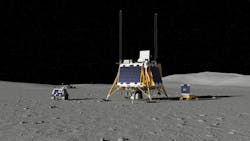
The mission demonstrated that smaller, private companies can reach the Moon and operate there, even as other efforts, such as ispace’s second Hakuto-R attempt, fell short. The mixed results highlighted both the promise and the risk that comes with commercial lunar exploration, where innovation moves quickly but margins remain thin.
Notably absent in 2025 was a fully operational Starship system. SpaceX continued flight testing throughout the year, focusing on vehicle design, crew safety, and recovery techniques. While several milestones were achieved, Starship did not yet reach the level of operational readiness required for its role as NASA’s lunar human landing system. As a result, Starship remains a central dependency for Artemis III and beyond, tying NASA’s lunar ambitions to SpaceX’s development timeline.
By the end of 2025, the space race had become less about national prestige and more about infrastructure. Satellites, launch vehicles, lunar landers, and space stations are increasingly viewed as interconnected systems rather than isolated missions. Governments still set strategic goals, but private companies now build and operate much of the hardware that makes those goals achievable.
What are the Expectations for 2026?
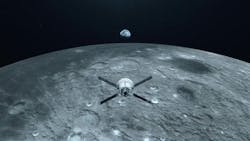
Looking ahead to 2026, several long-delayed milestones are expected to converge. NASA is targeting Artemis II for a crewed lunar flyby (Fig. 2), a mission that would mark humanity’s first return to the moon since Apollo. Starship is slated to move closer to operational status, with orbital refueling demonstrations becoming a critical focus. Success in that area would unlock not only lunar missions, but also future Mars-bound advances.
Commercial activity is also expected to intensify. Additional lunar landers are scheduled under CLPS and international programs, while satellite constellations will further expand. Analysts expect increased focus on space-based infrastructure, including communications, navigation, and Earth monitoring, over symbolic exploration. Even long-term ambitions, such as Mars cargo missions, are increasingly thought of as engineering validation exercises rather than headline-grabbing events.
In retrospect, 2025 will be remembered as a year where the modern space race matured. The technology advanced, the business models stabilized, and the limitations became clearer. The dramatic moments may have been delayed, but the groundwork was laid.
If 2026 delivers on even a portion of what’s now scheduled, it could mark the moment when years of incremental progress finally turn into visible, historic achievements that go beyond Earth’s orbit.
About the Author
 Cabe Atwell
Cabe Atwell
Technology Editor, Electronic Design
Cabe is a Technology Editor for Electronic Design.
Engineer, Machinist, Cartoonist, Maker, Writer. A graduate Electrical Engineer actively plying his expertise in the industry and at his company, Gunhead. When not designing/building, he creates a steady torrent of projects and content in the media world. Many of his projects and articles are online at element14 & SolidSmack, industry-focused work at EETimes & EDN, and offbeat articles at Make Magazine. Currently, you can find him hosting webinars and contributing to Electronic Design and Machine Design.
Cabe is an electrical engineer, design consultant and author with 25 years’ experience. His most recent book is “Essential 555 IC: Design, Configure, and Create Clever Circuits”
Cabe writes the Engineering Life & Engineering on Friday blog on Electronic Design.
See Cabe's cartoons & comic strips here.


Comment About the Article
To join the conversation, and become an exclusive member of Electronic Design, create an account today!
 Leaders Logo
Leaders relevant to this article: