5G Wireless Telematics Tech Targets Autonomous and Software-Defined Vehicles

Hyundai Mobis’ MTCU telematics solution brings 5G into the automotive fold, enabling capabilities such as high-precision map services and remote control for autonomous driving.
Jan. 26, 2026
3 min read

What you'll learn:

  • The current 4G-based telematics market is evolving with 5G technology, enabling high-precision map services and remote control.
  • Hyundai Mobis’ telematics solution (MTCU) is capable of 5G wireless communication.
  • 5G solutions are also essential for SDV transformation, and the company aims to complete product development in the first half of this year.

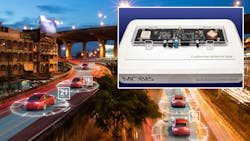
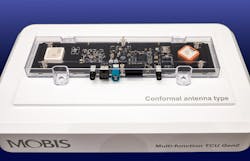
As global automakers prepare for mass-production applications to enhance connected car services, Hyundai Mobis is developing a 5G wireless communication-based, antenna-integrated telematics solution (Multi-function Telematics Control Unit, henceforth abbreviated MTCU) to strengthen its automotive electronics. 

Telematics is a driver convenience technology that integrates information and communication technology into vehicles to provide functions such as driving route guidance, accident and theft detection, and remote control.

Making the Leap to 5G Telematics

With the mobile communication generation transitioning from 4G to 5G, market competition in the mobility sector is intensifying, particularly around the development of high-specification, multifunctional telematics products. Currently, most vehicle telematics functions worldwide operate on 4G mobile communication. Hyundai Mobis is also currently mass-producing and supplying 4G-based telematics products.

"To achieve rapid market entry in the next-generation connected car service sector, we will complete product development by the first half of this year and secure market leadership in the global market," said Jung Soo-Kyung, Executive Vice President and Head of the Automotive Electronics Business Unit at Hyundai Mobis.

5G-based telematics technology enables new services such as high-precision map services, remote control for autonomous driving, and ultra-high-definition streaming.

Currently, 4G-based communication only allows services like over-the-air (OTA) updates, car-to-home services (connecting vehicles to smart homes), and infotainment content streaming. This 5G-based control solution is also recognized as an essential technological capability required to respond to the shift toward software-defined vehicles (SDVs).

The solution being developed by Hyundai Mobis eliminates the need for externally protruding antennas, integrating antenna functionality into the built-in controller. This design offers the advantage of a sleeker vehicle appearance.

Making It Happen Through Collaboration

To secure this technology early, Hyundai Mobis is collaborating with various mobile communications modem, data-transmission/reception, and signal-conversion device specialists, including Korea's AM. This company was established in 2001. It entered the M2M module business in 2006 and commercialized the world’s first dual-mode (3G+TRS) mobile phone in 2008.

AM’s M2M modules can be widely used in telecommunication apps from CDMA to LTE. They’re found in such various uses as telecommunication systems, security systems, telematics, healthcare systems, smart grids etc.

Hyundai Mobis claims to be the global number 6 automotive supplier, headquartered in Seoul, Korea. It has expertise in sensors, sensor fusion in electronic control units (ECUs) and software development for safety control.

The company's products also include various components for electrification, brakes, chassis and suspension, steering, airbags, lighting, and automotive electronics. Its R&D headquarters are in Korea, with four technology centers in the United States, Germany, China, and India.

In other news, Hyundai Mobis and Qualcomm Technologies Inc. signed a comprehensive agreement to co-develop next generation solutions for SDV and advanced driver-assistance systems (ADAS).

Through this collaboration, they will develop integrated solutions tailored for emerging markets while pursuing broader global supply opportunities by leveraging the combination of Hyundai Mobis’ experience in system integration, sensor fusion, and perception with Qualcomm’s capabilities in system-on-chip (SoC) technology.

Hyundai Motor Group also announced the appointment of Dr. Minwoo Park as head of its advanced vehicle platform (AVP) division and CEO of 42dot, an autonomous-driving software and mobility platform development startup, to strengthen its SDV and autonomous driving-based vehicle software competitiveness.

Park brings expertise from such tech companies as NVIDIA and Tesla, where he led autonomous-driving development from research through to commercialization.
About the Author

Murray Slovick

Contributing Editor

Sign up for our eNewsletters
Get the latest news and updates

Voice Your Opinion!

To join the conversation, and become an exclusive member of Electronic Design, create an account today!