Joint Efforts Put 900-V EV Platforms on the Fast Track
What you'll learn:
- Features of onsemi's EliteSiC M3e MOSFETs that lend themselves to the creation of high-voltage EV platforms.
- Details behind onsemi's strategic collaborations with NIO and Geely to deliver 900-V electric-vehicle platforms.

To bolster EV performance, it’s essential to continually update and design products with extended driving range, significantly reduced charging times, and faster acceleration. To make it happen, electric-vehicle (EV) automakers are moving from 400-V to next-generation 900-V platforms. By increasing voltage, automakers can deliver more power with less heat and energy loss, which translates directly into faster charging times, longer driving range, and more consistent performance.
onsemi and NIO
On that front, onsemi announced an expanded strategic collaboration with NIO Inc. to advance EV platforms. EliteSiC solutions from onsemi are the catalysts for such an advance by handling higher voltages with what’s said to be greater efficiency and reliability, all essential for EV adoption.
The EliteSiC power modules offer bare-die solutions, gel-encapsulated case modules, and transfer molded modules, all incorporating full silicon-carbide (SiC) MOSFETs. The partnership leverages onsemi’s enhanced EliteSiC M3e technology to improve efficiency.
In addition, onsemi said that by enabling higher power density, its technology allows more performance to be packed into a smaller, lighter system, contributing to improved vehicle dynamics and interior space. The company adds that its SiC technology can handle higher voltages with better efficiency than traditional silicon.
Its enhanced thermal performance helps to maintain consistent output during demanding driving conditions while supporting long-term reliability. As a result, drivers can benefit from quicker starts, smoother power delivery, and longer range with less time spent charging.
The collaboration builds on a partnership that began with the EliteSiC technology supporting NIO’s 400-V platforms. Today, EliteSiC underpins NIO’s transition to 900-V architectures, including in its latest flagship SUV, the ES9, and additional models debuting at the 2026 Beijing Auto Show.
EliteSiC enhanced M3e technology delivers optimized switching performance through improved body-diode characteristics, reducing energy losses (Eon) while maintaining strong short-circuit robustness. These advances translate into higher system output, improved thermal performance, and increased overall drivetrain efficiency. For drivers, this means:
- More miles from every charge by reducing energy lost as heat in the powertrain.
- Stronger, more consistent acceleration, including at highway speeds and under load.
- Shorter charging times, supported by high-voltage, fast-charging systems.
- Reliable performance over time, with power systems designed to operate under demanding conditions.
onsemi and Geely
China-based Geely Auto Group Co. Ltd. has also expanded its global strategic collaboration with onsemi. The chipmaker's silicon-carbide power technology will be integrated across vehicles built on Geely’s SEA-S (Sustainable Experience Architecture - Super Hybrid) platform to drive faster, more efficient EV development.
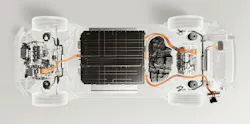
SEA-S is a specialized 900-V, high-performance platform designed for premium electric and "super hybrid" vehicles that incorporates onsemi’s EliteSiC power technologies at the heart of its electric drive systems. SEA-S is a modular platform developed by Zeekr Technology Europe (previously China Euro Vehicle Technology), a company based in Gothenburg, Sweden within Geely Automobile Holdings group of companies.
These next-generation vehicles are designed to take full advantage of high-voltage 900-V architectures, delivering faster acceleration, extended driving range, and significantly reduced charging times.
EliteSiC M3e MOSFETs
By supporting system-level integration, onsemi is helping customers bring scalable, higher-performance EV platforms to market more quickly The EliteSiC M3e MOSFETs also offers what is the company claims to be the industry’s lowest specific on-resistance with short-circuit capability — critical for the traction inverter market that dominates SiC volume.
Packaged in onsemi’s discrete and power modules, the 1,200-V M3e die is said to deliver substantially more phase current than previous EliteSiC technology, resulting in about 20% more output power in the same traction inverter housing.
Conversely, a fixed power level can now be designed with 20% less SiC content, saving costs while enabling the design of smaller, lighter, and more reliable systems. This approach is becoming increasingly important as automakers transition to higher-voltage architectures and more advanced electric drive systems.
Previously, EliteSiC M3e SiC technology powered an 800-V drive platform featured in select YU7 electric sport utility vehicle (SUV) models made by China-based Xiaomi. Models feature an advanced 800-V drive platform powered by the EliteSiC M3e technology.
About the Author
Murray Slovick
Contributing Editor
Comment About the Article
To join the conversation, and become an exclusive member of Electronic Design, create an account today!
 Leaders Logo
Leaders relevant to this article: