New Coherent LiDAR Expands 3D Sensing
What you'll learn:
- How coherent LiDAR is able to instantly measure both a target's distance and its velocity.
- The main reason behind the faster and richer measurement returns: a coherent optical modem.
- Why the platform could lead to safer autonomous vehicles and sensing systems that work better in poor visibility.
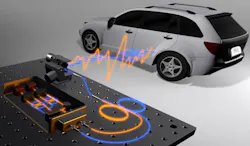
Most commercial LiDAR systems, such as those found in autonomous cars, primarily measure distance. LiDAR uses laser pulses to determine where surfaces are located and build a 3D understanding of objects around the vehicle.
To be sure, a vehicle doesn’t simply need to know that something is in the road. It needs to understand what it’s viewing: a sign, pavement, pedestrians, or another vehicle.
So, interpreting what these sensors see in most cases also requires input from other sensors, such as cameras, radar, and thermal imagers, that capture infrared heat signatures and translate them into visible images.
Going forward, coherent LiDAR may be able to shoulder more of the perception workload because it natively delivers 4D data—instantly measuring both a target's distance and its velocity.
The main benefit of LiDAR over radar is that the light used has a very short wavelength, which enables precise measurements to be taken.
Here’s how it works: A laser pulse is fired, which starts a timer. It’s stopped when the echo of the laser pulse is received, and the range can be calculated from the elapsed time.
Richer Data from Each LiDAR Return
In the journal Optica, researchers from the University of Toronto, the Vector Institute (a non-profit AI research facility based in Toronto, Canada), Ciena (an optical networking and AI-driven network automation infrastructure company) and POSTECH (Pohang University of Science and Technology, a research university in South Korea) reported on the Polarimetric Full-Wavefield Coherent LiDAR. It’s able to uncover deeper information from each measurement.
The system measures depth, velocity, and polarization properties at the same time. It can help determine the location of an object and how fast it’s moving. The platform achieves material-sensitive sensing via how light interacts with its surface.
The researchers developed a LiDAR system that uses a coherent optical modem as the transmitter and receiver. This made it possible to send and detect multiple properties of light with extremely high speed and precision. In turn, the system is able to extract far more information from each measurement than is possible with a conventional LiDAR system.
Like the backing singers on an old Motown hit song, this new LiDAR system smoothly and seamlessly supports the headline act. By analyzing frequency shifts, the system calculates the exact speed of moving objects in real-time. Mixing the return signal with a local oscillator amplifies the weak return light, allowing the system to operate at lower laser powers while maintaining long-range detection.
Coherent detection also acts as an optical filter, largely ignoring ambient sunlight and noise that would overwhelm standard sensors.
Simplifying the Sensor Stack
The new system measures how the polarization properties of light change after interacting with the target surface, enabling it to recover distance, velocity and material properties.
A Doppler velocity map identifies a moving vehicle and separates it from the static background. And a polarization map reveals material-sensitive details not resolved by depth or intensity, including the sign text and difference between artificial and real plant life. Together, they address blind spots in traditional vision and depth-sensing technologies
What’s more, algorithms were developed that can disentangle these effects to produce clean estimates of distance. The researchers also developed a new way to make sense of the measurements, which are difficult to recover and are degraded by noise and distortions induced by the LiDAR system’s internal optics.
They showed that the LiDAR system could recover surface properties of materials such as metals, plastics, and objects with varying surface roughness.
Coherent Detection and FMCW
Another benefit of coherent LiDAR is that the bandwidth of the signal chain is fairly low — the photodiode bandwidth can be restricted to a few hundred MHz.
There are different ways to implement a coherent detection LiDAR system. However, the most popular is via frequency-modulated continuous-wave (FMCW) modulation.
Coherent detection – and particularly FMCW – bring with them several advantages for applications such as ADAS and autonomous vehicles, where <1-km range is required and there’s a high likelihood that other, potentially interfering LiDAR systems are deployed. They include immunity to interference, high signal-to-noise ratio, native high-accuracy velocity detection (to provide additional information to perception systems), and ease of system modification.
Smarter Sensing
The larger promise is that LiDAR can do more than map shapes by helping machines understand physical conditions.
In the near term, this work is still at the research/prototype stage. But future sensing systems based on this technology could help machines understand the physical world better.
>>Check out this TechXchange for similarly themed articles and videos
 promo_id_132400435__akarat_phasura__dreamstime
About the Author
Murray Slovick
Contributing Editor
Comment About the Article
To join the conversation, and become an exclusive member of Electronic Design, create an account today!
 Leaders Logo
Leaders relevant to this article: