Bi-SCR-Based EMC Protection Strengthens Automotive IC Reliability
What you'll learn:
- Details of the new Bi-SCR technology that enables complete on-chip control of harsh system-level EMC environments.
- Earlier, the company announced it successfully developed a SiC planar MOSFET process platform for 450 to 2,300 V, securing high reliability and yield competitiveness.
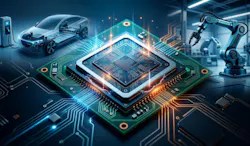
As more electronic components continue to flow into vehicle designs, ensuring the reliability of semiconductors to operate without malfunction even under extreme electrical stress conditions has emerged as a core challenge.
To address this issue, SK keyfoundry, an 8-inch foundry in Korea, has developed on-chip electromagnetic compatibility (EMC) protection technology based on a bidirectional silicon-controlled rectifier (Bi-SCR). It’s said to be capable of enhancing the EMC of automotive semiconductors.
A traditional silicon-controlled rectifier is a unidirectional device that conducts current in only one direction from anode to cathode. On the other hand, a bidirectional SCR allows current flow and power control in both positive and negative directions. Unlike standard SCRs, a bidirectional switch handles alternating current (AC) seamlessly across both half-cycles
The company stated it successfully applied this technology to its 0.13-µm BCD (bipolar-CMOS-DMOS) process products and has entered mass production. BCD process technology combines analog (bipolar), digital (CMOS), and power (DMOS) transistors onto a single silicon die.
Conventional electrostatic-discharge (ESD) protection devices are designed to safely clamp high-voltage spikes and divert excess current away from sensitive microelectronics. However, they were primarily limited to controlling momentary discharges during the chip manufacturing or assembly processes.
This newly developed technology enables complete on-chip control of harsh system-level EMC environments. It includes those required by automotive standards such as ISO 10605, where electrical stress can occur continuously during vehicle operation.
The familiar ESD, due to charge build-ups generated, for example, when moving about inside a vehicle or getting out of it, has assumed greater significance with the increase of vehicle electronic modules. ISO 10605 (Road vehicles − Test methods for electrical disturbances from electrostatic discharge) is the international standard used to test immunity compliance of electronic components in automotive applications.
Optimizing the Protection Capabilities of Auto Power ICs
The “Bi-SCR” structure implemented by SK keyfoundry claims to offer flexible trigger-voltage adjustment and high-current handling capability. In particular, it’s said to possess high area efficiency, optimizing the protection capabilities of automotive power ICs, which face severe space constraints and require high integration. The “on-chip” solution can effectively control EMC stress internally without the need for external protection components such as transient voltage suppressor (TVS) diodes, which were previously essential in system designs.
According to SK keyfoundry, this achievement was made possible by combining SK keyfoundry's automotive BCD process technology with its EMC and ESD protection design capabilities. Leveraging this mass production capability as a stepping-stone, the company plans to continuously expand its portfolio of protection devices based on high-voltage LDMOS, bipolar junction transistors (BJTs), SCRs, and diodes.
Furthermore, it aims to strengthen market competitiveness across various automotive applications that require high reliability, such as automotive power-management ICs (PMICs), motor drivers, and power-control ICs.
"In the recent automotive semiconductor market, beyond simple component-level ESD performance, 'EMC robustness' under actual harsh automotive electronic system environments is emerging as a core competitive edge," said Derek D. Lee, CEO of SK keyfoundry. "The successful mass production and application of this Bi-SCR-based on-chip EMC protection technology is a significant technological milestone that has elevated the reliability and system stability of automotive semiconductor products to the next level."
He added, "We will continue to strengthen the high-reliability, high-voltage, and high-efficiency process platforms demanded by our automotive customers and solidify our differentiated foundry competitiveness."
450- to 2,300-V SiC Planar MOSFET Process Platform
In other SK keyfoundry news, earlier the company announced that it completed the development of silicon-carbide (SiC) planar MOSFET process platform, which is gaining traction in the next-generation compound power semiconductor market. The company revealed that it has secured an order for the development of a 1,200-V SiC MOSFET product from a new unnamed customer, marking its full-scale entry into the Si.
Following prototype evaluation and reliability verification, the company plans to begin full-scale mass production in the first half of 2027.
About the Author
Murray Slovick
Contributing Editor
Comment About the Article
To join the conversation, and become an exclusive member of Electronic Design, create an account today!
 Leaders Logo
Leaders relevant to this article: