A Flood of EV FUD and Disinfo
What you’ll learn:
- While nearly every developed nation is rapidly adopting clean energy, electrified transportation, and other sustainable technologies, America is doubling down on its commitment to fossil fuels.
- This trend has been accompanied by a surge in press releases, reports, and other pronouncements that portray EVs and renewable energy as inconvenient, unreliable, and economically impractical.
- A closer look at their data sources and analytic methodologies raises questions about the accuracy of the claims they make, and the motivations of the groups that promote them.
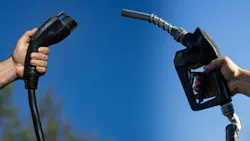
Is the recent surge of anti-EV propaganda proof that the transition to green transportation is stalled? Or is it a sign that industries whose fortunes are built on internal combustion technologies are undergoing an extinction burst, a phenomenon which often precedes the rejection of a dysfunctional behavior, or the rapid decline of a dominant species?
I’m asking because over the past year, my inbox and LinkedIn feeds have become choked with a growing flood of FUD (fear, uncertainty, and doubt), half-truths, and disinformation about renewable power, EVs, and the fossil fuels they’re in the process of displacing (see figure).

Unfriendly Persuasion
The pro-fossil propaganda I receive ranges from “public service messages” from Exxon-Mobil and Chevron, to half-baked opinion pieces from the Heritage Foundation, the Consensus Institute and other billionaire-funded “think tanks.” Most of these “authorities” use suspiciously similar sets of cherry-picked facts and provably false claims to downplay the threat of climate change while encouraging continued dependence on coal, gas, and oil.
Other common tactics include questioning the environmental benefits of EVs, or promoting hydrogen as an “alternative” fuel, despite its high cost and dismal efficiency. Unsurprisingly, much of the funding for disinformation about EVs can be traced to organizations with apparent ties to the same fossil-fuel interests, as well as some being supported by “laggard” automakers continuing to focus on selling ICE-based transportation solutions.
I’m also seeing many of these points of disinformation popping up in random mailings from smaller businesses and self-appointed “industry experts.” Their motivations are often unclear, but it appears that many of them are simply taking advantage of the surge in anti-EV propaganda to promote whatever random agenda they happen to have.
One recent example of this practice came from Evan Cox at a firm called Law Bear, a firm that appears to specialize in automotive injury lawsuits. In one of the strangest marketing ploys I’ve seen this year, Mr. Cox pitched me a story line that he wanted me to write about a study that supposedly identified “the most inconvenient states for driving EVs.” (see the original email below)
I was about to hit the Delete key when I noticed that the study ranked my home state of New Jersey as “the least convenient state for EV owners.” As a New Jersey-based EV owner, pride and curiosity overrode common sense, and I decided to fact-check Mr. Cox’s claims.
It only took a few minutes to learn that the official-looking study had used data sources ranging from being relatively accurate to very questionable. And even when the data was accurate, the authors used flawed methodologies and obviously biased assumptions to reach conclusions that only bore a passing resemblance to reality.
Questionable Data, Flawed Premises, Distorted Conclusions
One of Law Bear’s strongest assertions about the pain of EV ownership is the relatively low number of public charging facilities. With 74 vehicles per commercial station, each of which is equipped with between two and eight chargers, the study says that there are 22 EVs vying for the use of each available public charging port. I’m not sure where Law Bear got its numbers from, but my research shows the situation to be even "worse,” with the actual number of EVs per station closer to 110.
This may seem alarmingly inconvenient, until you take a closer look at the data — and apply a small dose of reality.
Let’s start with the basics:
- A 2025 report from the NJ Motor Vehicle Commission said that the state had 6,431,666 registered vehicles cruising its roads, of which 206,271 were battery-electric vehicles (BEVs). This accounted for 3.5% of the fleet, and 11.96% of the state’s new car sales.
- According to US EV Charging Stations.com, as of August 2026, New Jersey had 1,883 public EV charging stations with 6,255 charging ports. This translates to 110 cars per charging station, or 32 cars per charging port.
- That looks pretty bad for EVs, until you consider that there are over three times as many ICE vehicles competing for each spot at one of New Jersey’s conventional gas stations. According to poidata.com, there are 2,462 gas stations in New Jersey, providing fuel to the state’s roughly 6,200,000 ICE vehicles. This means that NJ’s gas/diesel car owners are presently competing with 252 other vehicles for a space at a gas station.
What’s more, Law Bear’s study conveniently ignores the fact that many of NJ’s EV owners have home chargers and rarely, if ever, use public charging facilities. Unfortunately, the only data about residential charging installations I could find came from the State of New Jersey’s ChargeUp rebate program, which has already provided rebates to 13,846 homeowners for installing chargers in their homes. But, since nearly every EV owner I have met has one, I have good reason to believe that the number of people who charge at home is significantly higher.
In addition, the study fails to include the small, but steadily growing, number of apartment complexes and condominiums that offer private charging services to their residents. As a point of reference, ChargeUp’s Multi-Unit Dwellings (MUD) EV Charging Program has provided another 604 rebates for multi-vehicle charging systems, which have already added another 1,713 private charging ports throughout the state.
Finally, Law Bear factors NJ’s high electricity costs into its inconvenience ranking. However, it fails to mention that, besides reducing the load on commercial charging stations, the many EV drivers who use home chargers pay about half of the $0.42-$0.50/kWh prices levied by most commercial Level 3 Fast Charge services.
Follow the Money
These are only a few examples of how Law Bear’s study begins with the conclusion it wants to reach and then adjusts the facts to fit. Another ding to its credibility is the fact that one of the primary sources for the study is the Tax Foundation, a libertarian think tank that publishes studies on U.S. tax policies.
Media Bias Fact Check describes the Tax Foundation as a “Right-Center organization” and rates it as “Mostly Factual” because it “often publishes factual information but utilizes loaded words (wording that attempts to influence an audience by using appeal to emotion or stereotypes) to favor conservative causes.” This shouldn’t come as any surprise, since much of the Foundation is largely funded by corporate interests with ties to the fossil-fuel industry, including the Koch Brothers and Exxon-Mobil.
Law Bear’s “news item” is only one example of the many well-funded disinformation campaigns I’ve seen. These appear to be attempts at keeping our nation in a state of denial about the geopolitical tensions, environmental concerns, and economic realities that make continued dependence on fossil fuels a very bad long-term bet.
While denial may be a reasonable coping mechanism for some individuals with life-threatening illnesses, it’s an unacceptable practice for industries and institutions whose decisions affect the lives of millions of others.
Postscript: Please note that the opinions expressed here are solely my own and open for debate. In the interest of fairness and full disclosure, below I’ve included an unedited copy of the story pitch Law Bear sent me below so you can draw your own conclusions. And, as always, your thoughts are welcomed in the comments section at the end of this story, or you can share them with me by email me by clicking on this link.
Here is a copy of the original email I received from Evan Cox at Law Bear:
From: Evan Cox <[email protected]>
Date: Mon, Sep 7, 2026, 10:54 AM
Subject: New Data Ranks America's Least EV-Friendly States
To: <[email protected]>
Hi Lee,
Federal funding for EV charging infrastructure was reduced to $300 million for 2026, leaving the national charging deficit largely unaddressed. According to a September 2026 report on the challenges of owning electric vehicles, New Jersey is the least convenient state for driving an EV. The study by Law Bear, an attorney-matching platform, examined all 50 states based on charging infrastructure, costs, and climate conditions affecting EV batteries.
- New Jersey is the least convenient state for EV owners, with 74 registered electric vehicles competing for each charging station.
- Hawaii and Alaska charge the most for electricity at nearly 50 cents per kWh, making each trip in an EV significantly more expensive than mainland alternatives.
- Drivers in Washington are required to pay an extra $150 each year just for owning an electric vehicle, on top of standard registration costs.
The research analyzed six factors that affect how practical it is to own an electric vehicle. This included how many EVs share each charging station, how many vehicles compete for individual charging ports, and electricity costs per kilowatt-hour. The study also looked at state tax credits for EV purchases, annual registration fees specific to electric vehicles, and average temperatures that impact battery performance. States received an EV Inconvenience Score from 0 to 100, where higher numbers mean more challenges for electric car drivers.
Here's a look at the top 10 least convenient states for EV ownership:
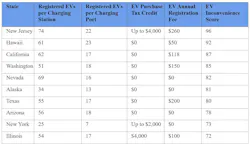
You can access the complete research findings here.
- New Jersey
- Registered EVs per charging station: 74
- Registered EVs per charging port: 22
- EV purchase tax credit: Up to $4,000
- EV annual registration fee: $260
- EV Inconvenience Score: 96
New Jersey is America's least convenient state for owning an electric vehicle. With nearly 135K EVs on the road but only 1,829 charging stations, drivers here have a hard time charging their cars on time. These numbers mean that for every charging port, there are 22 EVs, which suggests long wait times during peak hours. The state does offer up to $4,000 in tax credits for new purchases, but then still charges a high $260 annual registration fee.
- Hawaii
Hawaii comes second as one of the toughest places to own an EV. The state has about 25.6K electric vehicles but only 420 charging stations across all islands, resulting in 61 cars competing for each location. Hawaii also charges 48 cents per kilowatt-hour for electricity, nearly 10 cents more than the national average, so driving an electric vehicle here costs as much as fueling a gas car in many mainland states. Unlike New Jersey, the state provides no purchase incentives for EV buyers either.
- California
California takes third place despite having the largest EV fleet in America. More than 1.2 million electric vehicles are registered here, but even with 20,166 charging stations, that still means every location has to serve more than 60 cars. Similar to Hawaii, California offers no state tax credits for purchases and charges $118 in annual registration fees. Neighboring Nevada, by contrast, provides residents up to $7,500 in purchase credits, making owning EVs more affordable across the border
- Washington
Washington ranks fourth among the least convenient states for driving an EV. The state registers about 152K electric vehicles and operates up to 3,000 charging points. This comes down to more than 50 EVs sharing each station, meaning residents might have to wait in long lines to power their cars. Another drawback of Washington is no tax credits when buying a new electric vehicle. Plus, drivers here face cooler temperatures of 48°F that can reduce battery efficiency and cut driving range.
- Nevada
Nevada rounds out the worst five states to own an EV. With 47.3K registered electric vehicles and only 683 plug-in spots, local drivers may often face congestion when charging their cars. The stations here do have more ports than coastal states, though, averaging 16 cars for every unoccupied charger. Unlike neighboring California, Nevada doesn't ask for annual fees from EV drivers. But the state still offers zero purchase incentives to offset purchase costs.
A spokesperson from Law Bear commented on the study:
"We often hear that EVs help you save money, but the reality is more complicated. The average electric vehicle costs over $40K, and in some states, electricity rates are so high that charging expenses can add up fast. EVs depreciate faster than gas cars, too, meaning you lose more money when it's time to sell. Electric vehicles are the future, sure, and they promise better safety. But whether getting one now makes financial sense is still up for debate."
ENDS
When using the data, please credit: https://lawbear.com/
About the Author
 Lee Goldberg
Lee Goldberg
Contributing Editor
Lee is the author of the popular PowerBites series.
Lee Goldberg is a self-identified “Recovering Engineer,” Maker/Hacker, Green-Tech Maven, Aviator, Gadfly, and Geek Dad. He spent the first 18 years of his career helping design microprocessors, embedded systems, renewable energy applications, and the occasional interplanetary spacecraft. After trading his ‘scope and soldering iron for a keyboard and a second career as a tech journalist, he’s spent the next two decades at several print and online engineering publications.
Lee’s current focus is power electronics, especially the technologies involved with energy efficiency, energy management, and renewable energy. This dovetails with his coverage of sustainable technologies and various environmental and social issues within the engineering community that he began in 1996. Lee also covers 3D printers, open-source hardware, and other Maker/Hacker technologies.
Lee holds a BSEE in Electrical Engineering from Thomas Edison College, and participated in a colloquium on technology, society, and the environment at Goddard College’s Institute for Social Ecology. His book, “Green Electronics/Green Bottom Line - A Commonsense Guide To Environmentally Responsible Engineering and Management,” was published by Newnes Press.
Lee, his wife Catherine, and his daughter Anwyn currently reside in the outskirts of Princeton N.J., where they masquerade as a typical suburban family.
Comment About the Article
To join the conversation, and become an exclusive member of Electronic Design, create an account today!
 Leaders Logo
Leaders relevant to this article: