In Vegas, Tesla Wants to Up the Robotaxi Stakes
What you'll learn:
- Parameters of the permit filing.
- Details of the latest version of Full Self-Driving software.
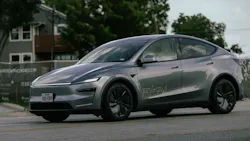
Tesla has officially applied to the Nevada Transportation Authority (NTA) for a commercial permit to deploy up to 5,000 autonomous robotaxis within the first 12 months of approval in Clark County, Nevada.
The application, designated as Docket 26-05015 and filed by Tesla Robotaxi, covers the cities of Las Vegas and Henderson as well as Harry Reid International Airport. The NTA has set a public comment deadline on or before July 5, 2026.
Is 5,000 a Real Estimate or Pie-in-the-Sky Ceiling?
According to most estimates, Tesla’s robotaxi fleet in the U.S. measures in the dozens of vehicles. Between the cities of Austin, Dallas, and Houston in Texas, only about 20 Tesla vehicles now actually carry passengers without a human safety driver.
What’s more, Tesla CEO Elon Musk said during the company’s Q1 2026 earnings call that safety validation was a limiting factor on fleet growth and noted that robotaxi revenue would not be material to 2026 results.
The NTA previously granted Amazon’s Zoox to run autonomous robotaxis in Nevada (AVNC 001 under Docket 24-12019), but with a cap of 65 vehicles. Also, it limits the service to free rides within a defined area in Clark County.
Cameras Only
Instead of using sensors such as LiDAR and radar like other self-driving cars, Tesla's Full Self-Driving (FSD) is a Level 2 advanced driver-assistance system that relies solely on cameras and artificial intelligence. It’s designed to navigate city streets, stop at traffic lights, and execute lane changes, but it strictly requires active driver supervision and readiness to take over at all times.
Tesla executives have said the software needs a major rewrite before it scales. As such, Tesla scaling depends on how quickly it can move to Full Self-Driving v15, a software rewrite targeted for late 2026 or early 2027.
So, even if Nevada grants the AVNC authorization, this summer, Tesla’s own roadmap says the enabling software will not arrive until later.
Designed to transition the system from supervised assistance to unsupervised autonomy, the software upgrade features a massive 10-billion-parameter neural network—nearly 10X larger than the preceding FSD v14 architecture.
Benefits of the New FSD Software
The new software will improve complex decision-making and edge-case handling. It will allow the AI to better predict erratic behavior, such as navigating multi-lane urban roundabouts or anticipating pedestrians hidden by large vehicles.
Furthermore, v15 is said to be fully compatible with current in-car hardware. It thus puts an end to concerns that the current AI4 software suite, which features a relatively modest 16 GB of memory, wouldn't be able to run on the new models being developed by Tesla.
Musk said that v15 represents a total architectural overhaul intended to take safety to another level— orders of magnitude beyond human capability.
About the Author
Murray Slovick
Contributing Editor
Comment About the Article
To join the conversation, and become an exclusive member of Electronic Design, create an account today!
 Leaders Logo
Leaders relevant to this article: