Modular Automotive Connectors Support Zonal Architectures – and More
What you’ll learn:
- The multiple connector and cabling challenges faced by today’s (and tomorrow’s) cars.
- Why zonal architecture calls for new connector designs and arrangements.
- How Molex MX-DaSH Modular Wire-to-Wire Connectors offer a forward-looking alternative.
The “razzle-dazzle” of advanced ADAS (advanced driver-assistance systems) functions and features (you can make your own list here) understandably get much of the automotive-related attention these days. However, the on-the-ground reality is that less-glamorous components such as connectors and cabling are vital to a design’s success and manufacturability.
Let’s face it: Whether internal combustion engine (ICE), hybrid, or electric-vehicle (EV) powertrain, automotive wiring has grown into a major design challenge of its own, far beyond what it was just a decade or two ago.
Now, as the industry transitions to zonal architectures to support the diverse electronic subsystems, cabling all of these loads to support both power and signals increases that challenge. Such interconnects must meet multiple demanding criteria, from the number and type of signals they handle, to physical ruggedness, to size and weight considerations.
Unifying Data-Signal Hybrid Connectors
That’s where a new connector family from Molex LLC seeks to ease the strain and pain. The company’s MX-DaSH (Molex data-signal hybrid) is a family of data-signal hybrid connectors that unify power, signal, and high-speed data connectivity in a single connector system, reducing the need for separate cable connectors for the different types of electrical connections in the vehicle.
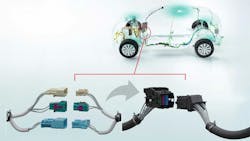
MX-DaSH Modular connectors utilize multiple, versatile cartridges incorporated into a single housing system to simplify wiring and harness architecture (Fig. 1).
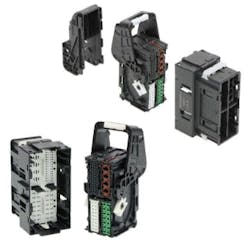
Each MX-DaSH Modular Wire-to-Wire Connector is based on an unsealed, cartridge-based hybrid connectivity platform that combines power and signal terminals into a single interface. The design flexibility easily supports the ongoing transition to centralized, zonal systems, along with easier upgrades and the addition of new automotive features (Fig. 2).
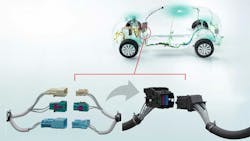
By consolidating multiple connectors into a single interface, designers can reduce wiring harness complexity, space requirements, and weight. Shrinking down the number of connections also simplifies the assembly process and minimizes the potential for installation errors, improving overall system reliability.
MX-DaSH Modular connectors are optimized for high-circuit-count connections such as instrument panel-to-body harness connections, seat power and signal connections, and electrical/electronic architecture components. Wiring and module engineers can also change cartridges within the housing, making it easier to add new features or swap out pins and cartridges to meet architecture needs.
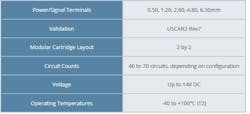
Maximum pin count for the connectors is 70 circuits, with maximum circuit count per cartridge as follows: 26 circuits for 0.50-mm cartridges, 14 circuits for 1.20-mm cartridges, four circuits for 2.80-mm cartridges, and three circuits for 4.80- and 6.30-mm cartridges.
Further, the MX-DaSH Modular connector’s adherence to USCAR2 performance specifications for automotive electrical connector systems is a benefit, along with USCAR49 performance specifications for miniature automotive coaxial connectors (Fig. 3).
The MX-DaSH Modular connectors include independent secondary lock (ISL) for positive locking, keying, blade stabilization, and vibration resistance. These capabilities help boost overall reliability by protecting against inadvertent disconnection in demanding automotive environments.
The series is already designed into cars in North America, Europe, and China. Details on the family are available at the system overview site, as well as in the brief datasheet. Don’t be surprised if non-automotive designs “pick up” on the benefits of connectors such as these for their projects — that sort of leveraging of products and technologies by “outside” users has happened many times before, usually with many favorable results.
About the Author
 Bill Schweber
Bill Schweber
Contributing Editor
Bill Schweber is an electronics engineer who has written three textbooks on electronic communications systems, as well as hundreds of technical articles, opinion columns, and product features. In past roles, he worked as a technical website manager for multiple topic-specific sites for EE Times, as well as both the Executive Editor and Analog Editor at EDN.
At Analog Devices Inc., Bill was in marketing communications (public relations). As a result, he has been on both sides of the technical PR function, presenting company products, stories, and messages to the media and also as the recipient of these.
Prior to the MarCom role at Analog, Bill was associate editor of their respected technical journal and worked in their product marketing and applications engineering groups. Before those roles, he was at Instron Corp., doing hands-on analog- and power-circuit design and systems integration for materials-testing machine controls.
Bill has an MSEE (Univ. of Mass) and BSEE (Columbia Univ.), is a Registered Professional Engineer, and holds an Advanced Class amateur radio license. He has also planned, written, and presented online courses on a variety of engineering topics, including MOSFET basics, ADC selection, and driving LEDs.