High-Reliability Automotive Gate Drivers Reduce Board Space
Gate drivers are essential circuits positioned between the controller and power semiconductor devices. By providing high-current drive and voltage amplification, they ensure efficient switching, fast turn-on/off times, and protection in applications like electric-vehicle inverters and motor controls.
Many gate drivers include built-in protection features such as undervoltage lockout (UVLO) and short-circuit protection to improve system reliability.
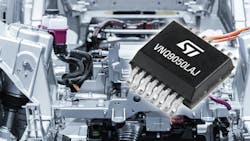
With 4-V minimum operating voltage, STMicroelectronics’ new VNQ9050LAJ 4-channel automotive high-side driver can handle disturbances such as extreme cold cranking operation down to 2.7 V. It leads to heightened vehicle reliability and helps ensure a satisfactory user experience.
Built on ST’s VIPower M0-9 technology, this device supports diverse load types, enables predictive maintenance, and maintains stable operation even at extremely low voltages. With pin-to-pin compatibility for seamless upgrades, they enhance safety, efficiency, and overall vehicle reliability.
Quad-Channel High-Side Driver
The VNQ9050LAJ is designed to drive 12-V automotive grounded loads through a 3- and 5-V CMOS-compatible interface, providing protection and diagnostics. The device integrates protective functions such as load current limitation, overload active management by power limitation, and overtemperature shutdown with configurable latch-off.
The part meets the latest version of LV 124, the car industry’s stringent quality and reliability test standard for electrical and electronic components. The standard consists of two parts: electrical requirements and tests, and environmental requirements and tests.
Typical on-resistance is as low as 50 Ω to help boost efficiency and save energy.
Current Mirror
The VNQ9050LAJ brings features to protect resistive, capacitive, and inductive loads. These include load-current sensing by implementing an on-chip current-mirror circuit with a sense FET that closely tracks the main power-FET parameters. The current mirror is connected to an external pin that permits connecting a resistor to convert the sensed current into a voltage for continuous load monitoring and detection of abnormal conditions.
The driver has a sense-enable pin that lets similar devices share the external sense resistor to minimize the BOM. The device also has an overvoltage clamp, thermal-transient limiting, and a configurable latch-off on overtemperature or power limitation with dedicated fault reset pin. Other protective measures include electrostatic discharge protection, loss of ground and loss of VCC protection, and reverse-battery protection.
In production now, the VNQ9050LAJ comes housed in PowerSSO-16 package.
Isolation Reduces Design Complexity, PCB Footprint
Isolated drivers are used for high-voltage, high-side applications, providing electrical isolation between the control circuit and the high-voltage side to provide safety for high-voltage systems (e.g., EV chargers and inverters). Using integrated gate-driver ICs significantly reduces design complexity, bill of materials (BOM), and PCB footprint, while increasing overall system reliability.
To that end, ST also introduced the STGAP2SA and STGAP2HSA automotive-grade, galvanically isolated 4-A gate drivers with 60-ns response time and close part-to-part matching. Those features lead to high switching frequencies that enhances power density and efficiency. The STGAP2HSA also delivers 6-kV surge isolation.
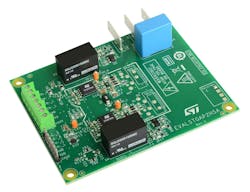
Suitable for IGBTs and silicon MOSFETs operating with a high-voltage rail up to 1,200 V, these new galvanically isolated drivers can sink/source 4 A at up to 26 V for unipolar or bipolar driving. The AEC-Q100-qualified devices can handle a wide variety of applications throughout conventional, hybrid, and electric vehicles. Typical uses include DC-DC converters, pumps, fans, heaters, e-compressors, and on-board chargers.
The drivers feature UVLO and an output safe state during power-up and power-down. There’s also Miller clamping to prevent induced turn-on. An active Miller clamp is a protective circuit feature in high-speed power device gate drivers, such as IGBTs or SiC MOSFETs, that prevents "false turn-on" or "self-turn-on" caused by the Miller effect. It works by providing a low-impedance path to ground for the gate when the device is off, preventing the parasitic capacitance from triggering the switch.
In addition, a self-monitoring watchdog makes the output safe if communication from the low-voltage side fails. Furthermore, a power-saving standby mode is entered by simultaneously holding the inputs high.
The STGAP2SA and STGAP2HSA are in production now.