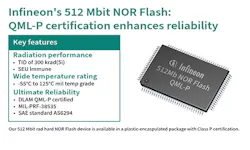
Announcements Distribution Solution Leaders Pilot NOW LIVE for all Infineon Distributors â join now, more information here ! How does QML-P certification enhance our 512 Mbit rad hard NOR Flash memory?  How does QML-P certification enhance our 512 Mbit rad hard NOR Flash memory? â4 Dec 2024 09:38 PM QML, which stands for âQualified Manufacturers List,â is a common term used to classify high reliability semiconductor solutions. QML-P, or âQualified Manufacturers List Class P,â is a term that may be less familiar to design engineers and refers to standard qualification for plastic packaging. This Knowledge Base Article will review everything you need to know about QML-P, including the certification tests required for qualification, and how our QML-P certified 512 Mbit NOR Flash memory delivers best-in-class performance. QML basics The United States Department of Defense (DoD) and the Defense Logistics Agency (DLA) are the two bodies who administer QML certification. QML certification asserts that a device and its components meet advanced performance, reliability, and quality standards for high reliability, mission critical applications defined in MIL-PRF-38535. Not only does QML certification ensure the reliability of a specific product, but it also assures the reliability of the semiconductor manufacturer itself, including its supply chain and workforce. All of Infineonâs high reliability memory solutions are QML certified, attesting to the quality of our space portfolio. What is Class P? QML-P is a critical standard for radiation hardened plastic-encapsulated space electronics. Developed in collaboration with NASA and other industry experts, QML-P ensures space-grade components, such as Infineonâs 512 Mbit NOR Flash memory, meet stringent performance requirements. QML-P is an extension of MIL-PRF-38535 with the SAE standard AS6294. Class P certified parts undergo radiation lot acceptance testing at the specified radiation level. Further tests for QML-P qualification includes x-ray inspections, wire bond pull, C-SAM inspection, visual internal and external inspection, as well as extensive screening, including 3-temp electrical test prior and post static and dynamic burn-in on every unit. Each individual unit is burned in for 384 hours at +125°C. Changing any component within the process flow is impossible without permission from the Technical Review Board and DLAM, adding lengthiness to the already demanding QML qualification process. Authorization and approval from both the Technical Review Board and DLAM on process changes guarantees product continuity and performance over a longer timeframe. Advantages of QML-P Plastic parts standardized under QML-P offer significant advantages. Primarily, QML-P parts ensure utmost reliability for mission critical applications. With QML-P certification, our customers benefit from reduced failure rates, thus lowering warranty claims, risk of liabilities, and other costs. Furthermore, the standardization of radiation hardened plastic packaging, which has long lacked certification measures and thus been susceptible to errors, such as outgassing and delamination, allows our customers to choose lighter and smaller plastic packages without hesitation. In addition to top-notch QML-P certification, our 512 Mbit NOR Flash memory features a 133 MHz QSPI data interface, single channel SPI mode for legacy support, a TID rating of 300 krad(Si), and a military temperature grade of -55 to +125°C. We additionally offer our best-in-class 512 Mbit memory in a ceramic package, which is specified to the industry standard QML-V. Conclusion QML-P certification plays a crucial role in standardizing the use of radiation hardened plastic packaging for space applications, ensuring components like Infineonâs 512 Mbit NOR Flash memory meet the highest standards of reliability and performance. Infineonâs memory solutions deliver best-in-class solutions for mission-critical applications. Visit our 512 Mbit product page for a deeper look into our 512 Mbit device. Copy Link Updated by: