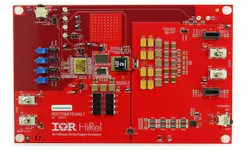
RIC70847EVAL1: High‑current, radiation hardened point‑of‑load evaluation platform RIC70847EVAL1: High‑current, radiation hardened point‑of‑load evaluation platform RIC70847EVAL1: High‑current, radiation hardened point‑of‑load evaluation platform 22 Apr 2026 11:54 PM Introducing RIC70847EVAL1 , a new evaluation board showcasing Infineon IR HiRel’s radiation hardened RIC70847 buck controller . Built for demanding environments and tight voltage tolerances, the board is engineered to help teams rapidly validate performance on real rails—especially space‑grade FPGA cores—while shortening design time. Download our companion application note to see complete test data, schematics, usage guidance, and more. What’s Inside: Controller, Gate Driver, and Rad Hard Power Stage RIC70847EVAL1 delivers dependable, high-current-point-of-load (PoL) power for advanced digital systems. The platform demonstrates a single‑phase buck topology suited to PoL conversion, ideal for today’s advancing FPGAs. The board is pre-populated with two Infineon IR HiRel R8 rad hard MOSFETs in a hermetic ceramic lid package. The high side and low side field-effect transistor (FET) can be replaced with any other logic level (5 V drive) FET in an SMD-0.2/e or SMD-0.5/e package footprint. The RIC70847EVAL1 features our radiation hardened IC and two N-channel power MOSFETs. Built for Space‑Grade FPGA Rails RIC70847EVAL1 helps you evaluate real‑world efficiency and dynamics under fast load steps, typical of modern FPGAs. Our board targets core rails found on space FPGAs, providing the current density and regulation needed for devices such as AMD XQRKU060 (VCCINT), Microchip RT PolarFire® (VDD), and NanoXplore NG‑Ultra (VDDCORE). Its nominal output is centered at 1.0 V with a ±3% window (0.97–1.03 V), aligning to common core‑rail requirements. Load‑Line Regulation for Agile Transient Performance The RIC70847EVAL1 leverages load‑line regulation (LLR) during transient tests to improve dynamic margin at the point of load. By introducing a controlled, predictable droop with increasing current, LLR reduces output capacitor stress and helps keep undershoot/overshoot within spec during abrupt current demands—ideal for FPGA core rails that swing from idle to full activity in microseconds. With LLR enabled, the board is validated under fast step conditions representative of real systems. Documented Control Loop and Stability Our user guide features Bode plot measurements demonstrating stability with margins typical for space grade designs. Download the application note for the full plots, stability metrics, and component selections. A simplified block diagram of the RIC70847. PCB Layout and Design Considerations The evaluation board is laid out to exemplify high‑current buck best practices, helping you translate the reference into a production design with minimal risk. Validated Performance, Ready for Your Bench Engineers can quickly replicate key scenarios from the lab and correlate results to their systems. The application note includes transient captures and loop data to accelerate your bring‑up and de‑risk design iterations. Recommended operating conditions: Output voltage: 1.0 V Output current: 40 A Switching frequency: 480 kHz The RIC70847EVAL1 is designed for configurability so users can modify the design to meet their specific program requirements. Examples include adjustable resistors and pin-select jumpers to change key parameters—such as load‑line regulation (LLR), overcurrent limit (OCP), slope compensation (SLP), and switching frequency (RT); oversized PCB footprints for the inductor and FET to accommodate different packages; and selectable current sensing implemented either with a shunt resistor in series with the inductor or via inductor DCR sensing. Get Started Speed up your evaluation with a turnkey board that mirrors real operating conditions and includes the data you need to make confident decisions. Download the application note for schematics, layout details, measurement setups, and recommended operating procedures—and put the RIC70847EVAL1 to work on your next mission‑critical design. All trademarks are the property of their respective trademark holders. Copy Link You must be a registered user to add a comment. If you've already registered, sign in. Otherwise, register and sign in.