Discrete Analog ICs Literally Become Nearly Invisible
Despite the widespread use of highly integrated analog and mixed-signal ICs, or perhaps as a consequence of them, there’s still a large need for single-function analog components. Sometimes they are the remedy for unique signal-processing requirements; other times, it’s to fix an oversight in the signal path (yes, it happens). That’s why thousands of discrete op amps, comparators, and similar components are available from dozens of sources.
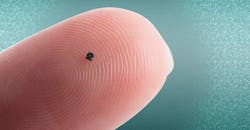
But the push for smaller ICs is inescapable, even for these analog components. Texas Instruments just announced its first entrants—the TLV9061 op amp and TLV7011 family of comparators—to be housed in the company’s X2SON package, which is claimed as the industry’s smallest. These packages measure 0.8 × 0.8 mm, resulting in a nearly unseeable footprint of just 0.64 mm2.
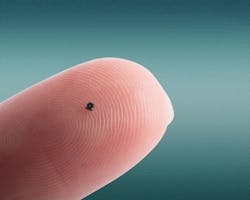
Now you see them, and now maybe you don’t: Both a comparator family and op amp from Texas Instruments require just a 0.64-mm2 footprint due to their unique X2SON package.
The TLV9061 op amp features a gain bandwidth (GBW) of 10 MHz, slew rate of 6.5 V/µs, and spectral density of 10 nV/√Hz, plus rail-to-rail inputs and output performance. In addition, it incorporates EMI filtering on the inputs to deliver robust performance in systems facing RF noise, while reducing the need for external discrete circuitry. The device is fully specified, including input bias current and offset drift, over the −40 to +125°C. Prices begin at US $0.19 in 1,000-unit quantities; more information is available here.
The TLV7011 family of nanopower comparators, presently consisting of four devices, consumes 50% less power than competitive comparators, according to TI. Two of the comparators operate from 1.6 V to 5.5 V, with dc offset of 0.5 mV, 260-ns propagation delay, and 5-µA supply current; corresponding specifications for the other two units are 1.6- to 6.5-V supply, 0.1-mV offset, 3-µs propagation delay, and 335-nA current. All of the comparators guarantee no phase reversal and include internal hysteresis for overdriven inputs to increase design flexibility and reduce the need for external components. Pricing begins at US $0.25 in 1,000-unit quantities; click here for the datasheet.
For design and evaluation, TI offers Spice models of both the op amp and comparator family at the TINA-TI SPICE model site. To breadboard designs using these tiny comparators, the company also offers a DIP adapter evaluation module ($5); just remember that you’ll have to take the associated DIP-module parasitics into your model, of course. Also, you’d better be sure that your production facility has pick-and-place systems that can handle and precisely place these tiny packages.

About the Author
 Bill Schweber
Bill Schweber
Contributing Editor
Bill Schweber is an electronics engineer who has written three textbooks on electronic communications systems, as well as hundreds of technical articles, opinion columns, and product features. In past roles, he worked as a technical website manager for multiple topic-specific sites for EE Times, as well as both the Executive Editor and Analog Editor at EDN.
At Analog Devices Inc., Bill was in marketing communications (public relations). As a result, he has been on both sides of the technical PR function, presenting company products, stories, and messages to the media and also as the recipient of these.
Prior to the MarCom role at Analog, Bill was associate editor of their respected technical journal and worked in their product marketing and applications engineering groups. Before those roles, he was at Instron Corp., doing hands-on analog- and power-circuit design and systems integration for materials-testing machine controls.
Bill has an MSEE (Univ. of Mass) and BSEE (Columbia Univ.), is a Registered Professional Engineer, and holds an Advanced Class amateur radio license. He has also planned, written, and presented online courses on a variety of engineering topics, including MOSFET basics, ADC selection, and driving LEDs.
Comment About the Article
To join the conversation, and become an exclusive member of Electronic Design, create an account today!
 Leaders Logo
Leaders relevant to this article: