“Silicon Valley” Was Coined by Electronic Design 55 Years Ago
What you'll learn:
- The Heinz Nixdorf MuseumsForum, in Paderborn, Germany, recently opened a gallery dedicated to “Silicon Valley” and early computing.
- Almost to the day 55 years ago, the term “Silicon Valley” was coined by one of the editors at Electronic Design.
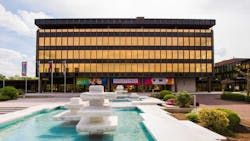
The Heinz Nixdorf MuseumsForum (HNF), in the city of Paderborn, Germany, occupies the former headquarters of the Nixdorf Computer AG, the country’s biggest computer builder of the 1970s and 1980s. Founded in 1996, the HNF calls itself the largest computer museum in the world. HNF recently opened a new gallery about Silicon Valley and early microcomputers. In preparation for the gallery’s opening, some historical facts about the Valley and its name were researched for the HNF's weblog.
In 1977, West German newsmagazine Der Spiegel put “Silicon Valley” in quotation marks. It has since become a household name. Geographically, it refers to the area stretching from Menlo Park to San Jose along California State Route 82 (Fig. 1).
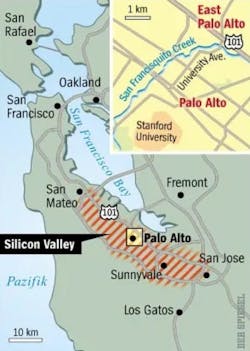
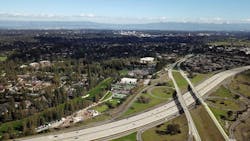
Figure 2 shows the northwestern end of the region, looking at Stanford and Palo Alto and the southern tip of San Francisco Bay. In the foreground, Interstate 280 runs to Cupertino and San Jose. “Silicon Valley” is roughly 25 miles long.
Silicon Implants
The term “Silicon Valley” also encompasses high-tech manufacturers based in the Santa Clara Valley and the companies associated with them. All are directly or indirectly involved with microchips, which are made of silicon crystals.
The Hewlett-Packard Company, founded in Palo Alto in 1939, is generally considered to be the first Silicon Valley firm. At that time, there were neither silicon chips nor a Silicon Valley, but that didn't bother anyone. We will go into more detail about the origin of the name in a moment.
The next Silicon Valley arrival was IBM. In 1943, the company opened a punch card factory in San Jose, followed in 1952 by a hardware development facility and then a manufacturing plant. The first product was the giant RAMAC disk storage system.
As early as 1948, brothers Russell and Sigurd Varian started a business north of what would later become Silicon Valley, manufacturing klystron tubes. In 1953, they moved to Palo Alto into the Stanford Research Park. Here the university of the same name attracted startups and established technology firms.
In February 1956, a company began working specifically with the element silicon. The Shockley Semiconductor Laboratory (Fig. 3), located in Mountain View, was formally a division of the measuring instrument manufacturer Beckman.
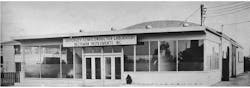
The head of the laboratory, physicist William Shockley, was one of the fathers of the transistor; he dreamed of innovative silicon diodes consisting of four layers. Unfortunately, he soon fell out with eight of his subordinates. They left him and founded their own company in nearby Palo Alto in September 1957.
It was financed by camera manufacturer Fairchild from the state of New York. Researchers such as Gordon Moore, Robert Noyce, and Jean Hoerni worked at Fairchild Semiconductor Corp., where they invented groundbreaking processes and products and laid the foundations for digital microelectronics.
However, the eight founders did not stay together for long. In the 1960s and early 1970s, other semiconductor companies emerged in the region, which became known as “Fairchildren.” The common link was the use of silicon technology.
Making Headlines
On January 11, 1971, the weekly Electronic News published the first installment of a three-part series by editor Don Hoefler. It was titled “Silicon Valley U.S.A.” and dealt with the genesis of the California semiconductor industry from 1955 onwards.
The newspaper was published in New York, but Hoefler had his desk in San Francisco and knew his stuff. It’s known that he picked up the expression from some marketing people, and we find it in the December 6, 1970, issue of Electronic Design, on page 21, available for download here:
The two words, “Silicon Valley” occurred in the news scope section in the headline “Where to go in MOS debated in ‘Silicon Valley’”—note the quotation marks (Fig. 4). The corresponding article described a meeting of the local IEEE chapter in Sunnyvale in November 1970, which was attended by 500 participants.
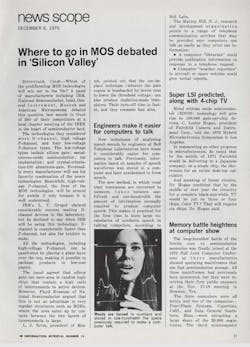
It’s unknown who actually created the term back then. It may have been one of the New York editors of Electronic Design or the field editor in San Francisco/Los Altos, Elizabeth de Atley. Apparently, she left ED in the early 1970s and went to SRI International.
In any case, the term “Silicon Valley” was, in fact, born 55 years ago, here at Electronic Design. Don Hoefler's articles are an excellent introduction to its early history; they end with a family tree that begins with Shockley and Fairchild and then lists the spin-offs and new companies. In 1971, Hoefler identified 23 firms, including Intel and its archrival AMD. In the 1970s, “Silicon Valley” referred to semiconductor and chip manufacturers; in the 1980s, the term also encompassed hardware and software companies.
The best-known names from the founding days are certainly Apple and Adobe. Amdahl, Atari, Silicon Graphics, and Sun Microsystems have since disappeared, and database giant Oracle moved to Texas. Near the end of the 20th century, the internet brought eBay and Google, and in the 21st century, Facebook arrived from the East Coast.
Venture capital firms also emerged. A pioneer in the industry, Arthur Rock, started in San Francisco in 1961, and later investors settled on Sand Hill Road. In Figure 2, this is the road that leads over the bridges in the foreground and continues eastward.
The Computer Rollkugel
Let's not forget Stanford University and the research institutes SRI International and Xerox PARC. At SRI, where Electronic Design’s field editor went, Douglas Engelbart invented the American computer mouse (there was also a German one, the Rollkugel), and in 1969, it received the first message from the ARPANET. PARC gave us the laser printer, object-oriented programming, the local area network, and the graphical user interface.
Silicon Valley company NVIDIA presently has the highest market capitalization on Wall Street, at more than four trillion dollars, with Apple jockeying for that pole position as well. Alphabet (Google) is yet another “Silicon Valley” startup that’s now in the top five market cap publicly traded companies.
[Ed. Note: None, ironically, fab their own Silicon. “Hype Valley,” anyone?]
Andy's Nonlinearities blog arrives the first and third Monday Tuesday of every month. To make sure you don't miss the latest edition, new articles, or breaking news coverage, please subscribe to our Electronic Design Today newsletter. Please also subscribe to Andy’s Automotive Electronics bi-weekly newsletter.
About the Author
Ralf Buelow
Historian and Author for Heinz Nixdorf MuseumsForum
Ralf Buelow is a historian of technology and based in Berlin. Since 2015, he has written the weblog of the Heinz Nixdorf MuseumsForum, Paderborn, Germany.
Comment About the Article
To join the conversation, and become an exclusive member of Electronic Design, create an account today!
 Leaders Logo
Leaders relevant to this article: