Passive Ultrasonic Tags: Easy-to-Use, Unique Activity Sensors
What you'll learn:
- Why passive ultrasonic offers a unique option of sensing discrete open/close events.
- How a team used passive, non-electronic metal tag for signal initialization.
- How they used DSP-based, non-ML, non-AI signal analysis to identify each tag.
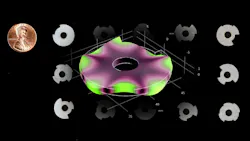
Every now and then you come across a project that looks (pick one or more) innovative, crazy, imaginative, easily understandable, tangible, likely to succeed big time, or will never succeed. This project from a team at the Georgia Institute of Technology (Georgia Tech) certainly fits the bill for those descriptors, and does so by leveraging disparate, entirely available technologies.
What have they done? It sounds simple: They devised a set of penny-sized, cheap metal tags with unique ultrasonic fingerprints that can be used to detect the opening of a door or window, and other similar modest movements. These tags, dubbed SoundOff tags, are totally passive, requiring no battery or backscatter scheme for power.
At the same time, the algorithm that recognizes and identifies each unique ultrasonic signature is fairly straightforward and doesn’t need a lot of computing power. Their concept is clear enough, but, as with so many ideas, it’s the details of its execution and implementation that really matter.
What’s Their Ultrasonic Tag Plan?
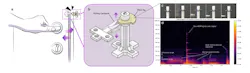
They use specially shaped, flat metal tabs each less than the size of a penny, with tiny cutouts along the edge and mounted on a small 3D-printed base. When struck, the tab creates an ultrasonic “ping,” which is distinct to that tab due to its edge cutouts. A microphone and signal path optimized for ultrasonic signals picks up the sound, which is then analyzed via digital signal processing to identify which tab was hit (Fig. 1).
What are some of the advantages of this scheme? The metal tabs are battery-free, quiet, inherently private, small, and cost only a few cents each. The limited range of the ultrasonic signals means it’s almost impossible to eavesdrop, and the use of ultrasound energy means that even users aren’t annoyed by the pings (as for dogs, that may be a different story!).
Beyond tracking doors and similar tasks, how can the tags be used? They could be attached to faucets to help monitor water use; attached to weights in the gym to count squats or presses; users could manually press a tiny version worn on a sleeve to trigger a timer or log an activity; or track stage boxes as they’re removed/replaced on a shelf.
Start with the Mechanical Side
The team began by creating a modeling and simulation tool to design the metal disks so that they would generate specific ultrasonic frequencies when struck (Fig. 2).
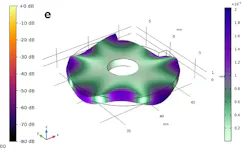
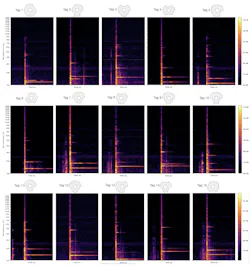
Their simulations identified nearly 1,300 initial designs that would each produce a unique frequency pattern in the ultrasound range. They found a set of between 50 and 100 unique designs and chose 15 of them to use in their tests (Figs. 3 and 4).
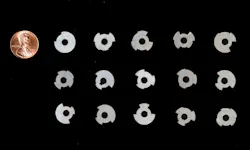
Producing the tags was a separate project. After evaluating the “ringing” of different metals, they settled on 1-mm-thick AISI Type 316 stainless steel (available in 0.3- × 0.3-m sheets) and used a 4.50-kW laser cutter to cut the tags. They were able to cut nearly 500 14-mm diameter tags from each sheet, for a per-tag cost under four cents.
To create the drum-like percussion excitation structure, they designed a modular standoff fixture and cantilever system. The fixture suspends each metal tag in-air while minimizing contact area, to isolate the tag from external vibrations and surface-specific resonance. The standoff includes a “snap-fit” cap, eliminating the need for bolts or tools during assembly. The cap locks the tag into place by flexing thin printed segments designed to deform and latch.
Multiple standoff geometries were designed to accommodate different application settings. Some fixtures mount the tag parallel to the surface (e.g., for vertical walls or door panels), while others hold the tag perpendicular (e.g., on toilets or drawers).
The cantilever is also fully 3D printed with a thickness of 0.6 mm, striking a balance between flexibility and durability. When struck, the cantilever snaps through the tag with sufficient force to excite its vibrational modes while resisting plastic deformation. This ensures a consistent energy input to help decouple signal amplitude from user-action variability.
What About Electronics and Signal Processing?
When I first started reading through their paper on this project, I assumed that it used artificial intelligence to identify the ultrasonic tag pattern and thus the unique tag. (As an analog-circuit friend recently remarked to me with some sarcasm, “If your project doesn’t have AI in it these days, you’re not doing it right!”) But I was wrong: Not only doesn’t it use AI, but it doesn’t even use machine-learning (ML) algorithms.
Instead, they created an algorithm with simple, hardcoded rules. That approach means the system can identify signals using little computational and electrical power.
The signal chain begins with a digital-output ultrasonic microphone that has 16-bit resolution and a 384-kHz sampling rate interfaced using a USB port. The microphone sound output is bandpass-limited to 20 to 100 kHz, then fed to a Raspberry Pi Zero for processing and classification. The streaming rate is 6.144 MB/s and power consumption is around 0.8 W for the Pi Zero.
The software continuously records the data received from the ultrasonic microphone into a buffer. On a separate thread, they run a “real-time” digital-signal-processing (DSP) pipeline and classification (Fig. 5).
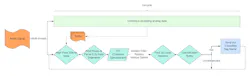
This DSP and classification thread operates once every second, analyzing the most recent data captured in the buffer. The one-second interval was chosen for a practical balance between responsiveness and required computing time and was sufficiently real-time for the application.
Due to the unique properties of the tags, this simple DSP with zero machine learning can achieve relatively high accuracy. This demonstrates the intrinsic advantages of the SoundOff tags:
- Operation in the ultrasonic range significantly reduces susceptibility to ambient noise.
- The selection of unique tags ensures highly distinctive and predictable signals.
As a result, simple hardcoded rules are sufficient for relatively accurate classification, eliminating the need for complex software pipelines. In contrast, conventional approaches using deep-learning models such as convolutional neural networks (CNNs) would impose much higher computational demands. It also would make the tags much more difficult to integrate as the CNN would require retraining with each new tag.
What About SoundOff Performance?
Due to the short wavelength, ultrasound energy attenuates faster than audible sound and can’t travel long distances. To assess performance, they built a wrist-wearable unit with standalone ultrasonic microphone, a Raspberry Pi Zero, a 1,200-mAh lithium-polymer battery, and a USB-C Breakout Board.
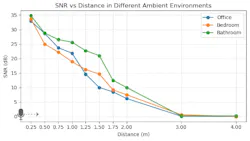
Using this system, they measured the tags using the ratio of signal power (dB) to noise power (dB) (SNR) across several common distances from 0.25 to 2.0 m. Then they evaluated DSP accuracy with respect to each distance. The team also repeated these measurements in three rooms with different ambient noise.
The results show that the tags have roughly the same SNR despite the different ambient environments, and that the arrangement works best with an SNR of at least 15 dB (Fig. 6).
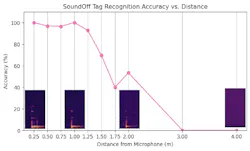
The accuracy results show that system performed reliably at short distances but degraded rapidly beyond one meter (Fig. 7). Accuracy was over 98% when the microphone was within one meter of the tag. Beyond this range (e.g., at 1.5 m), the DSP failed to recognize the tag signals and recognition became random and unreliable (with accuracy dropping below 50%). At a further distance of 3 m, the signals could not be recognized at all.
They acknowledge a fundamental limitation of the system: The sensing range is constrained by the high attenuation of ultrasonic sound in air. Ultrasonic frequencies experience significantly greater attenuation than audible frequencies, as the attenuation coefficient increases roughly with the square of frequency. This results in exponential decay of signal amplitude over distance, with higher-frequency components vanishing disproportionately faster.
Full details are available in their lengthy yet highly readable and even enjoyable paper “SoundOff: Low-cost Passive Ultrasound Tags for Non-invasive and Non-intrusive Smart Home Sensing” published in Proceedings of the ACM on Interactive, Mobile, Wearable and Ubiquitous Technologies. It’s behind a paywall but that page also has a link to download the entire paper as a pdf (70 MB!).
It’s nice to see a research project that brings together multiple disciplines (materials science, mechanical modeling, acoustics, 3D printing, laser cutting, signal-processing algorithms, circuit design and construction, and more), isn’t especially esoteric, and doesn’t require super-specialized, expensive equipment to work toward a conclusion.
About the Author
 Bill Schweber
Bill Schweber
Contributing Editor
Bill Schweber is an electronics engineer who has written three textbooks on electronic communications systems, as well as hundreds of technical articles, opinion columns, and product features. In past roles, he worked as a technical website manager for multiple topic-specific sites for EE Times, as well as both the Executive Editor and Analog Editor at EDN.
At Analog Devices Inc., Bill was in marketing communications (public relations). As a result, he has been on both sides of the technical PR function, presenting company products, stories, and messages to the media and also as the recipient of these.
Prior to the MarCom role at Analog, Bill was associate editor of their respected technical journal and worked in their product marketing and applications engineering groups. Before those roles, he was at Instron Corp., doing hands-on analog- and power-circuit design and systems integration for materials-testing machine controls.
Bill has an MSEE (Univ. of Mass) and BSEE (Columbia Univ.), is a Registered Professional Engineer, and holds an Advanced Class amateur radio license. He has also planned, written, and presented online courses on a variety of engineering topics, including MOSFET basics, ADC selection, and driving LEDs.
Comment About the Article
To join the conversation, and become an exclusive member of Electronic Design, create an account today!
 Leaders Logo
Leaders relevant to this article: