A Bridge Too Far? How Standards-Based Sensor Integration Saves Size, Power, and Cost
What you'll learn:
- In modern automotive camera systems, sensor integration refers to embedding the long-reach automotive interface directly into the image sensor itself.
- The goal of sensor integration is to eliminate this bridge chip.
- By offloading most of the link complexity to the ECU and minimizing requirements on the serializer, A-PHY integration simplifies camera design while preserving high-speed video performance.

As vehicles incorporate more cameras into their vehicles to enable features such as surround view, parking assist, and other advanced driver-assistance systems (ADAS), engineers are placing a bigger emphasis on reducing cost, power, and size across the board in their systems. Even so, most camera modules today rely on a two-chip approach: the image sensor outputs a short-reach interface, which is then converted by a separate bridge device into a long-reach protocol. As a result, there’s more complexity at the module level.
A more efficient approach is to integrate the long-reach interface directly into the image sensor, eliminating the need for a bridge device and simplifying the overall system architecture.
What is Sensor Integration in the Automotive Sense?
In modern automotive camera systems, sensor integration refers to embedding the long-reach automotive interface directly into the image sensor itself. Traditionally, a camera sensor outputs data through a standard interface such as MIPI CSI-2 (Mobile Industry Processor Interface Camera Serial Interface 2) using D-PHY, which is a mature, source-synchronous physical layer designed for short-reach, low-power camera/display links in mobile devices.
The data is then passed to an intermediate bridge chip, which converts it into a long-reach automotive protocol such as GMSL (Gigabit Multimedia Serial Link) or FPD-Link (Flat Panel Display). The bridge adds cost, increases power consumption, and occupies valuable space within the camera module.
The goal of sensor integration is to eliminate this bridge chip entirely. With integration, the sensor directly outputs the automotive interface signal over the cable, reducing both component count and system complexity (see figure).
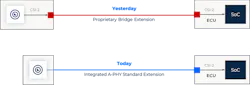
The first practical example of this approach is Sony’s IMX828 sensor. It implements native connectivity using A-PHY, a long-reach, high-speed, and robust automotive SerDes standard built specifically for vehicles.
A-PHY’s Asymmetric Link Advantage
Sensor integration is only possible with standardized connectivity, allowing the sensor vendor access to the channel specification. Theoretically, any standardized connectivity solution could enable sensor integration, providing they have authorization from the MIPI Alliance. However, MIPI A-PHY was designed from the ground up to enable exactly this type of sensor integration by reducing sensor-side complexity, shifting the heavy processing to the deserializer side.
By carefully designing the amplitude of the uplink and downlink transmissions, the sensor uplink receiver can operate at a low symbol rate and high amplitude, minimizing reception challenges. Moreover, downlink data from the camera is intentionally limited in amplitude to reduce echo on the sensor side receiver.
Because A-PHY transmits and receives at the same time, over the same wire, echoes of the downlink signal could theoretically interfere with the uplink reception. By keeping the uplink as a high-amplitude/low-baud signal, and the downlink as a low-amplitude/high-baud signal, the effective interference is minimized at the camera receiver. In practice, this design results in a sensor receiver that requires little to no equalization and minimal echo mitigation, making it easy to integrate into the sensor itself.
Additional Design Decisions Supporting Integration
Several deliberate design decisions contribute to the simplicity of the serializer design:
- Amplitude optimization: The downlink amplitude is deliberately lower (approximately 6 dB lower) than the uplink.
- Symbol-rate management: The uplink receiver operates at a low symbol rate (e.g., 100 megasymbols per second), whereas the downlink occupies much higher bandwidth. This reduces overlapping energy and echo interference at the uplink receiver.
- Therefore, the receiver enjoys a high SNR (uplink signal/downlink echo): High-amplitude, low-baud uplink vs. low-amplitude, high-baud downlink echo.
- Line coding choice: Simple line coding such as 8b10b/NRZ is used on the uplink, providing favorable conditions for the sensor receiver with minimal processing overhead.
Together, these design optimizations allow the serializer to be extremely simple. This minimizes the need for equalization or echo cancellation, which in turn enables compact, low-power, and cost-effective sensor designs.
In contrast, incumbent long-reach protocols such as GMSL and FPD-Link don’t natively support direct sensor integration because they’re proprietary. Also, other attempts at standardized connectivity aren’t optimized for integration, with their designs placing more processing requirements on the sensor side, making integration more challenging. While competing solutions may achieve similar power or size metrics at the serializer level, they weren’t designed from the ground up for integration.
Implications for System Design
By offloading most of the link complexity to the electronic control unit (ECU) and minimizing requirements on the serializer, A-PHY integration simplifies camera design while preserving high-speed video performance. Designers benefit from smaller camera modules with reduced component count, along with lower power consumption and reduced heat generation. The simplified system design and integration also mean that the solution is scalable, suitable for high-resolution cameras at speeds up to 8 Gb/s or higher.
These advantages make A-PHY-based sensor integration a compelling option for automotive OEMs and tier-one suppliers seeking compact, high-performance camera systems.
About the Author
 Eyran Lida
Eyran Lida
Chief Technology Officer and Co-Founder, Valens Semiconductor
Eyran Lida is the lead inventor of HDBaseT technology and a lead technical contributor to MIPI’s A-PHY specification. As Valens CTO, Mr. Lida is responsible for technology strategy development and for Valens’ patent portfolio. Mr. Lida’s background includes close to 30 years of communication systems software and hardware architecture development experience, with primary expertise in wireline hardwired DSP modem design. Mr. Lida Holds a B.Sc. in physics and computer science from the Hebrew University in Jerusalem.
Comment About the Article
To join the conversation, and become an exclusive member of Electronic Design, create an account today!
 Leaders Logo
Leaders relevant to this article: