Low-Voltage 4:1 Analog Multiplexer Does One Thing—and Does It Very Well
What you’ll learn:
- The continuing need for basic analog-function components.
- The characteristics of a tiny 4:1 multiplexer/1:4 demultiplexer for analog signals.
- How an evaluation board simplifies checkout of this analog signal-channel IC.
We’ve all seen and likely used highly integrated, predominantly analog ICs in roles such as multichannel analog front ends, and the performance of many of these integrated solutions is generally quite good. In fact, depending on the design details and layout specifics, an integrated IC can be as good or better than one made up of smaller, single-function analog ICs, and certainly simpler to design in.
Despite this, there’s still an ongoing need for building-block, limited-function ICs for a set of design objectives that the integrated approach can’t meet, challenging constraints, or even a change in design requirements once the design cycle is underway (yes, it happens). In these cases, an analog signal path made of carefully chosen ICs with more limited functionality may provide the needed solution.
That’s where a component such as Analog Devices' ADG1704 plays a role (Fig. 1). The low-voltage, 4:1 multiplexer allows for easy selection of one of four signals to be passed further along the signal chain. Note that this 4:1 multiplexer looks like a resistor in the signal path when “on,” so it can be used in either direction, functioning as a 1:4 demultiplexer for routing a signal to one of four paths.
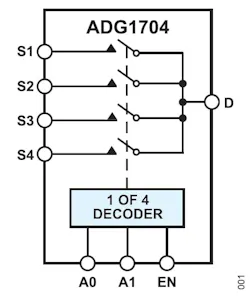
It features just 2.4 Ω of on-resistance — a critical specification to maintain accuracy in most signal-chain paths — in a 2- × 2-mm LGA package. Applications include a wide range of analog single-routing scenarios including automated test equipment, data-acquisition systems, medical equipment, audio and video signal routing, communications systems, and even relay replacement. Operating temperature range is −40 to +125°C (you might be surprised at how many real-world applications need this wide range).
In a typical application, the ADG1704 is used to multiplex multiple sensor inputs into a single analog-to-digital converter (Fig. 2).
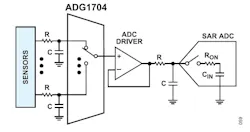
The rail-to-rail input signal will see a switching time of 50 ns or better, depending on supply voltage and temperature. It operates with a low-voltage single supply ranging from +1.08 to +5.5 V or a low-voltage dual supply from ±1.08 to ±2.75 V.
The switches are turned on with a logic 1 input on the corresponding digital control line, while the digital-control inputs are 1.8- and 3-V JEDEC compliant for ease of use with microcontrollers and field-programmable gate arrays (FPGAs). A single enable input is used to disable all of the switches.
Despite the functional simplicity of the device, its datasheet has the numerous necessary and expected tables of specifications as well as charts characterizing its performance needed for modeling an all-analog component. Among these are on-and-off leakage currents vs. temperature and supply voltage, off isolation vs. frequency, transition time vs. temperature, crosstalk vs. frequency, total harmonic distortion plus noise vs. frequency, and insertion loss vs. frequency.
Analog Devices also offers the EVAL-ADG1704ARDZ evaluation board for this device (Fig. 3). A nine-page datasheet details include connection information, schematic, PCB artwork, and bill of materials (BOM).
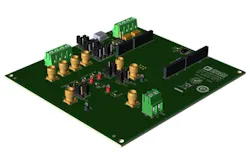
Wire-screw terminals are provided to connect to each of the source and drain pins as well as optional Subminiature Version A (SMA) connectors. Multiple power options on the board provide power supplies to the evaluation board. A four-terminal screw connector can be used to provide VDD, VSS, GND, and VL connections directly to the ADG1704 from an external power supply.
On-board 3.3- and 1.8-V voltage regulators are included to provide alternative options for VDD and VL. The voltage regulators can be powered from one of three options: the external 5-V supply via the screw terminal, the 5-V USB Type-C connector on the evaluation board, or via an available 5-V supply from a connected SDP-K1 controller board or compatible Arduino board.
About the Author

Bill Schweber
Contributing Editor
Bill Schweber is an electronics engineer who has written three textbooks on electronic communications systems, as well as hundreds of technical articles, opinion columns, and product features. In past roles, he worked as a technical website manager for multiple topic-specific sites for EE Times, as well as both the Executive Editor and Analog Editor at EDN.
At Analog Devices Inc., Bill was in marketing communications (public relations). As a result, he has been on both sides of the technical PR function, presenting company products, stories, and messages to the media and also as the recipient of these.
Prior to the MarCom role at Analog, Bill was associate editor of their respected technical journal and worked in their product marketing and applications engineering groups. Before those roles, he was at Instron Corp., doing hands-on analog- and power-circuit design and systems integration for materials-testing machine controls.
Bill has an MSEE (Univ. of Mass) and BSEE (Columbia Univ.), is a Registered Professional Engineer, and holds an Advanced Class amateur radio license. He has also planned, written, and presented online courses on a variety of engineering topics, including MOSFET basics, ADC selection, and driving LEDs.