Opto Devices Extend to Fulfill Automotive, Harsh-Environment Apps

It’s no secret that optoelectronic devices such as photocouplers and photorelays (related functions but with a distinct difference) are an attractive solution to many interface problems related to galvanic isolation, elimination of ground loops, implementing level shifting, and supporting relay-like functionality but without moving parts.
However, legitimate concerns linger about their long-term performance over wide temperature ranges and other extremes. Acknowledging these issues, Toshiba Electronic Devices & Storage Corporation introduced electrooptical devices with extended-range specifications.
The TLX9920, a photovoltaic-output photocoupler in a thin, long-creepage-distance SO6L package, is aimed at solid-state relays (SSRs) in automotive equipment. It’s suitable for use as a gate driver for high-voltage power MOSFETs among other uses used in SSRs. When combined with a high-voltage power MOSFET, it can provide high-voltage and high-current switching that’s difficult to achieve with photorelays.
The TLX9920 is compliant with AEC-Q101, the automotive electronic component reliability standard that mandates −40 to 125°C operation, among other factors. Representative applications include automotive battery-management systems, onboard chargers, and inverters, as well as industrial energy storage systems.
The special SO6L package (3.84 × 10.0 × 2.1 mm) features a creepage distance of over 8 mm, allowing for a high isolation voltage (BVs = 5000 V RMS) (Fig. 1). It meets the requirements of international standard IEC 60664-12, which calls for a creepage distance of 5.6 mm or more for application in environments with pollution degree 2 and an operating voltage of 400 V or more.
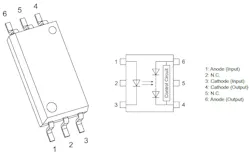
The device optically couples a photodiode array with an infrared light-emitting diode. Each photodiode is connected in series, making it suitable for driving the gate of MOS devices. The photocoupler also incorporates a control circuit on the receiver side, eliminating the need for an external discharge resistor and improving switching speed.
Minimum open voltage VOC is 13.5 V while minimum short-circuit current ISC is 8 μA. Turn-on time is typically 0.6 ms, with a 1.0 ms maximum; the complementary turn-off times are 0.1 and 1.0 ms (typical/maximum).
Normally Open Photorelays
At the same time, Toshiba has also introduced four similar voltage-driven photorelays with a normally open (1-Form-A) arrangement. The TLP3407SRB, TLP3412SRB, TLP3412SRHB, and TLP3412SRLB, housed in diminutive S-VSON4T packages with a 2.0- × 1.45-mm footprint and a height of 1.3 mm, feature 500-V RMS (minimum) isolation (minimum) (Fig. 2).
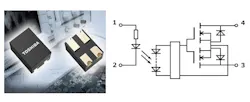
These photorelays maintain a maximum operating temperature rating of 135°C (10 degrees higher than their current offering) for equipment that operates at high temperatures, increasingly an issue in test scenarios.
In addition, because they’re voltage-driven-type photorelays with built-in resistors on the input side, no external resistor is required, thus reducing space requirements on boards. Applications include automotive semiconductor testers, probe cards, and burn-in equipment, where multiple photorelays need to be mounted within a limited board space, and reliable high-temperature operation is required.
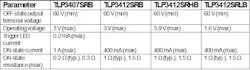
The four devices have many similarities but differ in some of their specific ratings so a good review of their individual data sheets is a good idea (see table).
All of the products are available immediately.
About the Author
 Bill Schweber
Bill Schweber
Contributing Editor
Bill Schweber is an electronics engineer who has written three textbooks on electronic communications systems, as well as hundreds of technical articles, opinion columns, and product features. In past roles, he worked as a technical website manager for multiple topic-specific sites for EE Times, as well as both the Executive Editor and Analog Editor at EDN.
At Analog Devices Inc., Bill was in marketing communications (public relations). As a result, he has been on both sides of the technical PR function, presenting company products, stories, and messages to the media and also as the recipient of these.
Prior to the MarCom role at Analog, Bill was associate editor of their respected technical journal and worked in their product marketing and applications engineering groups. Before those roles, he was at Instron Corp., doing hands-on analog- and power-circuit design and systems integration for materials-testing machine controls.
Bill has an MSEE (Univ. of Mass) and BSEE (Columbia Univ.), is a Registered Professional Engineer, and holds an Advanced Class amateur radio license. He has also planned, written, and presented online courses on a variety of engineering topics, including MOSFET basics, ADC selection, and driving LEDs.