Low-Gigahertz, 40-dB-Gain Transmit Amplifier Fills Broad Needs
What you'll learn:
- The wide applicability of transmit amplifiers in the 1.5- to 2.7-GHz range.
- The key performance specifications of this new amplifier.
- The user-settable parameters of the amplifier.
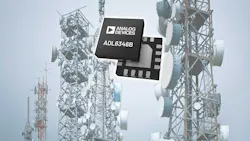
There’s an almost insatiable demand for amplifiers in the busy low-gigahertz segment of the wireless spectrum, with numerous vendors offering a wide range of solutions. Joining the list of available amplifiers is the ADL6346B from Analog Devices.
Representative applications include 4G, LTE, and 5G links using frequency-division-duplex (FDD) and time-division-duplex (TDD) broadband as well as macro-, micro-, and remote-radio head (RRH) nodes and massive, multiple-input and multiple-output (mMIMO) communication systems.
The transmit-side two-stage differential amplifier provides an interface between RF analog-to-digital converters (ADCs), RF transceivers, and system-on-chips (SoCs) to power amplifiers (Fig. 1).
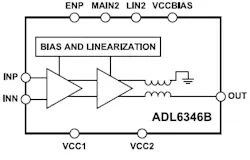
The ADL6346B also includes an integrated impedance-matching and integrated RF balun, which allows it to be configured as a differential-input, single-ended output. This enables high-performance RF capabilities in desired frequency ranges, with 100- and 50-Ω differential inputs and 50-Ω single-ended output (Fig. 2).
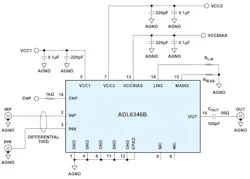
The 1,500 -to 2,700-MHz device operates from a single 5-V supply, featuring 40-dB power gain and 4-dB noise figure. OIP1, OIP2, and OIP3 intercept points are 26, 50, and 40 dBm, respectively. To optimize performance versus power level, users can adjust the DC operating and linearization currents of the ADL6346B using external resistors.
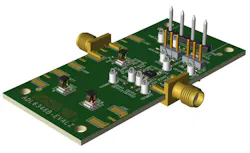
Potential users of products such as these RF amplifiers benefit from — and expect — an evaluation kit. The ADL6346-EVALZB is designed to evaluate the features and performance of the ADL6346B (Fig. 3).
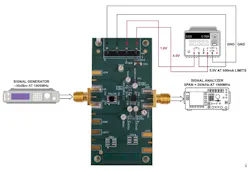
The User Guide shows that the evaluation setup requires only a signal generator and spectrum analyzer (plus power supplies, of course); a network analyzer is an optional addition (Fig. 4).
The ADL6346B amplifier is available in a 16-lead, 3- × 3-mm LFCSP package and fabricated using an advanced silicon-germanium (SiGe), bipolar complementary metal-oxide semiconductor (BiCMOS) process. Full details are available in the 14-page ADL6346B datasheet, which includes the usual and necessary tables and performance graphs.
About the Author
 Bill Schweber
Bill Schweber
Contributing Editor
Bill Schweber is an electronics engineer who has written three textbooks on electronic communications systems, as well as hundreds of technical articles, opinion columns, and product features. In past roles, he worked as a technical website manager for multiple topic-specific sites for EE Times, as well as both the Executive Editor and Analog Editor at EDN.
At Analog Devices Inc., Bill was in marketing communications (public relations). As a result, he has been on both sides of the technical PR function, presenting company products, stories, and messages to the media and also as the recipient of these.
Prior to the MarCom role at Analog, Bill was associate editor of their respected technical journal and worked in their product marketing and applications engineering groups. Before those roles, he was at Instron Corp., doing hands-on analog- and power-circuit design and systems integration for materials-testing machine controls.
Bill has an MSEE (Univ. of Mass) and BSEE (Columbia Univ.), is a Registered Professional Engineer, and holds an Advanced Class amateur radio license. He has also planned, written, and presented online courses on a variety of engineering topics, including MOSFET basics, ADC selection, and driving LEDs.