Thermal-Stabilized Mini Crystal Oscillator Satisfies Low-Power Apps

What you'll learn:
- Crystal oscillators combine the crystal and associated oscillator circuit for a complete timing solution.
- This 5-V thermally stabilized oscillator offers a very high level of performance with modest power requirements.
- The datasheet for the Microchip EX‑423 provides comprehensive specifics including min/max and short/long-term numbers.
The quartz-based piezoelectric crystal oscillator has come a long way since its development in the 1930s as a frequency-determining element, which soon supplanted radio tuning based on an LC “tank” circuit. Back in those days, the crystals were ground by hand, mounted in a holder, and then compared to a standard using Lissajous figures on a crude oscilloscope (frequency counters as we know them didn’t exist) (Fig. 1).
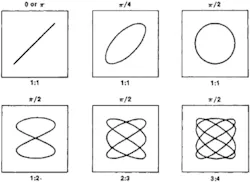
Today’s crystal-based oscillators are far smaller, more accurate, higher frequency, and made via a highly automated process, of course. They’re almost always sold as a complete circuit with the associated oscillator in addition to the crystal element itself.
A recent addition to the high-performance, high-end oscillators is Microchip Technology’s EX‑423 Evacuated Miniature Crystal Oscillator (EMXO), which extends their extensive line of timing and frequency devices (Fig. 2). This compact, low‑power timing solution is designed for applications that demand high stability, accuracy, and long‑term reliability. The temperature-stabilized EX‑423 delivers this performance in a low‑profile, 13- × 13-mm package for space‑ and power‑constrained designs.
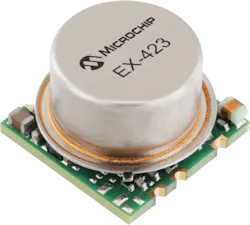
The ruggedized EX‑423 is sealed in an ultra‑high vacuum designed to provide optimal thermal insulation and help improve frequency stability. Its quartz crystal uses a four‑point mount to enhance shock survivability and reduce g‑sensitivity, suiting it for GPS/GNSS tracking, military radios, medical devices, ocean-bottom-node (OBN) seismic systems, test and measurement equipment, and satellite communications.
The EX‑423 combines ultra‑low phase noise with tight temperature control, strong short‑term stability (Allan deviation), fast warm‑up, and long‑term frequency stability. Operating over the widely used 10- to 20-MHz frequency range, the device consumes 1 W during warm‑up and as little as 0.2 W at +25°C (in steady state), helping extend battery life while maintaining a clean, stable reference under stressful operating conditions. The EX‑423 requires a nominal 5-V supply, and a 3-V version is available as well.
Stability versus operating temperature range spans ±5 parts per billion (ppb, and yes, that’s “b” for billion) from 0 to +50°C, increasing to ±20 ppb from −40 to +85°C. Along with many other critical dynamic specifications called out on the 8-page datasheet, Allan deviation is 4 x 10-12 at τ = 1 second. (Allan deviation or Allan variance is an insightful statistical parameter for characterizing timing sources and gyroscopes; if you’re not familiar with it, you should be).
The datasheet also provides short- and long-term performance numbers, including aging over one-day, one-year, and 10-year periods, as well as many other important performance specifications. And it does so not only at “nominal” settings, but also maximum and minimum bounds.
As an additional user-accommodation feature, the EX-423 is offered in both surface-mount (SMD) and through-hole mounting options, to meet designer preferences (or mandates).
About the Author
 Bill Schweber
Bill Schweber
Contributing Editor
Bill Schweber is an electronics engineer who has written three textbooks on electronic communications systems, as well as hundreds of technical articles, opinion columns, and product features. In past roles, he worked as a technical website manager for multiple topic-specific sites for EE Times, as well as both the Executive Editor and Analog Editor at EDN.
At Analog Devices Inc., Bill was in marketing communications (public relations). As a result, he has been on both sides of the technical PR function, presenting company products, stories, and messages to the media and also as the recipient of these.
Prior to the MarCom role at Analog, Bill was associate editor of their respected technical journal and worked in their product marketing and applications engineering groups. Before those roles, he was at Instron Corp., doing hands-on analog- and power-circuit design and systems integration for materials-testing machine controls.
Bill has an MSEE (Univ. of Mass) and BSEE (Columbia Univ.), is a Registered Professional Engineer, and holds an Advanced Class amateur radio license. He has also planned, written, and presented online courses on a variety of engineering topics, including MOSFET basics, ADC selection, and driving LEDs.