Isolated Temp Sensor “Rides ON” Heat Source, Provides Analog Output
What you'll learn:
- Why many available temperature sensors still have application gaps.
- How a new sensor design galvanically isolated the sensing element for close-contact sensing.
- The performance of the sensor device in challenging settings includes a comparison to NTC thermistors.
Temperature is the most widely measured physical variable for many good reasons, as it directly and indirectly affects so many processes, actions, and systems. As a result, almost countless contact and non-contact sensors can measure it, with overlapping attributes, benefits, and considerations.
Still, a dilemma often emerges here: Although there are so many available, off-the-shelf, high-performance sensors to choose from, the bigger problem in numerous cases is getting the desired sensor into the right place to make an accurate, meaningful measurement.
Isolation Barrier + Analog Temperature Sensor
That’s where Texas Instruments’ ISOTMP35R comes into the story (Fig. 1). TI maintains that this is the industry’s first reinforced, isolated temperature-sensor IC. It combines an integrated isolation barrier supporting up to 5-kV RMS withstand voltage with an analog temperature sensor featuring a 10 mV/°C slope from –40 to 150°C and corresponding output ranging from 100 mV to 2.0 V.
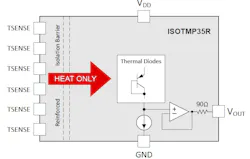
Why does this matter? Such integration enables the sensor to be co-located adjacent to challenging high-voltage heat sources like power MOSFETs, IGBTs, and busbars, thereby eliminating the need for external isolation amplifiers or isolated data converters.
This direct contact with the high-voltage heat source also provides greater accuracy and faster thermal response compared with approaches where the sensor is placed further away to meet isolation requirements. Applications for this type of temperature sensor include AC charging stations, DC fast-charging stations, EV/HEV battery pack and charger functions, powertrain sensing, rack and server PSUs with 48-V output, and server PSUs with 12-V output, to cite a few. (Note that an automotive AEC-Q100-qualified version, the ISOTMP35R-Q1, is also available.)
Flexibility is critical in the typical application setting. The ISOTMP35R accepts a wide supply range of 3.1 to 34 V, enabling use in systems where a regulated low-voltage rail isn’t available alongside the high-voltage domain.
The ISOTMP35R doesn’t require any external calibration or trimming to provide a worst-case accuracy of ±0.5°C at room temperature and ±3.0°C over the full –40 to 150°C temperature range. The linear output, 500-mV offset, and factory calibration of the ISOTMP35R simplify the circuitry requirements in a single-supply environment where reading negative temperatures is necessary.
The 12-pin SSOP surface-mount package (approximately 10 × 4 × 3 mm high) provides excellent heat flow from the heat source to the embedded thermal sensor, minimizing thermal mass and providing more accurate heat-source measurement. This reduces the need for time-consuming thermal modeling and improves system design margin by reducing mechanical variations due to manufacturing and assembly. Despite this “closeness,” the integrated isolation barrier satisfies UL 1577 requirements.
Evaluation and Alternatives
Obviously, there are already many ways to measure temperature in similar settings, such as by using a negative temperature coefficient (NTC) thermistor. Addressing these alternatives, TI provides two test examples.
In the first test configuration highlighted in the datasheet, heat was applied primarily through the TSENSE pins while the remaining device pins were exposed to ambient temperature. This configuration reflects real-world use cases where the device is thermally coupled to a localized high-voltage heat source, such as a power transistor or copper plane, with the rest of the package influenced by ambient conditions.
The thermal response follows a first-order characteristic, reaching approximately 63% of the final value in about 3.7 seconds. This indicates tight thermal coupling between the heat source and the internal temperature sensor through the TSENSE pins.
The second configuration discussed compares the ISOTMP35R versus discrete NTC thermistor implementations. The ISOTMP35R is thermally coupled directly to the heat source through the TSENSE pins. In contrast, the thermistors are positioned approximately 8mm away and rely on heat transfer through PCB material and with/without a thermal conductive epoxy (Fig. 2).
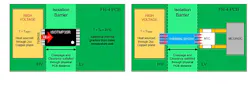
Figure 3 shows the measured thermal response of the ISOTMP35R compared to two NTC configurations, both with and without that thermal epoxy.
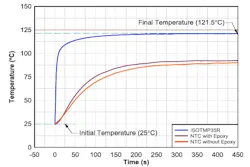
The ISOTMP35R reaches the final temperature significantly faster and remains closer to the 125°C reference during the transient response. This behavior results from the direct thermal coupling through the TSENSE pins, which minimizes thermal resistance between the heat source and the sensing element.
Temp-Sensor Evaluation Module
Evaluation boards play an important role in allowing designers to check out a new device type and minimize unforeseen “surprises.” For this unique sensor, TI offers the somewhat unusual ISOTMP35REVM evaluation module (Fig. 4). This $49 module features a detachable, “breakable” ISOTMP35R temperature-sensor board portion, including a screw hole for easy attachment with good thermal conductivity to a high-voltage busbar or power MOSFET.
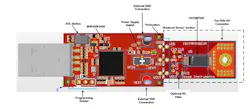
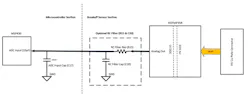
An easy-to-use cloud-based GUI is available on the web or can be downloaded for offline use; the 21-page datasheet provides full details on this module and its use (Fig. 5).
The ISOTMP35R non-AEC-Q100 version is priced at $2.495 in low quantities (1 to 99) and $1.235 (1,000 pieces). It’s supported by a comprehensive 44-page datasheet with the usual necessary tables and charts, along with discussion of principles, applications, and additional analysis. The automotive-qualified ISOTMP35R-Q1 has its own datasheet ($1.606/1,000 pieces).
About the Author
 Bill Schweber
Bill Schweber
Contributing Editor
Bill Schweber is an electronics engineer who has written three textbooks on electronic communications systems, as well as hundreds of technical articles, opinion columns, and product features. In past roles, he worked as a technical website manager for multiple topic-specific sites for EE Times, as well as both the Executive Editor and Analog Editor at EDN.
At Analog Devices Inc., Bill was in marketing communications (public relations). As a result, he has been on both sides of the technical PR function, presenting company products, stories, and messages to the media and also as the recipient of these.
Prior to the MarCom role at Analog, Bill was associate editor of their respected technical journal and worked in their product marketing and applications engineering groups. Before those roles, he was at Instron Corp., doing hands-on analog- and power-circuit design and systems integration for materials-testing machine controls.
Bill has an MSEE (Univ. of Mass) and BSEE (Columbia Univ.), is a Registered Professional Engineer, and holds an Advanced Class amateur radio license. He has also planned, written, and presented online courses on a variety of engineering topics, including MOSFET basics, ADC selection, and driving LEDs.