“The Final Frontier” Gets Enhanced Analog-Component Support

What you'll learn:
- The increasing need for space-related components, including basic analog-function ICs.
- The availability of a new current-sense amplifier as well as a differential-to-single-ended RF amplifier.
- An option for temperature sensing that supports both internal device and external system readings.
Due to the proliferation of space-based applications in low, medium, and geostationary orbits (as well as deep space exploration), components rated for these challenging environments are receiving lots of justified attention. For various reasons, it’s mostly the processors and their power supplies and power subsystems that attract the most news, but it takes a slew of additional classic analog components that are also space-rated to create a system.
Proof of this new reality is seen in a trio of space-rated building-block analog components recently introduced by Texas Instruments that cover various parts of the analog-related signal chain. Radiation-hardened performance for each is spelled out in detail in their respective comprehensive datasheets, including total ionizing dose (TID) and single event effects (SEE), with the latter for both single event latch-up (SEL) and single event transient (SET).
INA951-SEP Current-Sense Amplifier
The INA951-SEP is a current-sense amplifier that can measure voltage drops across shunt resistors over a wide common-mode range from –4 to 80 V (Fig. 1). The negative common-mode voltage allows the device to operate below ground, thus accommodating precise measurement of recirculating currents in half-bridge applications.
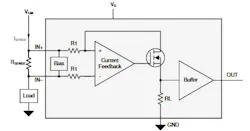
The combination of a low offset voltage, small gain error, and high DC CMRR enables highly accurate current measurement. The INA951-SEP is not only designed for DC current measurement, but also for high-speed applications (needed for overcurrent protection) with a high bandwidth of 1.3 MHz and 85-dB AC CMRR (at 50 kHz).
The INA951-SEP operates from a single 2.7- to 10-V supply, drawing 1.5 mA of supply current, and is available with a gain option of 20 V/V. It’s specified over an operating temperature range of −55°C to +125°C and comes in a space-saving 2.90- × 2.80-mm SOT-23 package. In addition, outgassing tests are performed per ASTM E595.
TRF0108-SP DRS RF Amplifier
The TRF0108-SP is a radiation-hardness-assured, differential-to-single-ended (D2S) RF amplifier for near-DC to 12 GHz use (Fig. 2).
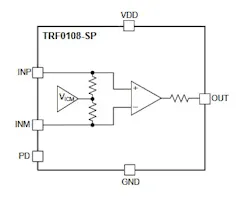
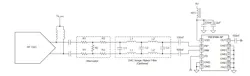
A common application for this device is as a buffer amplifier for an RF DAC, such as TI’s DAC39RF10-SP or AFE7950-SP, which have differential outputs. In many conventional designs, passive baluns are used to interface differential amplifier outputs with single-ended RF DACs.
The TRF0108-SP replaces these bulky and expensive passive baluns while offering excellent gain and phase imbalance, as well as input and output return loss (Fig. 3). The 2- × 2-mm package greatly reduces required PCB area compared to use of baluns, especially critical in high-channel-count RF systems. The TRF0108-SP operates on a single 5-V supply and consumes about 170 mA in the active state.
TMP8R01-SP Remote and Local Temperature Sensor
Finally, there’s temperature. It’s a rare system that doesn’t need temperature sensing, either for its native functionality or to monitor operating conditions independent of that functionality. That’s where the TMP9R01-SP high-accuracy remote and local temperature sensor has its place (Fig. 4).
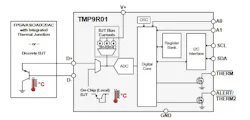
This digital I2C temperature sensor integrates a 12-bit ADC, bias-current sources, and calibration circuitry in a 24-pin, 4.9- × 3.0-mm VSSOP plastic package (just 99 milligrams) and operates from a 1.7- to 3.6-V supply.
The device measures remote temperature (–64 to 191°C range, ±1.5°C maximum error) by forcing a bias current through an external bipolar junction transistor (BJT) or the integrated diode/junction of an FPGA, ADC, or ASIC, digitizing the resulting ΔVBE and reporting temperature with 0.0625°C resolution. An additional on-chip sensor provides local temperature measurement (±2.0°C maximum error)
The TMP9R01-SEP incorporates multiple calibration and protection features, including series-resistance cancellation, programmable nonideality factor (η-Factor), offset correction, and programmable digital filter. Designers can set high- and low-temperature limits that drive the ALERT output for over-and-under temperature thermal protection. Up to nine pin-selectable I2C/SMBus addresses allow for multiple sensors on the same I2C bus.
Due to the universal importance of space-qualified temperature measurement and the many ways to implement it, TI also offers an insightful application note, “How to Optimize Space-Grade Temperature Sensing Designs.” It examines the sensing alternatives and their relative merits.
About the Author
 Bill Schweber
Bill Schweber
Contributing Editor
Bill Schweber is an electronics engineer who has written three textbooks on electronic communications systems, as well as hundreds of technical articles, opinion columns, and product features. In past roles, he worked as a technical website manager for multiple topic-specific sites for EE Times, as well as both the Executive Editor and Analog Editor at EDN.
At Analog Devices Inc., Bill was in marketing communications (public relations). As a result, he has been on both sides of the technical PR function, presenting company products, stories, and messages to the media and also as the recipient of these.
Prior to the MarCom role at Analog, Bill was associate editor of their respected technical journal and worked in their product marketing and applications engineering groups. Before those roles, he was at Instron Corp., doing hands-on analog- and power-circuit design and systems integration for materials-testing machine controls.
Bill has an MSEE (Univ. of Mass) and BSEE (Columbia Univ.), is a Registered Professional Engineer, and holds an Advanced Class amateur radio license. He has also planned, written, and presented online courses on a variety of engineering topics, including MOSFET basics, ADC selection, and driving LEDs.