Hydrogen Sensors Help Detect Explosive Conditions in Batteries

Lithium-ion (Li-ion) batteries offer high energy density and fast charging capabilities, but they’re also highly sensitive to thermal runaway. This happens when a battery cell overheats uncontrollably until it ignites or explodes. The heat generated can spread to other cells within a battery pack, causing the entire assembly to erupt into flames.
While battery fires are relatively rare, they burn hot and are hard to extinguish because they’re fed by chemical reactions. As a result, they have remained a persistent safety concern in electric vehicles (EVs) and beyond.
In EV batteries, rising temperatures are a red flag for thermal runaway. However, hydrogen can serve as an even earlier indicator as it’s released before heat even starts building up inside the pack and ignition occurs. Fast, reliable detection of the gas can help prevent overheating and potentially stop fires before they start.
“Thermal runaway isn’t always instantaneous,” said Peng Tu, CEO of Posifa Technologies. “In many EV battery incidents, hydrogen is released during the early venting phase — minutes before ignition.”
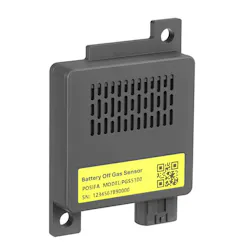
The San Jose, California-based company introduced a series of hydrogen gas sensors, PGS5100, to enable early warnings of thermal-runaway events and other potentially explosive conditions in EV battery packs and related safety-critical systems.
The MEMS-based sensors detect the concentration of hydrogen by measuring changes in the thermal conductivity of the gas as it builds inside battery packs during thermal runaway. They feature a 100-ms response time and 200-ms warm-up time to react fast to potential faults. Running on a 5-V supply with average power use of 50 mW, the sensors also integrate humidity and pressure sensors to help them adjust to changing conditions, ensuring accurate measurements over wide temperature, humidity, and altitude ranges.
What Causes Thermal Runaway and What Prevents It?
A lithium-ion battery is a finely tuned electrochemical device where complex chemical and electrical processes collide, and thermal runaway describes a chain reaction of exothermic reactions that can occur in the cell when it is outside its out of its safe operating area (SOA), explained Daniel Parr, a technology analyst at market research firm IDTechEx.
This scenario is often caused by internal short circuits or other faults that can lead to unusually high currents. Punctures and other physical damage, specifically to the separator between the anode and cathode, may also cause short circuits, as can the growth of needle-like structures called dendrites inside the cell. Another trigger for short circuits are deformations or other defects in the cell that compromise the separator’s integrity. These defects can be introduced in the battery production process, so they’re more likely to occur in lower-quality cells.
Thermal runaway may also develop due to overcharging or undercharging the battery cells. On top of that, this scenario can be caused by unsafe environmental conditions, including exposure to excessively high or low temperatures as well as extreme mechanical pressure and vibrations.
Once it starts, thermal runaway can be broken down into several stages, which transpire as the battery cell reaches different temperatures. Cooling systems are typically used to prevent thermal runaway in one cell from propagating to others in the pack. However, this isn’t always able to contain thermal runaway to a single cell once it starts, said Parr. This is especially true for overheating that can occur with a delay, in which the battery starts overheating several hours after being damaged or experiencing a short circuit.
During the early stages of thermal runaway, gases are produced through the decomposition of the cell components, including the liquid electrolyte. These gases include not only hydrogen, but also carbon dioxide and various volatile organic compounds (VOC), such as electrolyte vapors.
Cell venting happens when gas builds up inside the cell and the pressure forces it out. While this venting helps relieve pressure in the cell and prevents further damage and full thermal runaway, these gases still must go somewhere, namely into the battery pack enclosure, said Parr. As hydrogen and other flammable gases fill the enclosure, they can cause corrosion of the battery packaging and components. This could also lead to combustion of the gases, which in turn can cause other cells to enter thermal runaway and erupt into flames.
A battery-management system (BMS) is used to monitor the voltage of every cell as well as the voltage, current, and temperature of the pack and applies these parameters to ensure safety and reliability. However, Parr said that most don’t keep track of cell venting or the presence of toxic and flammable gases like hydrogen inside the pack, which can be comprised of tens to hundreds — or sometimes even thousands — of cells in EVs and energy storage systems (ESS),
Gas Sensors: A Solution for the Future for Battery Safety?
According to IDTechEx, hydrogen and other gas sensors are well placed as solutions to this problem. Parr predicts that gas sensors will represent over 50% of advanced sensor deployments in battery packs by 2036.
By detecting dangerous gases, including hydrogen and carbon dioxide, earlier warnings of thermal runaway can be provided. A BMS equipped with these sensors could detect thermal runaway up to 30 minutes before a battery fire occurs, compared to 5 to 10 minutes with traditional sensors. Thus, the issue is addressed before it gets out of control. Besides that, the build-up of these gases in the pack enclosure can be monitored to prevent potentially explosive conditions from forming in the first place.
However, different sensors must be used to detect the presence of different toxic and flammable gases in the battery pack. Hydrogen sensors could be one of the main sensors in EVs because hydrogen is produced soon after electrolyte vaporization.
Hydrogen sensors are often based on thermal conductivity principles. Air with higher concentrations of hydrogen will have a higher thermal conductivity. By measuring the heat loss through the gas sensor and comparing it to a reference sample of air, the concentration of hydrogen can be determined.
Posifa said the PGS5100 is designed to detect hydrogen inside the battery pack fast and accurately, measuring concentrations of the gas from 0% to 25%. The sensors are also resistant to condensation and non-reactive to contaminants, offering long-term stable operation in harsh conditions.
Housed in an IP6K9 enclosure with an automotive-grade connector, the sensors are suited for battery-safety systems in EVs and other applications requiring robust hydrogen monitoring, such as grid-connected battery storage and backup battery units in data centers.
Besides batteries, Posifa said the sensors can also be used with hydrogen fuel cells, which are being deployed at data centers as a source of primary or backup power. Fuel cells work by combining a chemical — often, hydrogen — with oxygen or another agent to cause a reaction, producing electricity in the process.
The company introduced the new sensors ahead of Sensors Converge 2026, taking place in Santa Clara, California, in May.
About the Author
 James Morra
James Morra
Senior Editor
James Morra is the senior editor for Electronic Design, covering the semiconductor industry and new technology trends, with a focus on power electronics and power management. He also reports on the business behind electrical engineering, including the electronics supply chain. He joined Electronic Design in 2015 and is based in Chicago, Illinois.