High-Sensitivity Proximity Sensor Detects Up to 600 mm
What you'll learn:
- The many uses of optical proximity sensors.
- How a tiny optical sensor eases many application challenges.
- Why a digital sensor output simplifies design-in.
Proximity sensors are literally and figuratively the often-invisible elements in systems as they react to motion, position, or a nearby presence. You can find one, or likely more, in commonplace applications:
- Printers, copiers, tablets, and home appliances
- Collision detection in robots and toys
- Proximity sensing and lighting control in offices, corridors, and public buildings
- Parking space availability in lots and garages
- Even water activation in lavatory appliances
It’s a long if not obvious list (if you make a deliberate effort to look around for them, you’ll see how many are out there, silently doing their job).
Just as proximity sensing has many applications, it can be implemented in many ways, with magnetic, capacitive, RF, and optical approaches among the most common. As always, there’s no single “best” proximity sensor, as it depends on the specifics of the installation, costs, ruggedness, use patterns, distance, potential interference, and many other factors.
The optical technique is very popular due to its ease of electrical and mechanical design-in, versatility, flexibility, RF noise immunity, low cost, low power requirements, ease of interfacing, and overall reliability. While early optically based proximity detectors used separate LEDs and photosensors, each with its respective driver or signal-conditioning circuitry, the popularity of the optical approach soon drove the development of more highly integrated and sophisticated solutions.
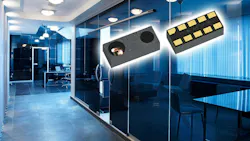
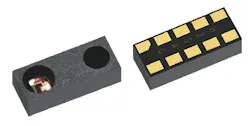
The latest entry is the VCNL36758 from Vishay Intertechnology. This device is a high-sensitivity proximity sensor with range up to 60 cm that incorporates an infrared (IR) LED and corresponding photosensor in a single package (Fig. 1).
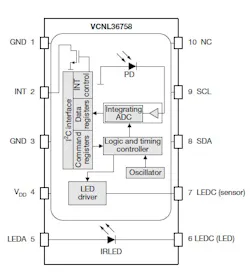
The single-chip sensor houses more than just the emitter IR LED and complementary photodetector (PD). It also includes drivers, amplifiers, analog/digital circuits, controller, and external I/O into a 5.0- × 2.0- × 1.5-mm surface-mount package (Fig. 2).
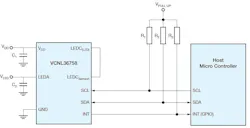
Its functions and capabilities are directly controlled and reported via the simple command format of the I2C (SMBus compatible) interface protocol (Fig. 3).
The device’s capabilities go far beyond basic IR emission and sensing. It offers individually programmable high- and low-threshold interrupt features for the best use of resources, as well as power savings at the microcontroller.
The 12-bit proximity-sensing function uses an intelligent cancellation scheme, so that crosstalk is eliminated effectively. Further, to accelerate the proximity-sensor response time, an adjustable “smart persistence” scheme prevents the misjudgment of proximity sensing but also allows for a fast response time.
Operating voltage is 1.7 to 3.6 V, while temperature compensation supports consistent operation from −40 to +85°C (if you think about it, many of the applications are in “exposed” or outdoor settings). The device is fully supported by a comprehensive 17-page datasheet that includes the expected numbers on voltages, currents, timing, and similar specs; I/O; registers and bit assignments; and timing. It also features diagrams showing spectral emission and sensitivity vs. angle.
As this is an electro-optical device with placement and mechanical considerations, Vishay has posted a 32-page guide “Designing the VCNL36758 Into an Application” that covers setup details, configuration options, physical siting issues, flowcharts, and much more.
About the Author
 Bill Schweber
Bill Schweber
Contributing Editor
Bill Schweber is an electronics engineer who has written three textbooks on electronic communications systems, as well as hundreds of technical articles, opinion columns, and product features. In past roles, he worked as a technical website manager for multiple topic-specific sites for EE Times, as well as both the Executive Editor and Analog Editor at EDN.
At Analog Devices Inc., Bill was in marketing communications (public relations). As a result, he has been on both sides of the technical PR function, presenting company products, stories, and messages to the media and also as the recipient of these.
Prior to the MarCom role at Analog, Bill was associate editor of their respected technical journal and worked in their product marketing and applications engineering groups. Before those roles, he was at Instron Corp., doing hands-on analog- and power-circuit design and systems integration for materials-testing machine controls.
Bill has an MSEE (Univ. of Mass) and BSEE (Columbia Univ.), is a Registered Professional Engineer, and holds an Advanced Class amateur radio license. He has also planned, written, and presented online courses on a variety of engineering topics, including MOSFET basics, ADC selection, and driving LEDs.