Waterproof USB-C Connectors Expand Application Arena

What you’ll learn:
- Why USB-C has become the de facto “universal” power/data connector, within certain current/voltage/power limits.
- The ruggedness shortcoming of USB-C that impacts its applicability.
- How a new family of waterproof USB-C connectors extends its usefulness.
Connectors usually don’t get much call-out or attention, as they’re often considered just another item on the bill of materials in many cases, despite their vital role. But one type has attracted a lot of mass-market attention in recent years: the USB Type-C connector (often referred simply to a USB-C).
The reason is simple: The European Union mandated this connector as of late 2024 for many classes of consumer products, such as smartphones and even laptops, to minimize the need for countless incompatible AC-DC chargers to reduce waste and other reasons. Ever since then, device vendors have been switching to USB-C as a “universal” connector, within limits, of course.
Apple finally gave up its decade-long opposition to USB-C as they preferred that users stay with their proprietary Lighting connector. (See the European Commission news release “EU common charger rules: Power all your devices with a single charger” for a brief overview).
You might say that USB-C is “hot” both figurately and literally, and the connector and associated cable can get pretty warm at its higher-power levels. Nevertheless, especially when used in combination with the complicated USB Power Delivery (PD) standard, it’s presently the connector that people will turn to first — if they can use it or are mandated to do so.
But there’s a problem with USB-C connectors. They’re not rugged or sealed against intrusion, yet that’s where many may be used outside of low-end consumer applications.
A New Family of Waterproof USB Receptacles
Addressing this challenge, Same Sky introduced he UJ family of waterproof USB receptacles with IPX5, IPX6, IPX7, IPX8, IP66, IP67, and IP68 ratings, making them well-suited for applications where moisture and environmental contaminants are a concern (see figure). (Not familiar with Same Sky? They were known as CUI Devices until September 2024 when they changed their name.)
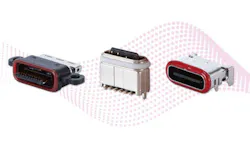
All models are compatible with reflow soldering due to their UV-glued O-rings. This simplifies the PCB assembly process, since there’s no need for a separate wave-soldering step (as is often the case with connectors and other larger components).
These IP-rated USB Type-C receptacles conform to a variety of USB standards from USB 2.0 up to USB 4.0 Gen 3x2 with data-transfer speeds up to 40 Gb/s as well as power delivery up to 240 W at 48 V and 5 A. The family also includes power-only models that remove the data-transfer pins to create a more cost-effective solution for designs where charging or power is the sole needed function.
The released models include:
- UJC-H-G-SMT-1-P6-TR-65 (power only)
- UJ32-C-H-G-SMT-4-P24-TR-68 (power/data)
- UJ20-C-V-G-SMT-P16-TR-66 (power/data)
- UJ20-C-H-G-MSMT-P16-TR-67 (power/data)
- UJ20-C-H-G-SMT-P16-TR-67 (power/data)
Among the mounting styles are hybrid mount, mid-mount SMT, mid-mount hybrid, and surface mount with or without anchor pins. The connectors are rated for up to 10,000 mating cycles, with an operating temperature range of −40 to 85°C. The UJC, UJ20, UJ32, and UJ40 models are available immediately with prices starting at $0.68 per unit at 700 pieces.
If your’e not as familiar with USB in general, and well as USB-C and USB-PD as you’d like to be, Same Sky has posted nearly a dozen useful tutorials in its Resource Library. Note that not everyone is fully enamored with USB-C and USB-PD as a “universal” power/data link; see the blog “USB-C and Power Delivery: Too much of a good thing?” (not a blog from Same Sky).
>>Check out this TechXchange for similarly themed articles and videos
About the Author
 Bill Schweber
Bill Schweber
Contributing Editor
Bill Schweber is an electronics engineer who has written three textbooks on electronic communications systems, as well as hundreds of technical articles, opinion columns, and product features. In past roles, he worked as a technical website manager for multiple topic-specific sites for EE Times, as well as both the Executive Editor and Analog Editor at EDN.
At Analog Devices Inc., Bill was in marketing communications (public relations). As a result, he has been on both sides of the technical PR function, presenting company products, stories, and messages to the media and also as the recipient of these.
Prior to the MarCom role at Analog, Bill was associate editor of their respected technical journal and worked in their product marketing and applications engineering groups. Before those roles, he was at Instron Corp., doing hands-on analog- and power-circuit design and systems integration for materials-testing machine controls.
Bill has an MSEE (Univ. of Mass) and BSEE (Columbia Univ.), is a Registered Professional Engineer, and holds an Advanced Class amateur radio license. He has also planned, written, and presented online courses on a variety of engineering topics, including MOSFET basics, ADC selection, and driving LEDs.