11 Myths About Data Sharing
What you'll learn:
- Why common misconceptions keep companies from sharing data.
- How secure platforms enable collaboration without adding risk.
- Ways that data collaboration accelerates AI, yield, and time-to-market.

In an era where data is hailed as the new oil, the semiconductor industry grapples with a paradox: the need for collaboration versus the fear of competitive risk. The industry's hesitance to share data across the ecosystem is often driven by concerns about intellectual property loss, implementation complexity, and security and privacy fears. Myths surrounding data sharing frequently hinder progress and innovation, clouding the understanding of how effective collaboration can be achieved.
Leading semiconductor organizations are increasingly recognizing the importance of differentiating between proprietary data that drives competitive advantage and intelligent data sharing through a secure collaboration space like Athinia. Such a solution allows for the protection of data ownership, governance, privacy, and security while fostering innovation.
This article seeks to debunk 11 common misconceptions that impede the advancement of data collaboration within the semiconductor ecosystem.
1. Sharing data compromises IP.
This concern is mitigated when only assigned viewers can see need-to-know data, and only the respective company can view its own data. So, it's not just a company that can view the data; it's very specific people who can view very specific data.
2. If it’s not fully anonymized, it’s too risky.
When it comes to security, obfuscating data makes it harder to understand while preserving its utility for analysis. For example, renaming things to molecule 1, molecule 2 instead of the real names. We have a system of governance and trust between the data that’s being shared between Device Makers and suppliers (best-in-class obfuscation of recipe, lot, layout, yield, subcomponent data, etc.)
3. It’s too complex across disparate systems and standards.
Our system works with everything that companies need and works with everything companies may already have on hand. Our partners needn’t change their existing systems to collaborate effectively. We normalize the data to ensure consistency in format and units, facilitating smoother interactions.
4. Device makers don’t trust suppliers to share data responsibly.
What we have seen is that, as long as security can be guaranteed through a many-to-many platform, there’s growing openness due to the undeniable advantage of communicating together without compromising security.
For example, we will see the numbers in the challenges regarding material dispositioning, where 30% of materials from suppliers are oftentimes rejected, increasing costs and waste. Then if we see that there’s collaboration, suppliers can boost predictability from 0% to 80%, revealing the time, money and yields they can save.
5. Data sharing leads to loss of competitive advantage.
There's a common misconception that sharing data with partners will dilute a company's competitive edge. However, effective data collaboration can enhance competitive advantage by fostering innovation, improving product quality, and accelerating time-to-market. Facilitating a secure environment in a “private collaboration space” allows companies to share insights while still protecting their proprietary information.
6. Data sharing is a one-way street.
Some believe that data sharing only benefits one party, typically the one receiving the data. In reality, effective data collaboration is mutually beneficial. When companies share data, they can gain insights that improve their own processes and decision-making, leading to enhanced productivity and innovation for all parties involved.
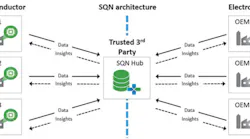
Athinia enables data flow between a fab and a material supplier, or between a fab and any supplier. Actually, every material supplier can have multiple interactions with fabs, every fab can have multiple interactions with material suppliers, and so on.
7. Data sharing is only for large companies.
Many believe that only large semiconductor companies can benefit from data-sharing initiatives. In reality, companies of all sizes can leverage collaborative data sharing to enhance their operations, improve efficiencies, and drive innovation. Our platform is designed to support businesses across the spectrum, making it possible for smaller players to participate in data collaboration.
8. Data sharing is too time-consuming.
There’s a perception that establishing data-sharing agreements and processes is overly complex and time-consuming. However, by streamlining the data-sharing process, it’s easier and faster for companies to collaborate. With structured data and secure frameworks in place, organizations can quickly start sharing valuable insights without significant delays.
9. Existing systems need to change.
To implement data collaboration, companies can—and should—still work with their existing systems; that shouldn’t change with data collaboration. At Athinia, we help companies connect their systems. We are allies of their IT departments, connecting them to their downstream partners outside their four walls, and this is where we see an advantage.
10. Data sharing is only for high-volume manufacturing.
Pipelined secure data collaboration significantly drives value by leveraging value drivers from material selection, driving application and layer wins to yield ramp — faster optimization with less time, chemistry, and wafers wasted. This is important in high-volume environments to get the fab running, drive down costs, and solve excursions.
However, the more data collaboration we have from the start within R&D and the yield ramp, the greater the value we’ve seen for suppliers. It opens the door to accelerated development, reduces costs, and shortens time to high-volume manufacturing.
11. AI strategy can be done without data collaboration.
An AI strategy that fails to consider data collaboration is clearly incomplete. It would be like using generative AI without having enough data backing the model. Companies can generate better yields through highly sophisticated, integrated partnerships while retaining control of their data to implement their AI strategies. Data sharing enables our customers to make better AI analysis. Moreover, data sharing and collaboration allow AI to do what companies can already do, but faster and better.
About the Author
Adam Schafer
CEO, Athinia Technologies
Adam Schafer, Ph.D., is the Chief Executive Officer of Athinia, a leading secure data collaboration platform tailored for the semiconductor industry. He joined the company in November 2024 as Vice President and Chief Operating Officer, bringing a wealth of experience from his previous role at the U.S. Department of Commerce, where he led Supply Chain Strategy for the CHIPS for America program. In this capacity, Adam drove U.S.-based semiconductor manufacturing initiatives, focusing on the Technology Portfolio, Supply Line Sustainability, Supply Chain Resilience, Workforce Development, Construction, ESG, and Chemical Compliance.
With over 22 years of diverse leadership and engineering experience at Intel, Adam has cultivated a deep understanding of semiconductor processes and supply chain dynamics. He began his career as a process engineer and progressed to Senior Director for Supply Chain Responsibility, where he honed his expertise in optimizing supply chain operations and driving efficiency.
Adam holds a B.S. in Chemistry and Philosophy from SUNY Oswego and earned both his M.S. and Ph.D. in Physical Chemistry from the University of Washington. In addition to his role at Athinia, Adam serves on the advisory board of Capturiant, a global integrated environmental asset authenticator, and is actively involved with the SEMI Climate Consortium and the Northwest regional SEMI Boards. His leadership is characterized by a commitment to fostering collaboration, enhancing data security, and driving innovation within the semiconductor ecosystem.
Related

Comment About the Article
To join the conversation, and become an exclusive member of Electronic Design, create an account today!
 Leaders Logo
Leaders relevant to this article: