From COM to SMARC to OSM: The Evolution of Embedded Computing Modules
What you'll learn:
- The differences between embedded computing modules and how to choose wisely between the different standards.
- Whether embedded computing modules based on proprietary form factors or open standards best serve your design.
- How to balance tradeoffs such as size and performance and whether you still need to compromise between them.
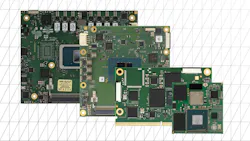
Have embedded developers ever had such a wide choice of high-performance, power-efficient computing modules? The breadth of options now available allows them to tailor size, cost, and performance without resorting to using custom hardware and the engineering costs that inevitably come with extensive component-level design. The proliferation is driven primarily by vendors choosing to adopt open standards rather than trying to build market share with limited, proprietary offerings.
Open board-level platforms have much in common with open-source software. Both gain from the scrutiny of experienced engineers from many organisations and industrial sectors.
They bring their knowledge of computer design to inform the mechanical, thermal, and signal-integrity choices that underpin an open platform’s specification. With a proprietary platform, you’re relying on the decisions made by the team of a single supplier, which may be highly experienced but lack the breadth enjoyed by a popular open platform.
Open platforms help avoid other common problems facing electronics engineers, such as obsolescence. Even if some suppliers stop supporting the format, others will be able to step in to provide new hardware. Openness also provides a level playing field for hardware suppliers to compete on performance and cost-effectiveness.
The Rise of Computer-on-Module (COM) Architectures
Choosing a single computer module from all of the options on the market can seem confusing at first. But the availability of off-the-shelf hardware platforms gives engineers the flexibility to fine-tune the form factor and I/O configuration of the module for each project relatively easily. The key is understanding which format best aligns with those requirements.
The computer-on-module (COM) architecture is very widely used because it combines the convenience of a ready-made compute module with the flexibility of a custom carrier board.
Introduced by the PCI Industrial Computer Manufacturers Group (PICMG), COM Express created a template for other COM-based standards, giving engineers a relatively easy way to expand I/O around a central processing core. When COM Express was introduced, single-board computers (SBCs) dominated. These parts comprised a PCB equipped with a processor and selection of standard I/O. One or more add-on modules could be plugged into the SBC to deliver custom I/O capabilities.
>>Download the PDF of this article, and check out the TechXchange for similarly themed articles and videos
 triacommodulespromo
 Ed Promo
With COM Express, a module contains the host processor that plugs into a carrier board. This lets users pick a suitable carrier board or develop their own to provide the I/O for their application and then plug in the optimal computing module using the COM Express standard. That leaves the door open for engineers to upgrade to more powerful or affordable COM Express modules over time without having to redesign the enclosure or cater to changes in the I/O layout.
The core I/O buses supported by COM Express include PCI Express, so the modular approach is ideal for embedded systems that need mass-storage capacity, Ethernet networks, and graphics displays. Some designers, though, will choose to employ the format in headless configurations.
x86 vs. Arm: Processor Architectures and Performance Scaling
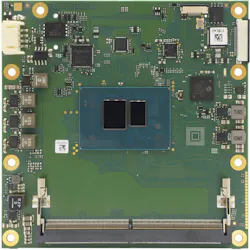
Reflecting its roots in industrial PC design, many COM Express modules are based on x86 CPUs. However, the ecosystem is no longer limited to that architecture. The market is expanding into higher-performance tiers with new standards such as COM-HPC, which is targeted at computationally heavy systems such as edge servers and AI nodes. These modules are loaded with additional high-speed PCIe lanes to enable more higher bandwidth and more scalability.
At the same time, COM standards have also adopted the Arm architecture, broadening the range of processor choices available to developers. The result is a richer mix of performance levels, power envelopes, and software ecosystems. Further diversification has come from hardware formats optimised for compact designs, extending COM concepts into ever-smaller footprints.
Finding the Right Form Factor: Size, Shape, and I/O Constraints
Physical size is a defining parameter in many embedded designs. Some projects offer generous board space, while others may only have a palm-sized space for the COM. Where space is plentiful, board selection is relatively straightforward. If you have a large amount of space, it’s easier to select a suitable board. But if space is limited, a smaller carrier board is required, and more compact configurations tend to have more restrictions on functionality.
Form factor directly influences usability and I/O flexibility. For instance, USB-A connectors take up significantly more space than USB-C. Orientation is equally important. More compact enclosures often require connectors to be distributed around the board’s perimeter.
In rack-mounted systems, for instance, arranging the connectors along the front or rear edge of the carrier board can help simplify installation and maintenance. It pays to consider size, shape, and connector placement early in the development process.
A More Compact COM for the IoT
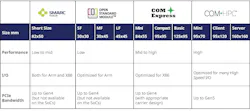
Introduced in 2016, the SMARC 2.0 standard provides a wider range of form factors using the same base specification. SMARC is specifically targeted at IoT devices and other ultra-compact embedded systems. Measuring a mere 82 × 50 mm, the Short SMARC form factor is slightly smaller than the Mini COM Express, which measures 84 × 55 mm and comes in at approximately 40% of the area of the Basic COM Express module.
SMARC module suppliers tend to focus on Arm and x86 processors that emphasize energy efficiency and real-time, low-latency performance. The core SMARC connector provides a range of I/O that includes Ethernet, USB, and typical device-level I/O channels such as I2C, as well as four lanes of PCIe.
While the difference in board area between Short SMARC and Mini COM Express is relatively small, the Open Standard Module (OSM) is even more compact. As a result, it’s even more closely aligned with the constraints of IoT and other devices requiring high performance at low power.
One of the keys to the size reduction is the omitting of any module connector and the use of an LGA package instead. This approach requires the module to be soldered directly to the carrier board. That limits field upgrades but improves shock and vibration resistance.
As a result, OSM modules range from 30- × 15-mm rectangles to 45- × 45-mm squares. Even at the largest dimensions, OSM modules have the edge on SMARC when extreme compactness is essential. The outcome is a versatile, future-ready standard for small, low-cost embedded computer modules that can be readily integrated into products of many shapes and sizes.
Selecting the Right COM Standard for a Specific Application
Numerous standards now employ the COM architecture, each with differences in terms of processing performance, I/O capability, bandwidth, and form factor. It’s no surprise, then, that the best choice is always application specific. Understanding these tradeoffs is key to unlocking the full value of a modular architecture.
Experienced suppliers such as Tria can help assess requirements and identify the standard that strikes the optimal balance of performance, scalability, and footprint for a design.
>>Download the PDF of this article, and check out the TechXchange for similarly themed articles and videos
triacommodulespromoEd PromoAbout the Author
Martin Unverdorben
Technical Information Manager, Tria Technologies
Martin Unverdorben is Technical Information Manager at Tria Technologies.
Comment About the Article
To join the conversation, and become an exclusive member of Electronic Design, create an account today!
 Leaders Logo
Leaders relevant to this article: