Embedded World 2026: Boards and Modules (Part 4)
What you'll learn:
- Which processors, NPUs, and interfaces distinguish five new edge AI and embedded platforms.
- How the boards target workloads such as machine vision, multimodal IoT, voice activation, and GNSS tracking.
- Which memory, connectivity, and expansion options matter for rapid evaluation and prototyping.
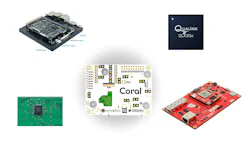
Here’s a look at five more modules that took the spotlight at Embedded World 2026. With an eye toward edge AI and IIoT solutions, these platforms bring a range of differentiating features to the table.
- Sundance SMT135-C Evaluation Board
- Synaptics Astra Machina SL2600
- POLYN NeuroVoice VAD90 EVB
- Qualinx QLX3Gx EVK
- Synaptics Coral Dev Board
Sundance SMT135-C Evaluation Board
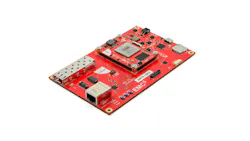
Sundance’s SMT135-C Evaluation Board is a high-performance development platform for edge AI, machine vision, and real-time control. Developers can use the ready-to-deploy form factor for robotics and intensive computational AI validation without requiring a full custom redesign. This helps shorten time-to-market while maintaining power efficiency for industrial IoT and machine-vision systems.
Synaptics Astra Machina SL2600
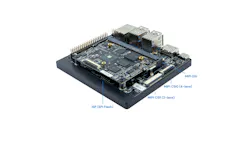
The Synaptics Astra Machina SL2600 is a modular platform designed for multimodal, AI-native IoT applications. The board runs on the Astra SL2610 dual-core Arm Cortex-A55 processor. Synaptics said the platform is the first production implementation to integrate Google’s RISC-V-based Coral NPU. That combination future-proofs edge AI designs and lets devices adapt to new models without depending on constant cloud connectivity.
POLYN NeuroVoice VAD90 EVB
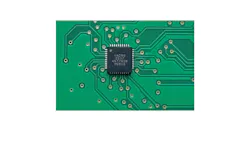
The POLYN NeuroVoice VAD90 EVB serves as an evaluation platform for the NeuroVoice VAD chip. With its neural-network inference capability, the board can perform voice activity detection without relying on higher power draw or cloud-based processing. OEMs can use it to validate microwatt-level power consumption and low-latency response, enabling responsive voice-activated devices while preserving privacy and battery life.
Qualinx QLX3Gx EVK
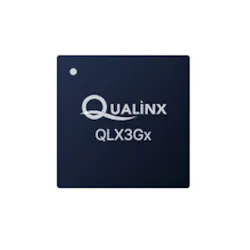
Qualinx’s QLX3Gx EVK is a validation platform for the QLX3Gx GNSS SoC. OEMs can use it to evaluate the company’s Dragonfly RF architecture, which underpins an ultra-low-power, software-reconfigurable GNSS chip. The kit targets IoT, wearables, asset trackers, and other battery-constrained systems that need flexible, efficient location capability.
Synaptics Coral Dev Board
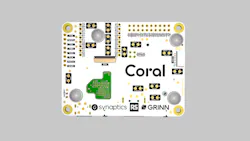
The Synaptics Coral Dev Board is built around the Synaptics Astra SL2619 SoC and targets fast on-device AI inference. Synaptics says the board is optimized for minimal power consumption, making it suitable for multimodal edge AI. It also supports quick prototyping for robotics and industrial applications with an open software stack that helps developers move toward production hardware and software.
>>Check out more of our 2026 Embedded World coverage
 Embedded World entrance
About the Author
 Cabe Atwell
Cabe Atwell
Technology Editor, Electronic Design
Cabe is a Technology Editor for Electronic Design.
Engineer, Machinist, Cartoonist, Maker, Writer. A graduate Electrical Engineer actively plying his expertise in the industry and at his company, Gunhead. When not designing/building, he creates a steady torrent of projects and content in the media world. Many of his projects and articles are online at element14 & SolidSmack, industry-focused work at EETimes & EDN, and offbeat articles at Make Magazine. Currently, you can find him hosting webinars and contributing to Electronic Design and Machine Design.
Cabe is an electrical engineer, design consultant and author with 25 years’ experience. His most recent book is “Essential 555 IC: Design, Configure, and Create Clever Circuits”
Cabe writes the Engineering Life & Engineering on Friday blog on Electronic Design.
See Cabe's cartoons & comic strips here.
Comment About the Article
To join the conversation, and become an exclusive member of Electronic Design, create an account today!
 Leaders Logo
Leaders relevant to this article: