Engineering the Compute Backbone of Smart Cities
What you’ll learn:
- Why edge AI and distributed computing are essential for meeting real-time, latency-sensitive demands in smart city infrastructure.
- How to align AI workloads with the right mix of hardware, accelerators, and power constraints for scalable edge deployments.
- How OS and system-level optimization drive deterministic performance, efficiency, and long-term reliability in harsh, real-world environments.

In cities around the world, re-engineering of core urban systems — parking, transit signaling, energy distribution, and public safety — is underway. Such systems now must operate continuously, autonomously, and under real-time constraints that traditional IT architectures were never designed to handle.
Today’s engineers are tasked with building systems that sense, infer, and respond in real-time to the ever-shifting dynamics of urban life. The global smart cities market, driven by IoT, AI, 5G networking, and edge computing, is projected to grow from approximately $877 billion in 2024 to more than $3.7 trillion by 2030.
This marks a turning point in smart city design: Edge AI and distributed computing are no longer architectural options. They’re operational requirements for systems expected to function as critical infrastructure. When deployed effectively, AI-powered edge applications enable cities to operate more intelligently and efficiently, improving convenience and enhancing safety across traffic and transportation, utilities, and public services.
However, the systems that power smart cities operate on a delicate balance. Engineers must continuously balance real-time responsiveness and system reliability against finite compute budgets, strict power constraints, and harsh physical environments.
Finding the right architectural balance — and deploying the right mix of technologies at the right layer — is the crucial next step for cities to scale from pilot projects to critical infrastructure.
Where Smart City Ambitions Meet Real-World Constraints
At the heart of smart city systems are real-world engineering tradeoffs.
From transportation and traffic management to retail infrastructure and power distribution, smart city applications demand AI-enhanced systems that can make instant decisions at scale. But delivering real-time responsiveness in remote or network-constrained environments challenges conventional cloud-centric architecture.
In these applications, computing requirements must be deliberately designed across two distinct layers. First is AI inference, the ability to ingest sensor data, analyze patterns, and make decisions locally. Second is post-inference processing, where outputs from AI models are transformed into actionable results for control systems, UI feedback, and long-term analytics.
Modern edge computers already integrate both layers of compute. In turn, engineers can reduce inference latency and enhance system stability by processing data at the source. This is critically important for engineers because it improves determinism, reduces network dependency, and simplifies system design in latency-sensitive environments. This edge-centric approach is particularly critical where milliseconds matter.
Consider vehicle tolling and monitoring systems. In a typical highway electronic toll collection (ETC) deployment, license-plate recognition systems must complete inference in well under 50 ms to avoid introducing downstream traffic bottlenecks.
Edge-based platforms now combine vehicle identification, blacklist checks, and high-speed inference locally, enabling law enforcement to act in near-real-time.
These deployments reduce end-to-end response times by tens to hundreds of milliseconds, depending on network conditions. For multi-lane gantries processing thousands of vehicles per hour, this difference determines whether traffic continues flowing smoothly or congestion builds up.
In smart city systems, average latency matters far less than worst-case latency. Cloud pipelines introduce variable network delay that erodes predictability in applications like traffic signal coordination or emergency alerts. On the other hand, local inference and decision-making at the edge create tighter, more reliable control loops.
With all of these applications, engineers must contend with power budgets, thermal limits, and the need for robust connectivity across distributed hardware. Designing compute platforms that integrate AI inference with reliable post-processing requires careful coordination across CPU, GPU, memory, and I/O subsystems.
These systems must also remain resilient in real-world environments marked by dust, heat, moisture, and unpredictable workloads from fluctuating sensor data, variable AI demand, and intermittent network conditions.
In short, the challenge for engineers is designing systems that deliver the right performance in the right place — consistently, predictably, and at scale.
Engineering Decisions that Determine Whether Smart City Systems Scale or Fail in Production
If you’re designing compute infrastructure for smart city applications, clarity of purpose is your first design imperative. Decisions you make at the hardware and software level — from AI model deployment to operating system choices — shape not only the performance of your application, but also its long-term maintainability and resilience in production.
Let’s break down a few practical principles that can help you navigate these complex trade-offs with confidence.
Align AI use cases with compute requirements
Most smart city AI applications today center on computer vision and sensor analytics (see figure). In transportation, for example, the primary use cases include hazard prediction and detection, traffic violation detection, and traffic signal management.
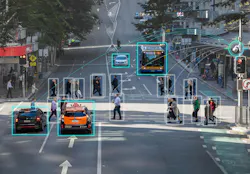
Many current deployments focus on convenience-oriented services such as automated checkout and smart parking, but safety-critical applications are gaining traction. Examples include railway slope collapse monitoring, fire detection, and other systems designed to prevent large-scale incidents.
In rail infrastructure monitoring, undetected defects remain a persistent safety risk. More than 3,000 rail accidents in the U.S. over the past decade have been linked to human error and track defects, demonstrating how infrastructure failures can quickly cascade into service disruptions and safety incidents.
Before selecting hardware or software platforms, engineers need to break down each AI workload in practical terms: model size, inference frequency, acceptable latency, and whether performance must be sustained continuously or only in bursts.
These factors determine whether inference and post-processing should run on the same device or be distributed across specialized units. Modern edge computers already provide basic AI acceleration through integrated NPUs, GPUs, or optimized inference engines, allowing you to reduce inference latency and minimize backhaul traffic by processing data closer to the source — a critical advantage in both safety- and time-sensitive applications.
Select the right hardware platform for the edge
Successful smart city deployments depend on making the right architectural compromises early, particularly around processor selection, acceleration strategy, and power envelope, before systems ever reach the field.
Today’s edge compute solutions span x86, Arm, and MCU-based architectures, each with distinct tradeoffs in performance, power efficiency, and scalability. Selecting the right hardware substrate is critical because excess compute overhead or power draw can quickly undermine system reliability, particularly in remote or power-constrained environments.
For example, heterogeneous edge architectures combining CPUs with GPUs or NPUs can significantly improve performance-per-watt for video inference workloads compared with CPU-only systems. Distributing AI inference across specialized accelerators can reduce power consumption while maintaining real-time performance requirements.
Effective platform design extends beyond processor choice to include close alignment between hardware and the operating system. OS selection must support latency and determinism requirements. In many cases, compact real-time operating systems (RTOSs) reduce overhead and provide more predictable scheduling than general-purpose OSs.
Physical design is equally important. IP6x-rated protection, ruggedized enclosures, and built-in remote management capabilities enable reliable operation in harsh environments. When CPU performance, I/O interfaces, and power subsystems are carefully balanced, the result is a stable platform that improves uptime and reduces long-term maintenance costs.
Optimize system behavior through operating system design
Once you’ve aligned the hardware and workload, the next frontier is system-level optimization. This means understanding how your chosen OS kernel interacts with peripheral devices and application workloads to affect both performance and power consumption.
An OS kernel tuned for low-latency interrupt handling and energy-aware scheduling often determines whether an edge system behaves predictably under load or degrades in ways that are difficult to diagnose once deployed. Techniques such as CPU core pinning for inference tasks and minimizing interrupt latency jitter are commonly used in real-time Linux deployments to maintain deterministic performance in multi-camera vision systems.
You should also quantify the power/performance characteristics of each peripheral device and sensor. A sensor that draws minimal idle power but spikes during data capture can contribute significantly to overall energy usage if not properly managed by the OS scheduler.
By taking a holistic view of processor performance, peripheral profiles, and OS behavior, you reduce wasted cycles and energy overhead. It ultimately yields a more efficient, resilient compute platform that serves your smart city application without unnecessary resource consumption.
Designing Edge Systems that Cities Can Depend On
Smart city architecture has evolved into a rapidly advancing technology ecosystem that can anticipate, adapt to, and enhance urban living in ways that were unimaginable just a decade ago. At its core, this evolution is driven by the convergence of compute, AI, hardware engineering, and real-time systems.
In this environment, system architects must think beyond traditional silos, carefully balancing responsiveness, power efficiency, and reliability against the functional demands of each application. In smart city infrastructure, success isn’t defined by peak performance benchmarks, but by whether systems behave predictably under real-world constraints — day after day, without intervention.
When you design with clarity by understanding AI workloads, selecting the right platform, and optimizing both hardware and software, you can build smart city systems that scale with confidence, operate deterministically, and earn the trust required to function as critical infrastructure.
About the Author
 Jay Liu
Jay Liu
Vice President, NEXCOM International
Jay Liu is Vice President at NEXCOM International, leading the Mobile Computing Business Unit for over 10 years. With over 25 years of experience in research and development design, he has dedicated his career to driving innovation and delivering impactful solutions.
 Lisa Chen
Lisa Chen
Assistant Vice President, NEXCOM International
Lisa Chen is the Assistant Vice President at NEXCOM International, where she has spent more than 20 years advancing industrial automation initiatives within the IPS Business Unit. She specializes in delivering scalable, cutting-edge solutions and leading strategic initiatives that enhance operational efficiency and drive global business growth.
Comment About the Article
To join the conversation, and become an exclusive member of Electronic Design, create an account today!
 Leaders Logo
Leaders relevant to this article: