A Stepping Stone to VITA 100 Power and Double-Density Modules
What you’ll learn:
- How VITA 91 doubles OpenVPX backplane bandwidth and prepares designers for VITA 100.
- Why signal integrity, connector density, and higher data rates become critical at next-generation speeds.

As AI and advanced processing systems expand in into edge-computing platforms, they will continue to demand extremely high bandwidth, often in a constrained amount of space. This is particularly true for defense-based computing systems for C5ISR, and they will often leverage Modular Open System Architecture Systems (MOSA).
Traditionally, OpenVPX has been the de facto standard for MIL ruggedized MOSA requirements. But, even that high-performance architecture, which allows for backplane performance at 100 GbE (over 25 Gbaud/s per lane) and PCIe Gen4 speeds, won’t be fast enough for some of the next generation of designs.
VITA 100 (via VITA) promises up to 8X the performance of OpenVPX, but it’s still in draft and will take some time to go through the prototyping and integration churn. However, there’s a stepping stone to the technology with VITA 91.
VITA 100 Overview
VITA 100 has a great deal of buzz about it, and many players in the defense marketplace want to be on the leading edge of technology. New specifications take time, though, not only to create, but to be proven out. The faster and more powerful the technology, the most challenging it is to complete both elements of development of a new specification.
VITA 100 will reach the 8X OpenVPX performance in three ways:
- Double the density of the connector.
- Double the data rate of the connector.
- Cut the bit/baud factor in half.
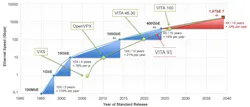
Figure 1 presents a chart on VITA 100 performance with PCIe Gen 5/6 and 400-GbE architectures for future AI accelerators. This bandwidth aggregates high-resolution data from radar, sonar, and electro-optical sensors without resulting in bottlenecks. VITA 91 is compatible with today’s OpenVPX architecture and utilizes a similar double-density connector that will be used in VITA 100.

Leveraging VITA 91 not only provides a higher bandwidth and more pins for switching and I/O, it gives the developer practical experience in these higher-performance systems. One can see the possibilities with the increased pin density and routing options.
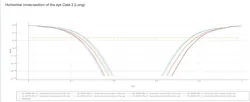
Developing and integrating a system to the higher speeds is also not without its challenges. Therefore, gaining that experience is like taking a prep class for VITA 100. For the backplane design, performing signal-integrity analysis at these speeds is paramount to help ensure clean signals. Figure 3 illustrates an example of signal-integrity analysis on a VITA 91 system.
Other VITA Applications
It’s not just mission computing systems and SIG/INT designs that use these high-performance systems. Quantum computing and various AI applications utilize the standards, sometimes simply leveraging elements of the mechanical and electrical specifications in VITA with a hybrid or customized design.
To stay on the leading edge while reusing the critical software/firmware for a project, employing open standards enable new plug-in cards (PICs) to be upgraded over time, protecting your investment.
3U Boards, 6U Boards, and…4U Boards?
Space is at a premium whether in the advanced-cooling data centers for supercomputing or on a sea-based vessel, aircraft, or drone. The 3U size is desirable as one can squeeze a lot of performance in a compact module form factor. But, many of the highest-performance AI chips coming out will not fit on a 3U × 160-mm module.
Using the 6U standard Eurocard size is the obvious alternative, but that much space isn’t always a viable option. So, VITA 100 will apply a new 4U size. This form factor is expected to be the Goldilocks size for many AI-based PICs.
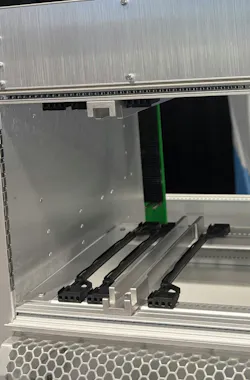
The powerful processors in AI computing are expected to be too large to be workable on a 3U board. However, the 4U size will fit the bill. The new size will mean new enclosures for many designs, such as air transport racks (ATRs). With a modular design approach, though, the shift to 4U can be incorporated in many rackmount configurations with much less effort. Figure 4 shows a modular PixCool chassis with a 4U backplane, including the VITA 100 prototype connectors per the draft specification.
The Continuing Legacy of OpenVPX
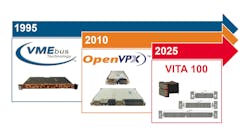
VITA specifications are developed to maximize backwards-compatibility where feasible. The newer architectures leverage the years of work completed in OpenVPX. In fact, many of the profiles of VITA 91 and VITA 100 are essentially mirror images (doubling the pins) of existing OpenVPX profiles today. Figure 4 shows the pinout examples of a OpenVPX, VITA 91, and VITA 100 slot profiles.
While VITA 100 promises a significant leap in performance, it’s important to note that OpenVPX will remain a critical staple of defense programs for decades to come. The technology is incredibly powerful and proven. Also, not all systems will require the bleeding-edge performance.
Many new OpenVPX-based systems opt for 10G-based speeds when 100G-based is an option. In fact, Pixus Technologies still develops a new VME-based enclosure system every year because its still “good enough” for many programs, even though the architecture is over 50 years old!
As the industry moves to these blazing fast speeds, it’s important to jog before you sprint. The VITA 91 specification offers the highest performance of a VITA-based system today. The technology is a great stepping stone to the capabilities of next-generation systems. Best of all, it’s already proven and available today!
>>Check out this TechXchange for similarly themed articles and videos
 image
imageAbout the Author
 Justin Moll
Justin Moll
Vice President of Sales & Marketing, Pixus Technologies
Justin Moll is the Vice President of Sales & Marketing for Pixus Technologies and has been with the company since 2012. He’s active in trade associations such as VITA and PICMG and served as the Vice President of Marketing for PICMG. Justin has been a keynote speaker and featured commentator at multiple embedded computing industry events.
Comment About the Article
To join the conversation, and become an exclusive member of Electronic Design, create an account today!
 Leaders Logo
Leaders relevant to this article: