Smarter breakers, safer home: Intelligent electrification of smart home electrical systems.

Today’s smart homes are truly something which to marvel. They are an ecosystem all unto themselves—a shining example of an edge network, if you will. They include strong interoperability with the internet and the World Wide Web and communicate with platforms such as Wi-Fi, Zigbee, Z-Wave, Matter, and Thread. They interconnect multiple devices and technologies such as smart appliances, electric vehicle (EV) charging stations, solar panels integrated with the power grid, backup power solutions, and more.
This integration has moved far beyond what typical energy management was only a decade ago. Today’s complex home energy systems require both a heightened emphasis on safety, security, and energy efficiency, as well as cross-platform integration, including artificial intelligence (AI). All these factors make the home energy system much more complex than ever.
This now requires an advanced approach to home energy management and consumption. At any given time, a multitude of devices are demanding power. When these include high-power-consuming devices such as EV charging and solar systems, the powering circuits must be cognizant of conditions that discern between a true power fault or just a momentary surge in a complex appliance network.
For this reason, age-old standard circuit breaker systems are no longer a primary consideration. New intelligent interrupters integrating Arc-Fault Circuit Interrupters (AFCI), Ground Fault Circuit Interrupters (GFCI), Combination Arc-Fault Circuit Interrupters (CAFCI), and Dual-Function Circuit Interrupters (DFCI) are now the go-to for the smart home.
The new home AI-enabled edge environment is capable of making critical safety decisions autonomously and instantaneously. This is crucial because protective measures cannot rely on delays from cloud connectivity and network latency.
Enter the “smart”
Today’s home energy systems start out with a smart panel and ramp up to an intelligent home electrification system (Fig. 1).
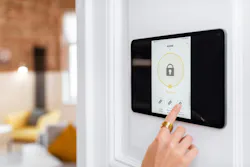
These systems manage bidirectional energy flow, remote load management, automation, and control at the circuit level. The system rounds out with precision interrupters, AI-enabled microcontrollers, and complex intelligence, all within the home’s edge environment. And much of this can be accessed and managed via a smartphone.
For instance, microprocessor-enabled smart panels can perform AI-driven load analysis and load balancing and can determine the ideal charging times for your electric vehicle and other high-demand devices. As well, load-management systems can deactivate non-essential appliances and environmental systems in the absence of occupants. They can also manage and run devices autonomously when energy costs are at their lowest.
Let’s talk safety
The propensity for home energy systems to vary widely in power utilization has become commonplace. Today's intelligent home energy systems must be able to distinguish between normal electrical current behavior and unsafe conditions in real time (Fig 2).
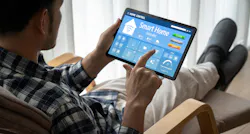
One of the most dangerous events is the arc fault, which causes $1.4 billion in property damage, annually. Early arc detection relied upon breakers tripping when a fault occurred. While effective, breakers did not ensure 100% reliability. But today, conditions that cause an arc to occur are much more varied than before, and not all of them create dangerous conditions. A significant benefit of intelligent systems is their capacity to differentiate between genuine arc faults and transient ones triggered by the inductive kick of a large appliance or circuit, or a power surge resulting from multiple devices simultaneously consuming electricity.
Additionally, there are high-current devices and conditions such as EV charging stations, bidirectional grid interconnect, solar systems, grid fluctuations, power surges, and the higher energized conditions of smart homes. Thus, smart panels need to be able to discern the potential hazard events from routine and take appropriate action.
The smart interrupter
Modern smart home systems now integrate non-destructive smart interrupters that can react to such system behavior. These circuit interrupters communicate with the smart panel via Wi-Fi, ZigBee, or some other protocol. This allows them to communicate with the panel and break and reset intelligently, for example. This adds an elevated measure of safety to the energized home.
What it takes
This technology behind this new home ecosystem is the microprocessor (MPC). MPC-based intelligent panels monitor the smart home’s electrical system. Such panels contain embedded processing devices such as TI’s MSPM0G5187 microcontroller with the TinyEngine™ neural processing unit. These systems continuously monitor the home power network and can make real-time decisions as needed. This means they can determine between dangerous and non-dangerous arcs and other conditions.
These MPC-base systems utilize advanced arc- and ground-fault detection algorithms, combined with precisely timed circuit-interrupter banks. Wired and wireless connections—including Wi‑Fi, Bluetooth, Ethernet, and cellular—link the panel to the grid, solar power, battery backup systems, and devices throughout the home.
Signals from an intelligent circuit interrupter or meter, or other smart sensors, provide critical information that the smart panel uses to determine conditions. The smart panel’s edge AI processing then analyzes the data to identify any anomalies, such as broken equipment or malfunctions. The smart panel can also examine usage history and analyze whether consumption levels in a particular part of the home are out of the norm.
Conclusion
Smart home electrification systems have taken home energy management to a new level. Today’s smart home energy systems are no longer just dumb go-no-go systems; they are fully interactive and manage home energy efficiently. They also provide energy management to get the most out of the system at the lowest cost.
And soon your phone will visualize and manage what your system is doing, well beyond just simple notifications or limited on/off/timed abilities of today. Energy data management will become an important element of this as well.
Smart homes will be a critical element of the evolving global electrical infrastructure. It will optimize the home’s power usage, manage energy costs, and contribute to energy conservation as an integral component of the global power infrastructure.
The evolution has only begun. As energy costs rise and energy demands ramp up logarithmically, heightened awareness will be placed on intelligent energy management and the evolution of intelligence in the energy infrastructure. Not just for the home, but everywhere. The switch has been flipped.
About the Author
 Ernest Worthman
Principal, Worthman & Associates
Ernest Worthman is the principal of Worthman & Associates, a high-tech industry analyst and an editorial columnist for a number of media outlets such as Endeavor Business Media’s Electronic Design and Informa’s 6G World. He is a nationally and internationally published technical editor/writer for wireless, semiconductor, cybersecurity, and other industries, and regularly speaks at industry events. He is a guest lecturer at Colorado State University’s College of Electrical Engineering.
Ernest’s present credentials include a B.S. Electronic Engineering Technology, A.A.S, Electronic Digital Technology; Senior and Life Member of the IEEE, a member of IEEE’s ComSoc, VTS, MTT, and 5G community, board member of the 6G Alliance, and a Panelist and session chair at various technical conferences.
Ernest has over 25 years of experience in high-tech print and online publishing. He’s held several editorial positions across a number of high-tech publications including Semiconductor Engineering’s cybersecurity and Internet of Everything/Everyone (IoX) channels, Editor of RF Design, and Editorial Director of Reed’s Wireless group, which included Wireless Design and Development and Fiber Optic Technology. He’s also been a contributing editor to Mobile Radio Technology, Satellite Communications, and others, as well as computer-related periodicals such as Windows NT.
His clients include Agilent (now Keysight) Technologies, RF Industries, GlobalFoundries, Advanced Linear Devices, Huawei, and others, for which he does technical and engineering writing and presents technical seminars.

Comment About the Article
To join the conversation, and become an exclusive member of Electronic Design, create an account today!
 Leaders Logo
Leaders relevant to this article: