Modified Mushroom Functions as Bit-Storage Memristor
What you'll learn:
- What is a memristor, and could it be a useful passive component?
- How a fungus can be utilized to apparently create a memristor element.
- The test plan and arrangement used to evaluate a fungus as a possible memristor element.
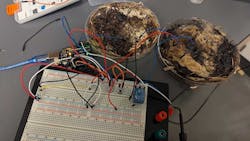
Here’s one I didn’t see coming: Fungal-based electronics may have a role in some sort of neural-type computing. Wait a moment, how’s that again?
Here’s the story. Researchers from The Ohio State University recently discovered that some common edible fungi, such as shiitake mushrooms, can be grown and “trained” to act as organic memristors, a type of electronic element that’s able to remember past electrical states (Fig. 1). (If you need a refresher on memristors, see the sidebar “What’s a Memristor, Anyway?” below.)
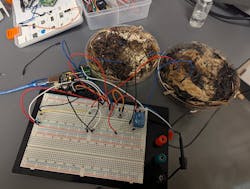
Their demonstration shows that these shiitake-based devices not only demonstrated similar reproducible memory effects to semiconductor-based chips, but they could also be used to create other types of low-cost, environmentally friendly, brain-inspired computing components.
I’ll admit it, when I first saw this item, I thought it was some sort of joke. After all, April 1 isn’t that far away. Let’s be honest. It’s easy to be dismiss efforts such as these, as they weren’t done with esoteric materials, sophisticated and costly instrumentation, or a complex lab setup.
The Potential of “Obscure” Developments
Then I gave it some more thought and realized that one thing we know about technological advances is that they often come from unexpected or initially ignored developments. You just never know which “obscure” developments will not be heard from again, and which ones will be picked up and become the basis for some important and often disruptive result.
Consider an example that I've cited several times in the past. When Isador Isaac Rabi devised a method of using molecular-beam magnetic resonance to measure the then-unknown magnetic moments of atomic nuclei in the 1930s (and earned a Nobel Prize in Physics 1944) — admittedly, a very advanced undertaking — the scientific consensus was “an impressive advance in knowledge, but so what?”
It wasn’t until three decades later when Dr. Raymond Damadian understood that this phenomenon could be used to image inside the body and detect tumors. He proved the concept in a small-scale demonstration, then built and demonstrated the first whole-body nuclear magnetic resonance system, now called an MRI, in 1977. (Similarly, the first laser was dismissed as “as solution looking for a problem to solve,” and we know that story unfolded.)
Details of the Team’s Mushroom Memristor Project
To explore the new memristors' capabilities, the researchers cultured samples of shiitake and button mushrooms. Once mature, they were dehydrated to ensure long-term viability, connected to basic electronic circuits, and then stimulated at various voltages and frequencies.
They connected wires and probes at different points on the mushrooms because distinct parts of it have different electrical properties. Depending on the voltage and connectivity, they observed a range of distinct performances.
The team discovered that when used as read/write memory (aka RAM), their mushroom memristor was able to switch between electrical states at up to 5.850 kHz with about 90% accuracy. Performance dropped as the frequency of the electrical voltages increased, but much like an actual brain, it could be fixed by connecting more mushrooms to the circuit.
For electrical testing, an alternating current was applied to each sample, and the corresponding current–voltage (I–V) characteristics were measured using a digital oscilloscope.
To extract accurate current values, a known shunt resistor was placed in series with each sample in a standard current-shunt arrangement (Fig. 2). To thoroughly investigate the memristor-like behavior of the four samples using mycelium coverage density, voltage sweeps were conducted using both square and sinusoidal waveforms.
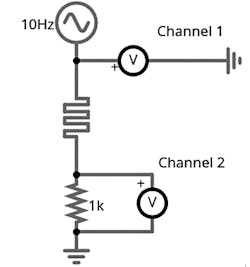
The square waves were used to detect sharp threshold-based resistance changes, whereas the sinusoidal inputs provided insights into the more subtle, continuous memory-like behaviors. This dual approach enabled the identification of hysteresis loops in the I–V curves, a key signature of memristor functionality.
Another circuit was to investigate the volatile memory characteristics of two fungal samples in series if the fungal samples exhibited memristor-like behavior. The test involved setting an arbitrary analog voltage value to represent a high value, and below that threshold was a low value. Again, the frequency range started at 200 Hz and concluded at 5.85 kHz.
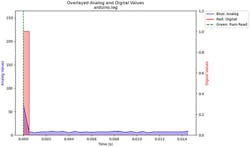
Given the polarized nature of memristors, another circuit was designed using an Arduino microcontroller development board. It had a voltage divider consisting of two memristor elements, whereby a voltage of opposite polarity to that used during read operations could be set (Fig. 3).
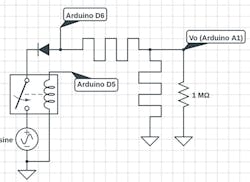
Both voltages used were approximately 5 V. The connected Arduino UNO cyclically applied a high-level signal to a relay containing a half-rectified sine wave through one of its digital output pins when reading the memristor bridge, thereby charging the divider.
This process induced an asymmetry in resistance, with the memristor closest to the input experiencing a reduction in resistance, while the output-side memristor exhibited an increase. The voltage across the divider was subsequently read using an analog input pin, and another digital pin was employed to run 5 V across the divider. The Arduino interpreted the stored state as “on” only when the measured voltage exceeded a predefined threshold, effectively enabling volatile memory detection based on the transient resistance states of the memristors.
Test Results and Conclusions
The teams also ran many tests with different voltages, frequencies, and other parameters. These included volatile memory tests with both single and continuous read-and-write operations across the memristor voltage divider (Fig. 4).
They noted that it’s difficult to draw a firm conclusion about the implications of the results. However, their paper “Sustainable memristors from shiitake mycelium for high-frequency bioelectronics” published in the journal PLOS ONE provides detailed tables of experimental settings and results, so you can draw your own conclusions. They also note that fungi are radiation-resistant, so that may encourage their use in space applications.
Although they also promote the environmental “sustainability” of mushroom-based devices compared to conventional solid-state ones, I see their work as raising a bigger question: Are “organic” networks possibly a disruptive technology?
After all, the body with its brain (just three pounds, ~50 watts), aided by external transducers (eyes, muscles, feeling) can drive a car. Yet it takes enormous computing power, DC operating power, cameras, LiDAR, sophisticated algorithms, and more to create a Level 5 or even Level 4 autonomous vehicle. The brain is certainly not executing these algorithms for image recognition and decision-making, nor doing these intense calculations, but somehow can do the task.
Perhaps Level 5 vehicles will become common when their processing is architected more like the human brain with organic-based neural networks rather than the “hard” gates of Boolean logic?
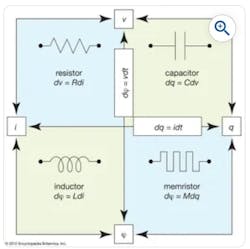
It’s a nonlinear component with properties that can’t be replicated with any combination of the other fundamental components, as it combines a persistent memory with electrical resistance. A memristor has a resistance that “remembers” what value it had when the current was last turned on. Thus, it could, in theory, be used to create solid-state devices that store data without requiring a constant energy flow to maintain their present values.
The memristor was first hypothesized in 1971 by Leon Chu, an electrical engineering professor at the University of California, Berkeley. However, it was not actually physically built until a team at Hewlett-Packard created one in the early 2000s. It received a great deal of publicity about its potential and use in non-volatile memory devices and was heralded as “the next big thing” in components. There were even some serious efforts to incorporate memristors into solid-state devices.
As with so many research advances, the anticipated success and adoption never occurred for many reasons: performance, manufacturability, density, cost, compatibility, and competitive advances (the Electronic Design article “Passive Components Get Active” is a poignant example of optimism gone to ground). The memristor is now mostly a historical “footnote” in the component world. But “never say never,” as sometimes failed advances come back later as technology needs, capabilities, and circumstances change.
References
IEEE Spectrum, “What is a Memristor?” (2008)
IEEE Spectrum, “The Mysterious Memristor” (2008)
American Scientist, “The Memristor” (2011)
Britannica, “Memristor”
EE World, “Magnetic resonance imaging (MRI), Part 1: How it works”
EE World, “MRI, Part 2: Historical development (and lawsuits)”
About the Author
 Bill Schweber
Bill Schweber
Contributing Editor
Bill Schweber is an electronics engineer who has written three textbooks on electronic communications systems, as well as hundreds of technical articles, opinion columns, and product features. In past roles, he worked as a technical website manager for multiple topic-specific sites for EE Times, as well as both the Executive Editor and Analog Editor at EDN.
At Analog Devices Inc., Bill was in marketing communications (public relations). As a result, he has been on both sides of the technical PR function, presenting company products, stories, and messages to the media and also as the recipient of these.
Prior to the MarCom role at Analog, Bill was associate editor of their respected technical journal and worked in their product marketing and applications engineering groups. Before those roles, he was at Instron Corp., doing hands-on analog- and power-circuit design and systems integration for materials-testing machine controls.
Bill has an MSEE (Univ. of Mass) and BSEE (Columbia Univ.), is a Registered Professional Engineer, and holds an Advanced Class amateur radio license. He has also planned, written, and presented online courses on a variety of engineering topics, including MOSFET basics, ADC selection, and driving LEDs.
Related
 dreamstime_xl_72744669
Comment About the Article
To join the conversation, and become an exclusive member of Electronic Design, create an account today!
 Leaders Logo
Leaders relevant to this article: