How to Control Brushless Motors (Part 3): Commutation (Download)
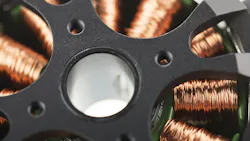
Real-time, low-latency control is critical to ensure smooth, stable, and fast movement for brushless DC (BLDC) motors. But maximizing the performance of BLDC motors — whether rotary or linear — requires continuous monitoring of the rotor position as it moves. The motor controller uses that to adjust the stator’s magnetic vector angle, increasing useful Q force generation while reducing undesired D force generation.
In high-performance motion control, a position-control loop compares the desired motor position with its actual position. Based on that difference, it outputs a current command proportional to the torque required to correct the error. The motor controller then distributes this current command across the motor’s windings to keep the stator vector aligned with the rotor position. Keeping everything aligned is referred to as commutation.
